

November 7, 2016 in Healthcare Analytics
Data governance and management
SHARE: PRINT ARTICLE: https://doi.org/10.1287/LYTX.2016.06.10

The healthcare analytics industry is making great strides. As part of my work I talk to many data analytics companies who report they are very busy with implementation projects. One large company told me that its implementation staffs are booked until end of the first quarter of 2017. This is evidence that the demand for healthcare analytics is strong.
I predicted the rise in demand during the latter part of 2016 in my previous articles. Payment reform has started to accelerate, with more states and commercial payers moving their contracts with providers from volume to value. Without a strong data analytics program, it is impossible for many provider organizations to stay viable in this new environment.
Many data analytics companies report their clients are missing the basic building blocks for a successful data analytics program: data governance and data management. Healthcare organizations jumped on the data analytics bandwagon without establishing a process of data governance. In this article I will outline the need for data governance and my experience leading such an initiative within a complex organization.
Data Has a Time Value
Data has a time value, and this is not a secret. Information and insights from data have the best value when the business is attempting to understand why something just happened. The longer the process takes, the less this value becomes. For data analytics to produce the best return on investment, it is important for the business to have the relevant data available at the fingertips of the analyst so that the analysis can be produced quickly to help decision-makers make decisions in a timely fashion. Therefore, the longer it takes to collect all the data and conduct the analysis the less effective the action becomes for the business (see Figure 1).
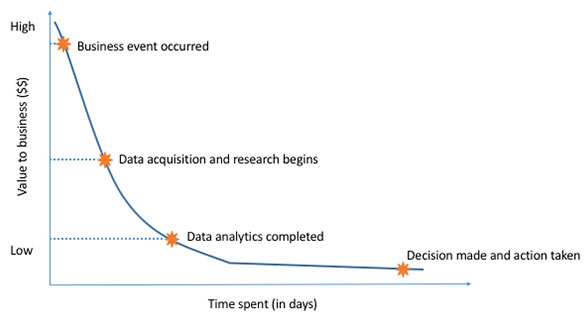
According to Health Catalyst, a leading U.S. healthcare analytics company, about 80 percent of an analyst’s time is spent in searching for the relevant data. That is a huge waste of expensive resources and valuable time for any organization.
Data Quality: The Other Big Issue
Access to data alone is not enough. Access to good quality data is extremely important to make the work of analytics worthwhile. According to IBM, one in three business leaders today in the United States do not trust their own data. Poor data quality costs the U.S. economy around $3.1 trillion a year. What is the point in conducting sophisticated analysis with expensive data analysts and scientists if that is the case?
In my experience data quality analysis is not always done adequately within healthcare organizations. It is one of the most tedious tasks that seldom bears any glamor. It is, however, a key function of what the data industry calls the role of a data steward. A data steward needs to have the necessary knowledge about the content and the metadata to assess the quality of the data, and then work with business units to correct what is wrong. Sometimes it may lead to fixing issues with the data acquisition process and even standardizing the data vocabulary.
Data Governance: Key Piece of the Puzzle
Timely access and quality bring us to data governance. Organizations need to invest time and resources to build a well-defined data governance process. It begins with identifying key people to participate in an organizational data governance committee. Many times the committee can be appointed by the CEO or the board of directors to ensure that the data in the organization is treated like an asset. In the case of healthcare organizations, members of such a committee may include the chief data officer, chief analytics officer, chief financial officer, chief medical officer, chief information officer, chief operating officer, etc. In other words, fairly senior members of the organization or top business unit leaders.
A data governance committee has to ensure that the organization’s data is governed appropriately, maintenance of metadata definitions and business rules are followed, and appropriate levels of data privacy and security audits are in place. Healthcare organizations benefit when they bring their clinical, operational and financial data together to develop a single definition of truth. To achieve that goal, the data governance committee needs leadership representation from all those functional areas.
Data Governance for a Networked Organization
I was asked to chair a data governance committee of a network of several healthcare organizations. The goal was to build data governance policies and procedures for building a centralized data analytics infrastructure. To achieve this goal we established a committee with leadership representation from all the functional areas as stated in the previous section. We embraced a framework that focused on four key areas: governance, stewardship, management and compliance.
We diligently worked on various policies and procedures that not only addressed the needs of the present day but also considered emerging opportunities such as data on social determinants of health, mental health and substance use.
To establish transparency in data flow between networked organizations, we implemented strict data access monitoring and reporting policies and procedures. We also defined oversight of data stewardship as a key role of the committee. Committee members were given the responsibility of developing data for a stewardship program within their own organization as well as within the centralized data organization that assumed the responsibility for the data analytics program. The committee oversaw specifications of data extraction, transformation and load specifications, along with adequate data security and privacy measures. The upfront time spent in crafting the governance process enabled this complex network of organizations to develop a data analytics infrastructure with confidence and transparency.
Data governance is a fundamental building block for successful and sustainable data analytics programs for organizations of any size and complexity. It is not a glamorous job. It does not create press cycles. It is also not very well understood by executives responsible for data infrastructure. However, technology for data analytics has now become a commodity with many vendors striving to earn enterprise business. Once the fundamental building block of data governance is in place, the data team of any organization can feel confident that they have established a sustainable and effective analytics program that will eventually garner kudos in the boardrooms.
Rajib Ghosh is the founder and CEO of Health Roads, LLC, a consulting company for enabling digital transformation in healthcare organizations. He has 25 years of technology experience in various industry verticals where he had management roles in software engineering, data analytics, program management, product management, business operations and strategy development. Ghosh spent a decade and half in the U.S. healthcare industry as part of a global ecosystem of medical device manufacturers, medical software vendors, telemedicine and telehealth solution providers. He’s held senior positions at Hill-Rom, Solta Medical and Bosch Healthcare. His recent work includes leading data-driven digital transformation in the public health space, including county-level healthcare agencies and organizations focused on underserved populations.
([email protected])