

November 7, 2016 in Forum
A conceptual framework for BI/analytics strategies
SHARE: PRINT ARTICLE: https://doi.org/10.1287/LYTX.2016.06.12
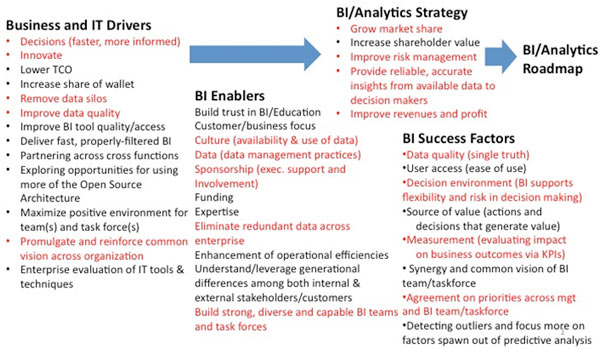
Business intelligence (BI) and analytics programs are among the “hottest” curricula being developed at universities and colleges worldwide. Definitions vary on what entails business intelligence or analytics, and there doesn’t seem to be a universal BI/analytics conceptual framework that is being used by organizations and universities to develop their BI/analytics strategy and associated roadmap. To provide some clarity and based on research and best practices in the field, I developed the BI/Analytics Conceptual Framework as shown in Figure 1.
- Analytics skills mature over time within organizations, suggesting the value of incorporating a CMM (capability maturity model) in your framework.
- Other business and IT drivers might include: different skill levels in working with voluminous data; visibility into competitors’ moves so competitive responses can be developed; being able to combine customer-provided data with other information we have about those same customers; curating and filtering information into “need to know” slices so confidentiality and privacy are protected.
- Other BI enablers may include: analytics to become trusted advisors to senior executives (this requires more than technical analytic skills – it requires deep understanding of the business and marketplace, strong influencing and relationship-building skills, organizational savvy, effective storytelling and visualization skills, and a willingness to present candidly even unwelcomed information); organizational design can help or hinder the impact of analytic investments; problem definition and problem prioritization.
- Other BI/analytics strategy goals: reduce speculation and judgment bias that affect objectivity and barriers imposed by “hidden” factors in the decision-making process.
- Other BI/analytics success factors: define problems correctly (digging and not just reviewing the surface); preparedness for the analytics process (collaboration); management of expectations about outcomes of analytics processes; applicability of the results; connect key risk indicators with key performance indicators.
The second round with the Delphi experts identified the red highlighted factors in Figure 1 as being the most important in the framework. Before going ahead in further revising the conceptual framework, I would be curious in getting your feedback as to the accuracy and completeness of this proposed BI/analytics conceptual framework.
I welcome input and thoughts. Send comments to [email protected].
Jay Liebowitz recently served as the inaugural Executive-in-Residence for Public Service at Columbia University’s Data Science Institute. His main role was to infuse data science and analytics into the U.S. federal government, with support from the Partnership for Public Service. His recent books are “Pivoting Government Through Digital Transformation” (Taylor & Francis, 2024) and “Digital Transformation for the University of the Future” (World Scientific Publishing, 2023). His newest book, due to be published in mid-2024, is titled, “Regulating Hate Speech Created by GenAI” (Taylor & Francis).
([email protected])