

March 6, 2017 in Five-Minute Analyst
Voter fraud
No, it’s not about the presidential election. It’s about a model car contest for kids.
SHARE: PRINT ARTICLE: https://doi.org/10.1287/LYTX.2017.02.18
This article is a true story about detecting voting fraud in a charitable auction, using no tools save a pencil, paper and smart phone. The setup is as follows: A group of kids have entered model cars into a contest where they are voted on by the other contestants. Each of the models had an attribute to be voted on, such as color, creativity, dangerousness, etc. Each participant is given a strip of 10 tickets and told that they could vote for “one car per category.” When I arrived at the event, I was asked to tally the votes. The organizer, having no idea what he was about to unleash on the problem, assured me that “my judgment was absolute,” with a telling wink that said, “expect foolishness” -– but did not elaborate.
As I started tallying up the votes by hand (40 participants x 10 tickets each = 400 tickets total), I realized that some of the votes were off … that there were way more tickets for some of the cars than there should have been. But how could I adequately prove (to myself) that there was cheating going on?

Pilots and Statisticians
Before all this happened, I was a Navy pilot. I took my first round of training flying the T-37 “Tweety Bird”’ at 37th Flying Training Squadron, Vance AFB, in Enid, Okla. I had a former fighter pilot instructor who was very fond of saying: “If you don’t know what to do, wind the clock, and by the time you’re finished, something useful will probably come to you.”
Years later, teaching and then practicing statistics, I had a similar mantra for my students: “If you are working a problem, and you don’t know what to do, you should compute the ‘marginal [1] distributions [2],’ and by the time you are finished, something useful may come to you.
Now, because we know that there were 40 participants with 10 tickets each, we infer that `(C) = 40. Once the marginals {1} are computed, it’s an easy exercise to compute the variance by hand using the definition, Var[C] = E[C2] – E[C]2, which can easily be done using our smart phone. We arrive at a standard deviation, s = 9.5. A purely statistical approach would be to be suspect of any car that received more than +2s.
This approach is, of course, wrong.
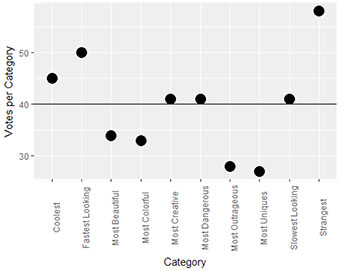
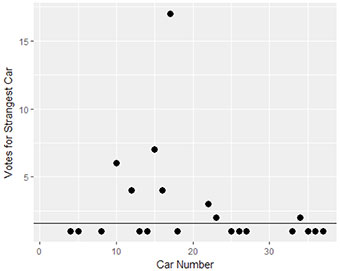
Let’s recall the original question, which is to find where participants had pathologically voted for themselves. Because each participant only has 10 tickets, looking for 19 extra tickets would imply that more than one kid colluded, a very unlikely scenario. We identify “strangest” and “fastest looking” as potential areas for cheating, with “strangest” being the most interesting. Figure 2 shows a plot of the distribution of votes for “strangest car” (solid line indicates the average number of votes for in this category.)
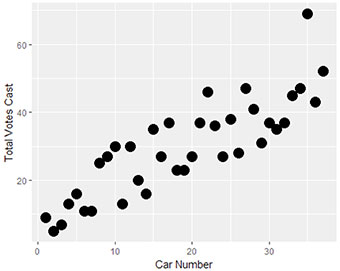
Figure 2: Plot of the distribution of votes for “strangest car.”
Interestingly, while car No. 17 received attention for having the most votes in a single category, it did not have the most votes overall. In fact, car No. 17 did not receive more than an average number of votes.
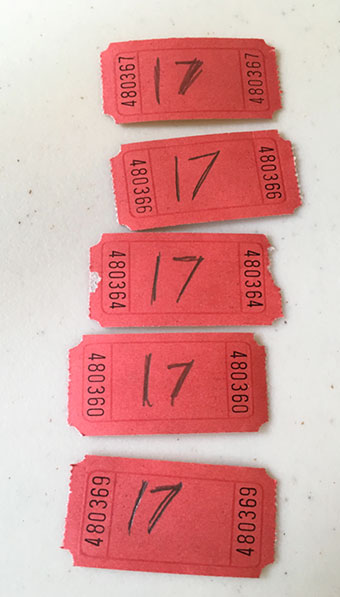
By using the conditional distribution of votes for “strangest,” we see that car No. 17 has an abnormally high number of votes.
Do I think that car No. 17 received an abnormally high number of votes from one source? I’ll let you be the judge.
An Interesting Observation
You will notice that the number of votes increases by car number. The participants were handed tickets at the entry of the judging line, which is in front of car No. 1, and as they neared the end of the line, found themselves voting for the “later” cars. Interestingly, as the saying goes, a rising tide floats all boats, and being later in the judging did not affect the distribution of prizes.
A final thought: This type of fraud was easy to catch because it was poorly executed. Had the owner of car No. 17 had a more moderate strategy, such as only “stuffing” the box by five votes, he may have won and his fraud gone undetected. This type of padding can be detected by statistical methods, but not ones that are likely to be employed by hand on a Sunday afternoon.
Harrison Schramm, CAP, PStat, is a senior lecturer at Naval Postgraduate School, splitting his time between Defense Management and Operations Research where, in addition to teaching, he runs the Contested At-Sea Logistics Lab (CASLL). He served as the inaugural chair of the INFORMS Security Conference and is a past president of the INFORMS Analytics Society.
([email protected])