May 1, 2017 in SaaS
Service as a Software: A new paradigm
Leveraging the interconnectedness of business problems to accelerate better decision-making.
SHARE: PRINT ARTICLE: https://doi.org/10.1287/LYTX.2017.03.01

In the short span of a few decades, the world of data-driven decisions has gone through a significant transformation at a bewildering speed. The cause can be linked to the hastening change in the business environment, as well as the rise and proliferation of connected devices, which continue to yield enormous amounts of data.
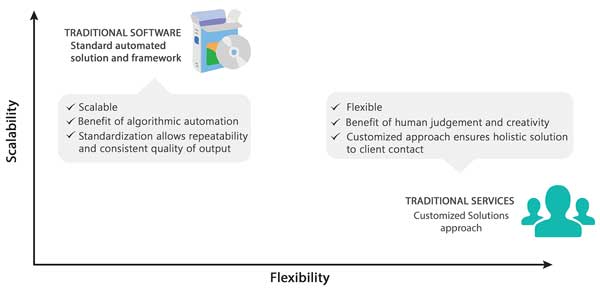
Software has been a boon to enabling and scaling analytics for decision support in large organizations. But, the two main paradigms of software development – packaged software that enables scale for repeatable, well-defined problems and the traditional services model where we develop custom solutions to solve specific business problems – have limitations; that is, a lack of flexibility in the first instance and the inability to scale in the second.
To address the limitations of traditional software development (see Figure 1) a new paradigm is required: service as a software, where man and machine come together and work in harmony. Businesses will need this “Iron Man” model – where decision scientists don exoskeletons of software and tools to attack big data (and small!) – to find new ways of solving business problems.
The More Things Change . . .
When we look at business problems and classify them by their underlying nature, logic and math, it turns out that many are similar. For instance, when providing a recommendation, which occurs across many business functions, the process still involves making some choices from a universe of possibilities to improve the probability of a relevant message and drive consequent action. Examples of this include:
- What offers do I suggest to a customer in a direct marketing campaign? What channel should I use to communicate with them?
- What products should I display on the home page of my website for a returning customer? Or on the shelf of my store?
- What additional services should I offer to someone who has bought or subscribed to one or more of my existing services?
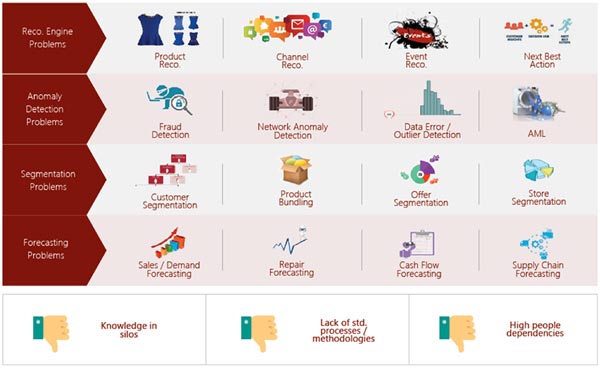
Figure 2: How a business problem is similar across different industries or applications.
Tools to Accelerate Better Decision-making
When designing software for solving problems, although it is easy to find techniques and algorithms, there is a need to apply an intelligence layer and framework on top of these algorithms that can adapt to the context and content of different use cases.
Today, the differentiation is no longer just in the techniques and algorithms, but in how they are configured and stitched together to solve business problems. Therefore, an adaptive solution framework we call Meta-software that addresses different business problem classes where the relevant techniques are wrapped in intelligent workflows and selection classes – including recommendation, classification, forecasting, segmentation, attribution, optimization, etc. – is essential to enabling better and faster solutions.
When designing software for solving complex business problems, it is easy enough to find algorithms for problems of classification, pattern recognition, optimization, recommendation and so on. However, one cannot ignore human input in problem definition, solution design and decision support.
An example would be product recommendations by a wealth manager for his or her well-heeled clients. Would you leave it completely to software to make the recommendations on a matter of money? Doubtful. When it comes to muddy and fuzzy business problems, augmented intelligence still performs better than artificial intelligence.
In today’s business world, problems are becoming more granular and more interconnected. By bringing man and machine together to blend heuristic and algorithmic solutions and preserve the flexibility of customization, business leaders can improve the efficiency of software development and accelerate the deployment of business solutions.
Deepinder Dhingra is an apprentice leader at Mu Sigma.