

May 1, 2017 in Five-Minute Analyst
Hamilton and duels
SHARE: PRINT ARTICLE: https://doi.org/10.1287/LYTX.2017.03.15
I have, like many others, been caught up in the Hamilton craze. Duels are a central feature of the Broadway show, with three prominently featured, two of which were fatal. Since neither I nor Analytics editor Peter Horner have been able to procure tickets via the normal means, we will have to settle for the next best thing – math about Hamilton. Below is a letter that I imagine written by a statistician to a number theorist who had offended him. Should Peter receive tickets before I do, I may challenge him to a duel.
Dear Sir,
I am writing to you this evening to express my displeasure over your recent Twitter comments, particularly your insinuations regarding the insignificance of my p-value.
Dueling has had a long and storied history among mathematicians. As you are no doubt pondering your impending death, I would like to remind you of the story of French luminary Evariste Galois. When challenged to deadly conflict, he spent his last night on this earth as I imagine you will, preparing his treatise on group theory. It is this treatise for which he is now remembered. The name of the woman involved – if it was truly a woman at all – is forgotten to history. Upon taking the field, he was shot dead by his rival. It would seem that you and your fellow number theorists should keep to your pencils, but the handling of weapons should be relegated to other men.
In any event, I look forward to admiring the brilliance of your contribution post-mortem. I will certainly take pride in having forced the brilliance from your mind before I force the blood from your veins.
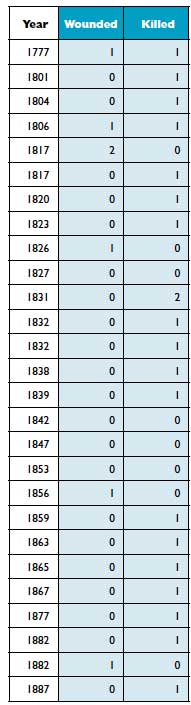
Now to matters at hand. I have produced a representative list of duels and their outcomes for your consideration (see Table 1).”
As you wisely eschew operations with actual data (a policy you should have adopted for actual weapons), I will summarize for you: There is a 70 percent chance that our duel, should it be consummated, will be fatal for at least one party. Should you somehow escape death, you will see that there will be a 22 percent chance of horrific maiming, which I would find satisfying in its own right.
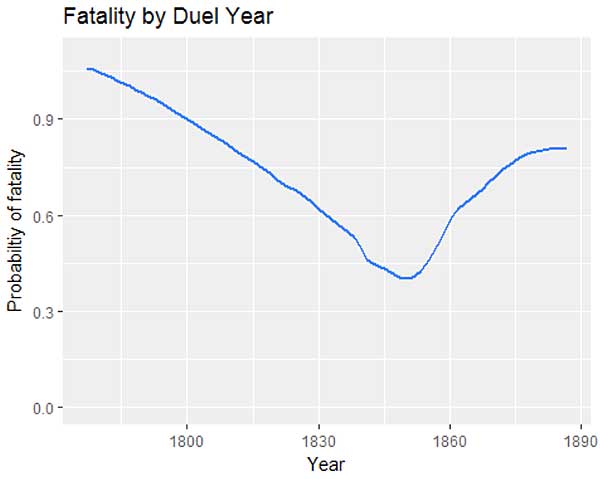
You may take some comfort knowing that depending on the year, the fatality of our encounter is variable, with fatality minimized before the U.S. Civil War (Figure 1). I have no explanation for this observation, save that perhaps mangy curs such as yourself showed more forbearance.
To summarize, I demand satisfaction.
I have the honor to be your obedient servant,
H. Schramm
Harrison Schramm, CAP, PStat, is a senior lecturer at Naval Postgraduate School, splitting his time between Defense Management and Operations Research where, in addition to teaching, he runs the Contested At-Sea Logistics Lab (CASLL). He served as the inaugural chair of the INFORMS Security Conference and is a past president of the INFORMS Analytics Society.
([email protected])