

May 1, 2017 in Thinking Analytically
Payload balance
SHARE: PRINT ARTICLE: https://doi.org/10.1287/LYTX.2017.03.16
The International Space Station requires occasional resupply of food, water and equipment from payloads that are delivered by rockets. Because rockets require their payloads to be balanced, deciding where to place cargo is critical to mission success.
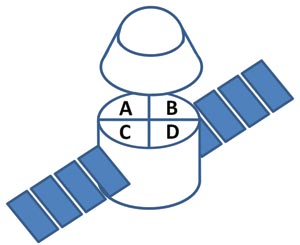
The accompanying image shows a delivery payload. There are four cargo sections within the payload labeled A, B, C, D. In order for the payload to be balanced, the total weight of cargo in section A must be equal to that of section D. And the total weight of cargo in section B must be equal to that of section C. Note that section A does not need to equal section B (nor does section C need to equal to section D).
There are 15 packages each of varying weights that must be included in the delivery. The weights of the packages in kilograms are as follows: 70, 90, 100, 110, 120, 130, 150, 180, 210, 220, 250, 280, 340, 350, 400. Each section must contain at least three packages and no section can hold more than 1,000 kg.
Question:
What are the weights of the sections when the payload is balanced?
Send your answer to [email protected] by June 15. The winner, chosen randomly from correct answers, will receive a $25 Amazon Gift Card. Past questions and answers can be found at puzzlor.com.
John Toczek is the AVP Predictive Modeling at Chubb in the Decision Analytics and Predictive Modeling department. He earned his BSc. in Chemical Engineering at Drexel University (1996) and his MSc. in Operations Research from Virginia Commonwealth University (2005).