

September 4, 2017 in Five-Minute Analyst
Nuclear deterrence
SHARE: PRINT ARTICLE: https://doi.org/10.1287/LYTX.2017.05.13
I have a longstanding policy of not commenting on current events in this column, but rather keeping it “light,” with use cases involving everyday problems, popular television shows and, for quite a bit of 2016, Star Wars. Originally, I sat down to write this column about “a world without the central limit theorem,” which was going to have this tagline: Tonight, we’ve replaced Bob’s Normal Distribution [1] with the Cauchy – let’s see what happens. Bob just had 8,000 cups of coffee – he never does that!
That was the article that I was going to write, and probably will for November. However, the current escalation between the United States and North Korea [2] caused me to put that on “pause” and return to a topic that I used to think about quite a bit previously – deterrence. There isn’t enough room to do this topic justice in one column, but I’d like to (repeat) some ideas that may be worth thinking about.
The study of deterrence is difficult because the data is censored in the sense that you only receive data when deterrence fails. One could – conceivably – count every day that nations did not go to war as a “success.” Conversely, one could claim times that the world was at the “brink” – such as the Cuban Missile Crisis – to be deterrence “successes”; however, it becomes exceedingly difficult to know when these brinks truly happen. After all, in the nuclear age, a politician late at night could be every bit as dangerous as any overt military buildup.
There are several excellent books written about deterrence, all worth a read, particularly “Arms and Influence” by Thomas Schelling and “On Thermonuclear War” by Hermann Kahn. Of course, the classic film “Dr. Strangelove,” which was inspired in part by the aforementioned Kahn, is always worth watching. In this column, I’d like to point out one very simple “nuclear war” game. In it, we’re going to take a continuous decision process and make it a discrete (finite valued) one. For ease of analysis, each side will register their decision at a fixed time, say 8 a.m., and their payoff will be immediately adjudicated.
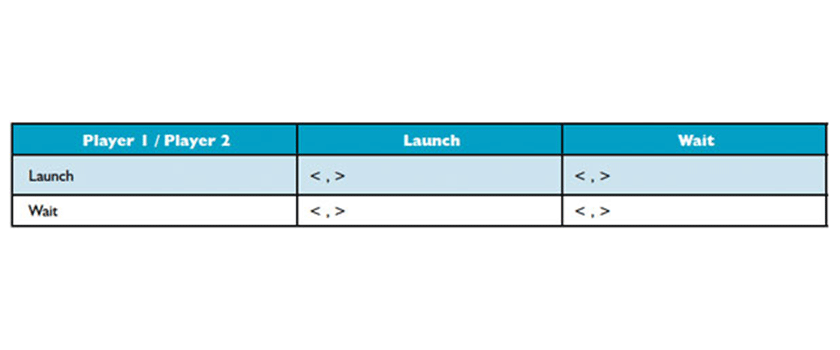
The choices are “launch,” which means initiate an attack, or “wait,” in which case a player does not launch their weapon but will retaliate if launched against (Table 1).
I haven’t filled in the boxes yet, but will explain as follows:
First, the “null” case. If both sides play “wait,” then nothing happens, and the world goes on until the next morning.
Second, the “launch/launch” case. If both sides launch, then they will both incur the damage the other will inflict. For sake of simplicity, let’s make this: < -10,-10 >.
Now, the interesting case. What happens if one side plays “launch” and the other plays “wait”? It might seem at first that the player who launches has the upper hand, because he will be able to inflict damage on the other side first and possibly eliminate the other player’s weapons – a so-called “splendid first strike.”
Developed powers are protected from this sort of strike by remote/airborne bombers and submarines.
The red arrows in Table 2 represent the fact that with second-strike options, the one-sided “launch” choices are indistinguishable from the “launch, launch” cell. Neither side can unilaterally do better than the <0,0> payoff. And the world goes on.

If one side has a “small” number of nuclear weapons, they may perceive that the other side has the advantage.
In Table 3, Player 2 perceives – correctly – that Player 1 can always do better by choosing “launch” over “wait.” Given that Player 1’s optimum choice is to “launch,” Player 2 may choose to use their own weapons.

It is for this reason that – paradoxically – having a more diversified portfolio of nuclear weapons makes one less likely to feel the need to use them. If this five-minute piece leaves you with one idea, it is that the notion of “use/lose” is dangerous and should be avoided.
A ‘final’ thought: It is estimated that the time of flight of an ICBM is around 40 minutes on the high-side. If the missiles were launched when you started reading, you would have around 35 minutes left. y
References
- This references a series of 1980s advertisements for Folger’s Crystals.
- https://www.washingtonpost.com/news/worldviews/wp/2017/08/08/trumps-fire-and-fury-statement-echoes-north-koreas-own-threats
Harrison Schramm, CAP, PStat, is a senior lecturer at Naval Postgraduate School, splitting his time between Defense Management and Operations Research where, in addition to teaching, he runs the Contested At-Sea Logistics Lab (CASLL). He served as the inaugural chair of the INFORMS Security Conference and is a past president of the INFORMS Analytics Society.
([email protected])