

December 4, 2017 in Five-Minute Analyst
PuzzlOR solution
SHARE: PRINT ARTICLE: https://doi.org/10.1287/LYTX.2017.06.13
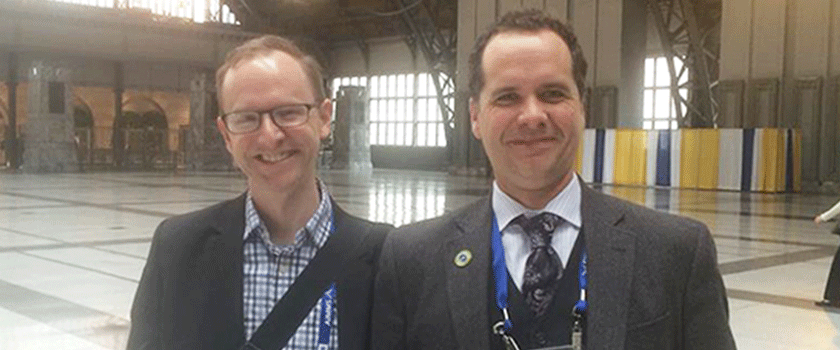
This article is part solution, part retrospective and part tribute to my longtime friend and colleague, John Toczek, the longtime author of the “The PuzzlOR” column in OR/MS Today and the “Thinking Analytically” column in Analytics magazine. In the last issue of both publications, John “cryptically” announced that he was ending his column as his “day job” had expanded and demanded more of his time.
The oldest email correspondence I could find between myself and John is from October 2008, discussing the Markov’s Prison Problem. I have a vivid recollection of solving at least one previous problem, the Traveling Spaceman. I was deployed with the Navy in Bahrain, and working John’s PuzzlOR problems gave me something interesting to think about – as well as keeping my skills sharp – while I was away from O.R.
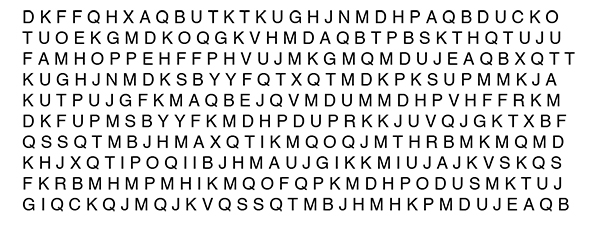
John’s final problem is a substitution cipher. He provides the text shown in Figure 1, along with the following assumption/clue: The word “puzzle” and/or “puzzlor” may be present.
Think about solving this problem while I tell more of my story.
This column began with an email to John. I was traveling and saw a news item that I thought might make for a good puzzle. The email resulted in an introduction to Peter Horner, who has been my editor ever since. That first piece was about the contest between law enforcement and DUI checkpoint apps.
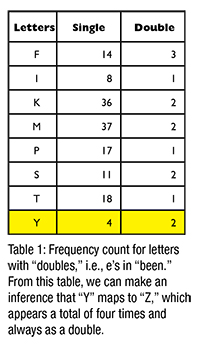
Substitution ciphers are susceptible to frequency analysis, with the knowledge that “e” is the most common letter in the English Language (although not always; the 1939 novel “Gadsby” famously does not include a single instance). It is straightforward to compute the frequency table using R, where “CTEXT” is the cyphertext (Figure 1):
library(magrittr); library(knitr); library(dplyr)
countL = function(string, letter){
s2 <- gsub(letter,””,string)
return (nchar(string) – nchar(s2))
}
doubles = vector()
singles = vector()
for(i in LETTERS){
singles[i] = countL(CTEXT,i)
doubles[i] = countL(CTEXT,paste0(i,i))/2
}
CountD = data.frame(Letters = LETTERS, Single = singles, Double = doubles)
CountD %>% filter(Double > 0) %>% kable()
CTEXT %>% gsub(“Y”, “z”, .) %>%
gsub(“S”, “p”, .) %>%
gsub(“B”, “u”, .) %>%
gsub(“F”, “l”, .) -> Sub1
You can use the frequency counts to make a guess about e, as well as “puzzlor” to make a guess about “o” and “r.”
Sub1 %>%
gsub(“K”, “e”, .) %>%
gsub(“Q”, “o”, .) %>%
gsub(“T”, “r”, .) -> Sub2
Which produces an output that looks something like this:
DelloHXAouUrereUGHJNMDHPA
ouDUCeOr…
Which produces an output that looks something like this:
DelloHXAouUrereUGHJNMDHPA
ouDUCeOr…
The last time I saw John in person was at INFORMS Analytics 2016 in Orlando, Fla. We were watching the two groups at the hotel arrive – the INFORMS attendees and the cheerleading conference that was happening at the same time. I remember walking around having one of the most enjoyable conversations of that year, covering manufacturing, fraud and – a common topic – elevator scheduling.
If you have followed along with your coding, you will have solved the final PuzzlOR by now:
“helloifyouarereadingthisyou
havecrackedthecodewithyoursupe
rioranalyticsskillsiwantedtothankyo
forreadingthepuzzlorforthesepast
tenyearsandletyouknowthatthiswill
bethelastpuzzlethishasbeenawon
derfulopportunityformetocontribu
tetotheinformscommunityandmeet
manynewpeoplebutitstimetocloseth
ischapterandmoveontonewopportu
nitiesthankyou”
Thank you, John, for your contributions to our professional dialog and giving many of us something interesting to think about while away from our “day jobs.”
SHARE: