

March 12, 2018 in Five-Minute Analyst
Medicaid spending
SHARE: PRINT ARTICLE: https://doi.org/10.1287/LYTX.2018.02.14
I have recently been connected to people who were interested in how U.S. states spend their money on Medicaid. Medicaid is a state and federally funded program that is administered by the states in accordance with U.S. federal guidelines, and as such is an important – and expensive – program for the well-being of citizens. Medicaid is a small part of the healthcare ecosystem and a rapidly growing part of the operations research (O.R.) and analytics practice. Practically every issue of this magazine, as well as its companion – OR/MS Today – includes articles on healthcare.
Specifically, Medicaid “…provides health coverage to millions of Americans, including eligible low-income adults, children, pregnant women, elderly adults and people with disabilities. Medicaid is administered by states, according to federal requirements. The program is funded jointly by states and the federal government” [1].
As we frequently recall, this is the five-minute analyst, not the five-year dissertation, and it is important to scope an issue to have an interesting discussion in approximately 700 words. In that spirit, we are asking one question: Do states achieve advantages via “economies of scale”? A priori, we would think that larger states would have lower per capita spending. Let’s explore that assumption.
We use data from the Kaiser Family Foundation (www.kff.org) retrieved Feb. 15, 2018. This data does not include administrative costs of the program, which can be significant but are more difficult to quantify for a variety of reasons. In any event, they are not easily distilled from Internet searches [2].
Our expectation is that states with a larger number of enrollees should have lower costs than states with fewer enrollees because of economies of scale. After obtaining the data, we plot it as shown in Figure 1.
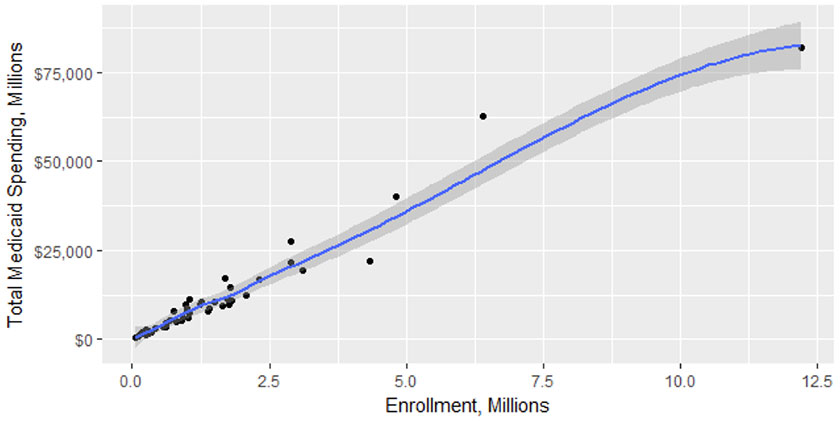
This plot leads us to believe that there is a linear relationship between the number of enrollees and the total costs. Applying ordinary linear regression, we see that this is indeed the case, with more than 96 percent of the total variability in a state’s expenditure explained by the number of enrollees, and each enrollee costing approximately $7,300 per year (p-value is zero).
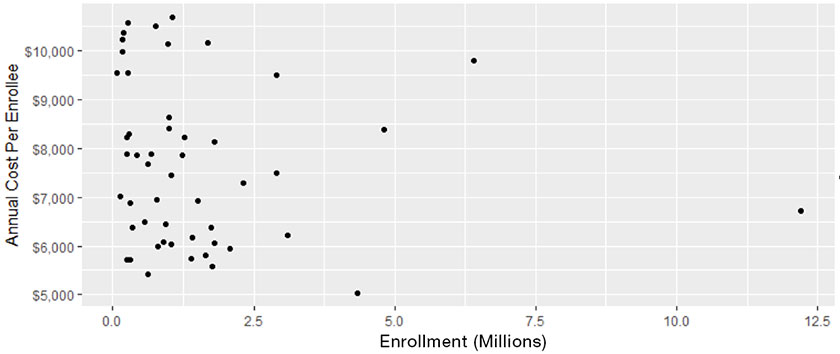
There is substantial variation within the states; for example, the most expensive state on a per-enrollee basis is Minnesota, which pays $10,600 per recipient. The least expensive state is Florida, which pays $5,033 per recipient. In general, there is not a strong trend between the number of enrollees and the per capita cost, as shown in Figure 2.
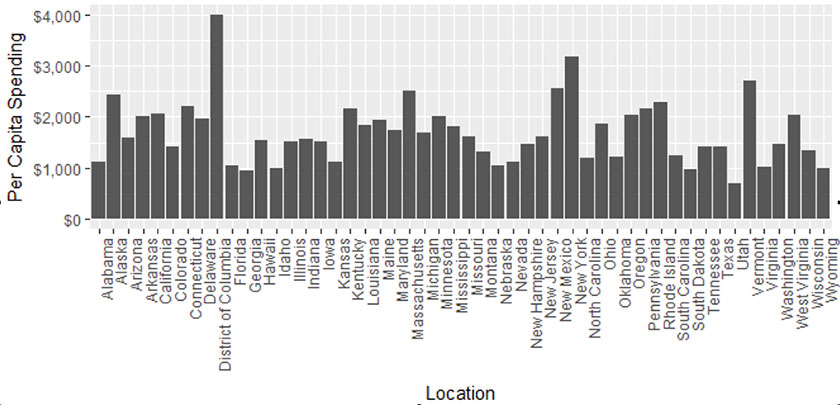
Beyond considering the cost per enrollee, we can also think about the cost per citizen, which changes the calculus significantly, as shown in Figure 3.
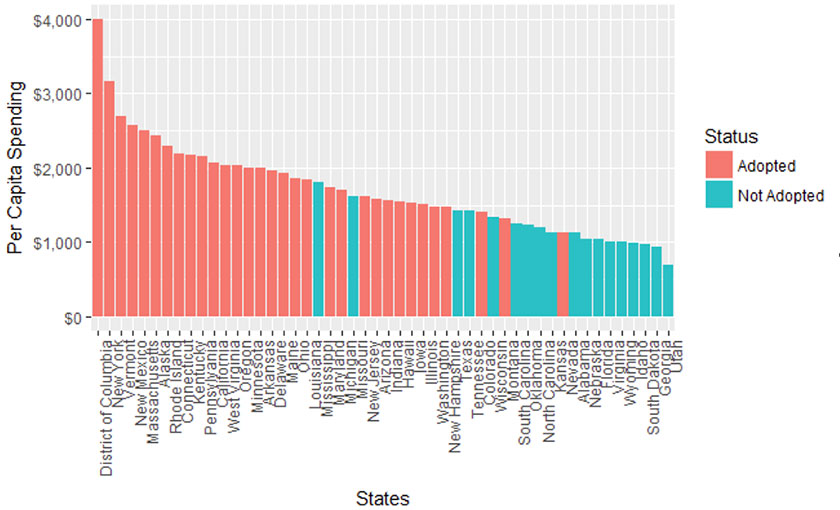
Finally, we address one (of potentially many) confounding variables: the so-called “Medicaid expansion.” As part of the Affordable Care Act, Medicaid has been made open in some states to those at 128 percent of the federal poverty level [3]. To understand the impact of this change in policy, we color code the bar chart and order the bars to be descending. The resulting chart is shown in Figure 4.
In conclusion, we hoped that we have piqued some of our fellow practitioners’ interest at the intersection of policy, data and healthcare. Medicaid, like all health programs, is important because it directly impacts the lives, livelihoods and well-being of people in every state.
References & Notes
- https://www.medicaid.gov/medicaid/index.html
- These are, of course, Internet searches done by me. If you find the data and are the first person to send it to me, I’ll owe you a Coke.
- https://www.kff.org/health-reform/state-indicator/state-activity-around-expanding-medicaid-under-the-affordable-care-act
Harrison Schramm, CAP, PStat, is a senior lecturer at Naval Postgraduate School, splitting his time between Defense Management and Operations Research where, in addition to teaching, he runs the Contested At-Sea Logistics Lab (CASLL). He served as the inaugural chair of the INFORMS Security Conference and is a past president of the INFORMS Analytics Society.
([email protected])