

May 6, 2018 in Five-Minute Analyst
Who shot first – an application of Bayes Theorem
SHARE: PRINT ARTICLE: https://doi.org/10.1287/LYTX.2018.03.14
Never tell me the odds.
– Han Solo
As many readers of this column already know, “Star Wars” (the movie) is one of my favorite topics for operations research. I have previously written about Kylo Ren, Luke Skywalker, Yoda and Emperor Palpitine. In honor of the upcoming Han Solo movie (May 25 release), I thought I would write about everyone’s favorite scruffy-looking nerf herder, Han Solo.
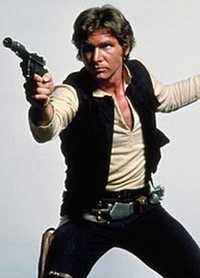
Han Solo is perceived for both getting in a lot of personal conflicts, as well as shooting first. Source Wikipedia
Han Solo is popularly perceived for both getting in a lot of personal conflicts, as well as shooting first. There is considerable controversy surrounding Han’s very first instance of personal combat in Episode 4, when confronted by bounty hunter Greedo in Mos Isley Cantina. In the original film, Han shot first, but in the re-release, Greedo is seen to shoot first. There is even a Wikipedia page dedicated to whether Han shot first. This is alluded to in the following bit of dialog from “Force Awakens” when they are confronted by Kanjiklub:
Han: We’re going to do what we always do – we’re going to talk our way out of it.
Chewbacca: “MRREAFFF…’
Han: YES WE DO – EVERY TIME!!!
Being fans and analysts in equal measure, we approach this problem by considering the instances of Han Solo’s personal combat and determining the probability – given the outcome of conflict – that Han Solo shot first.
Before proceeding, we note that Han Solo’s instances of personal conflict could be analyzed as a class of problems called the “sniper’s duel,” which themselves may be generalized to Lanchester quations, which we used previously to study the Battle of Hoth from Episode V. Additionally, we have previously explored one-on-one duels to examine Hamilton.
First, we present Table 1, noting Han Solo’s personal conflicts, opponents and outcomes. As before, there was no readily available source, so along with our trusty assistants, we (re)watched the four episodes where Solo appears (you know, for science).
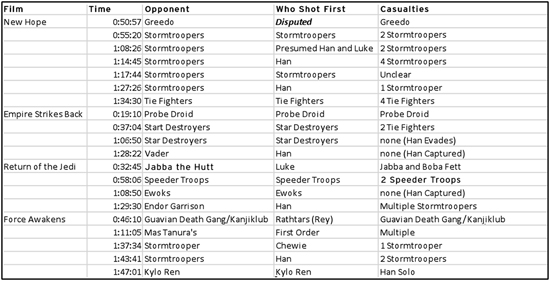
Table 1: Time, Opponent, first shot and outcome of Han Solo’s personal conflicts, Episodes 4-7 of “Star Wars.”
By “personal conflict” we refer to “one-on-one” or “few-on-few” battles. Major fleet engagements, like the Battle of Hoth or the Battle of Yavin IV, are excluded from analysis.
From this table, we can graph the evolution of Han Solo’s cumulative “first shot” probability, which is given by the number of times that Han has shot first (so far) divided by the total number of conflicts he has entered.
We can also compute the following statistics about how often Han shoots first and who dies.
Did Han shoot first?
Mon kee ches kreespa Greedo?
– Jabba the Hutt
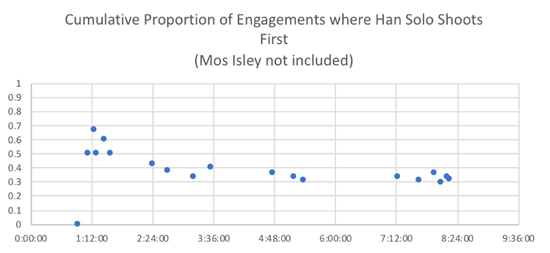
Figure 1: Cumulative probability that Han shoots first over all engagements in “Star Wars.” The time index at the bottom is cumulative runtime of Episodes 4-7 (including credits).
Whether or not Han shot first, we know that Greedo died, and nobody disputes this. To determine the probability that Han Solo shot first, we need to apply Bayes Theorem and reverse the conditioning.
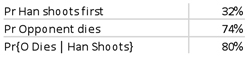
Figure 2: How often Han shoots first and who dies.
Finn: We’ll just use Bayes Theorem to get that answer.
Han: THAT’S NOT HOW BAYES’ THEOREM WORKS!!!
(Admittedly, this is not dialogue from “Star Wars,” but wouldn’t it be cool if it was?)
A quick restatement of Bayes Theorem is:
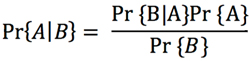
It has a lot of important applications in making inference and has gained popularity as an alternative to p-values in hypothesis testing. In our application, we are using it to “reverse the conditioning” on the variables. In our specific case:

Plugging in numbers from our table, we conclude that the probability that Han shot first given that Greedo died is 34 percent, which is very close to the (unconditioned) probability that Han shot first. This is because the probability that Han shoots first is very close to the probability that Han’s opponent dies, although they are not correlated.
Final statement: Regardless of what the math says, Han totally shot first!
Harrison Schramm, CAP, PStat, is a senior lecturer at Naval Postgraduate School, splitting his time between Defense Management and Operations Research where, in addition to teaching, he runs the Contested At-Sea Logistics Lab (CASLL). He served as the inaugural chair of the INFORMS Security Conference and is a past president of the INFORMS Analytics Society.
([email protected])