

July 8, 2018 in Healthcare Analytics
AI, blockchain expected to fuel industry’s growth
Despite setbacks, healthcare analytics market’s future success will be built on secure, private sharing of data by multiple institutions.
SHARE: PRINT ARTICLE: https://doi.org/10.1287/LYTX.2018.04.04

During the first week of June the U.S. Justice Department decided not to defend the constitutionality of the Affordable Care Act (ACA) if it is challenged in court. Historically, a sitting government deciding not to support an existing law passed by the Congress is a deviation from the norm. Insurance companies would be free to charge more (or even deny coverage) to consumers with pre-existing conditions, and millions of consumers with pre-existing conditions could effectively find themselves back to square one. Also, the decision introduced instability in the insurance market. Insurers were getting ready to set their pricing for the next year, and now they are completely confused regarding pricing strategy. Interestingly, insurance companies issued a statement opposing the position taken by the DOJ, but it remains to be seen how they will respond to this new development with their future prices.
Will the DOJ’s decision negatively impact the healthcare analytics market, especially in the insurance sector? The jury is still out. Nonetheless, the move toward value-based purchasing model, a payment reform initiative of ACA that acted as a major catalyst for healthcare analytics, is not anticipated to change. In the provider market, however, uncertainty might lead to a wait-and-watch approach. On top of that, a recent declaration by IBM Watson Health to significantly reduce its workforce rattled many. It is possible that IBM’s expectation of the growth in the use of artificial intelligence (AI) in healthcare didn’t materialize.
Consumers need to have visibility about what is happening with their data, who is accessing it, when they are accessing it and why they are accessing it. Source: ThinkStock
Applying AI in medical care is a hard problem; evidence of efficacy is important. Medicine is a difficult domain to navigate, and it takes many years to make a technology sophisticated and accurate enough to win endorsement from medical professionals. IBM’s failed attempt at MD Anderson Cancer Hospital is a reminder. Diseases in real life are not static – they change and so do the diagnostics. Algorithms, therefore, can never be static – training data sets have to change to match the new reality, and new evidence has to be established through clinical trials. AI for healthcare is not a sprint, it is a marathon, and short-term hypes are bound to wane.
However, despite that bad news, at least one market report suggests that the future of healthcare analytics remains bright, with the U.S. healthcare analytics market potentially reaching $54 billion by 2025. Newer technological breakthroughs such as AI and blockchain are expected to fuel the growth along with the drive to reduce cost of service delivery and reduction of systemwide waste. However, the building block for this growth will surely come from secure and private sharing of data by multiple institutions engaged in consumer healthcare.
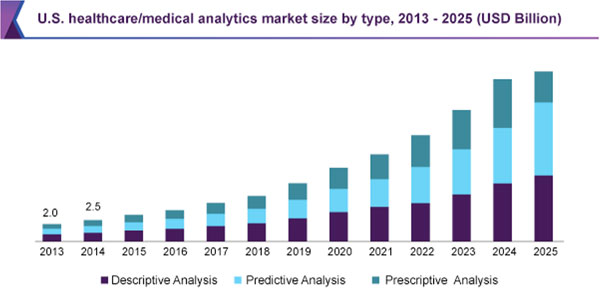
Figure 1: Despite setbacks, the healthcare analytics market is expected to continue to grow according to one report. Source: www.grandviewresearch.com
Blockchain and Electronic Health Records
In my previous column I alluded to the use of blockchain as the enabler for data sharing with appropriate privacy and security measures among multiple medical and social care organizations. The lack of trust among institutions and legal barriers that exist today are significant deterrents for data sharing and, therefore, act as a roadblock for advanced analytics solutions. For healthcare analytics to reach its market potential as described in the report mentioned earlier, such barriers need to come down. In this column I would like to touch upon one blockchain implementation proposal that could build trust among data sharing organizations and instill confidence in the minds of the consumers who entrust healthcare organizations with their data.
The debate regarding the “ownership” of healthcare data continues within the healthcare industry. I participated in many data sharing meetings where the executives and middle management of healthcare organizations referenced patient data that they have in their custody as “their data.” I cringe every time I hear that. Patients have made healthcare organizations their custodian of healthcare data; health data sets were generated by the consumers when they interacted with the staff and equipment of the healthcare delivery organizations. So, consumers should be the lawful owners of this data.
New Hampshire is the only state that provides ownership of patient data to patients. Most states don’t have any formal legislation delineating custody of medical records. Although most systems allow patient to have access to the data via some kind of web or mobile app, the problem arises when multiple health systems are involved, which is typically the case. We live in a silo-ed environment where each custodian of our data fights to be legally compliant and to avoid business risk by not allowing cross-sharing with other custodians. That’s a good strategy for their own business operation perhaps, but it’s terrible for the true owners of that information.
Recently, Apple’s entry into the healthcare market excited some pundits who are proclaiming that Apple can solve this issue and put “personal health records” back in the game. I would argue that it is great for the consumers to own that information, but they need to have full control including the potential sale of the data to researchers or pharmaceutical companies interested in buying it. Today, consumers get virtually nothing from such transactions. Consumers need to have visibility about what is happening with their data, who is accessing it, when they are accessing it and why they are accessing it. If profit-making entities like pharmaceutical companies are using the data to validate efficacy of a new drug, then urge them to share the fair market value of that data for that access.
This is the area where blockchain could shine as it removes intermediaries. It is not advisable to store the entire health record (or health record curated from many places) of a patient in a blockchain. That’s too much data to handle and encrypt; too much data will make blockchain processing unwieldy from the performance standpoint. Organizations that need to share information could develop smart contracts between them and their patients. This could enable patients to have control of their data sharing and subsequent use. Actual data could still reside inside individual provider’s electronic health record system.
MedRec developers, who are focused on developing a blockchain-based health data sharing platform on Ethereum, have proposed the architectural concept shown in Figure 2. This could be considered as a key building block for the modern day personal health record platform. Another startup called Medicalchain is using a similar approach.
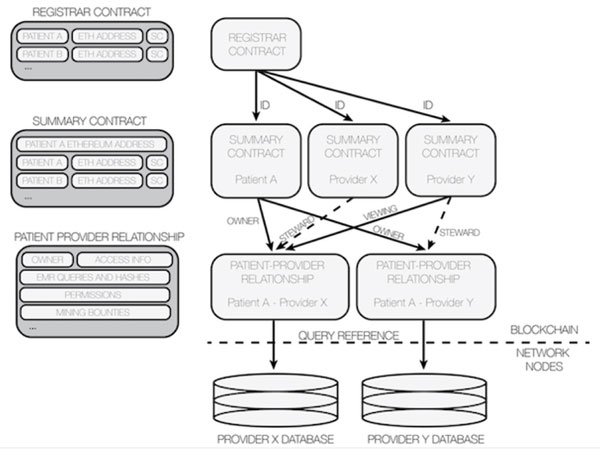
Figure 2: MedRec’s proposed architectural concept of a blockchain-based data sharing platform. Source: https://medrec.media.mit.edu/technical/
This is a fascinating new area that could potentially bring portability of health data like never before while addressing the privacy concerns many people have. In countries where a legal framework for health data privacy is in its infancy, a trust framework could be built with a blockchain platform instead of a lengthy legal framework, thus enabling secure and user-controlled data sharing. We will continue this discussion in future columns. Please stay tuned.
Rajib Ghosh is the founder and CEO of Health Roads, LLC, a consulting company for enabling digital transformation in healthcare organizations. He has 25 years of technology experience in various industry verticals where he had management roles in software engineering, data analytics, program management, product management, business operations and strategy development. Ghosh spent a decade and half in the U.S. healthcare industry as part of a global ecosystem of medical device manufacturers, medical software vendors, telemedicine and telehealth solution providers. He’s held senior positions at Hill-Rom, Solta Medical and Bosch Healthcare. His recent work includes leading data-driven digital transformation in the public health space, including county-level healthcare agencies and organizations focused on underserved populations.
([email protected])