

September 10, 2018 in Newsmakers
INFORMS everywhere: U.S. Census Committee, queues and Kathmandu
SHARE: PRINT ARTICLE: https://doi.org/10.1287/LYTX.2018.05.05

Former INFORMS President Cook named to U.S. Census committee

Thomas Cook, a former president of INFORMS, a founding partner of Decision Analytics International and a member of the National Academy of Engineering, was recently named one of five new members of the U.S. Census Bureau’s Census Scientific Advisory Committee (CSAC). The committee meets twice a year to address policy, research and technical issues relating to a full range of Census Bureau programs and activities, including census tests, policies and operations. The CSAC will meet for its fall 2018 meeting at Census Bureau headquarters in Suitland, Md., Sept. 13-14.
Cook spent most of his career at American Airlines, where, as assistant VP of Operations Research from 1982-1987, his relatively small group of O.R. specialists pioneered the use of revenue management in the airline industry. Under Cook’s leadership, the group continually expanded in size and influence until it became a major division of the airline known as American Airlines Decision Technologies (AADT) with Cook serving as president (1987-1993). Starting in 1993 and through a series of mergers with other internal divisions, AADT became part of Sabre Technologies Solutions, a legendary $1 billion IT services company that at the time boasted the largest O.R. group in the world. Cook was president of Sabre when he left American Airlines in 1999.
After leaving Sabre, Cook joined McKinsey & Company, and later became CEO of two O.R.-based firms, CALEB and TCI. His teams at American Airlines, Sabre and Caleb won three prestigious Franz Edelman awards from INFORMS for their outstanding achievement in applied analytics, operations research and management science.
Cook was inducted into The National Academy of Engineering in 1995, when he was cited for his “leadership in advancing operations research and decision-support technologies within the transportation industry.” He became a Fellow of INFORMS in 2002 and was awarded the Kimball Medal by INFORMS in 2007.
Cook, who holds a Ph.D. in operations research, taught operations research, statistics and computer science at the University of Tulsa, University of Texas at Austin and Boston University before joining American Airlines.
Larson, AKA ‘Dr. Queue,’ featured in The Guardian video on queues
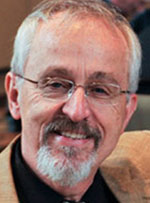 Richard C. Larson, an INFORMS Founding Fellow and the Mitsui Professor of Data, Systems and Society at MIT., was recently interviewed by The Guardian for a video, “After you: The psychology of queues and how to beat them.”
The Guardian notes that queues are simple: you join at the back and wait your turn. But there’s a whole branch of psychology devoted to studying how they work … and how things can go bad when someone acts out of line.
“People view fairness in queuing as more important than the duration of the wait,” Larson explains in the video. “Research has shown that at fast food restaurants, customers would prefer a queue, which is single, serpentine, guaranteed first-come, first-served that has twice the average wait than a fast food restaurant, which has parallel, multiple queues where chances are that someone comes in after you gets served before you.”
An expert on queues and widely known as “Dr. Queue,” Larson is a past president of both INFORMS and the Operations Research Society of America (ORSA, a forerunner of INFORMS), as well as a member of the U.S. National Academy of Engineering.
Kaplan, Cochran make presentations at APORS 2018 in Kathmandu
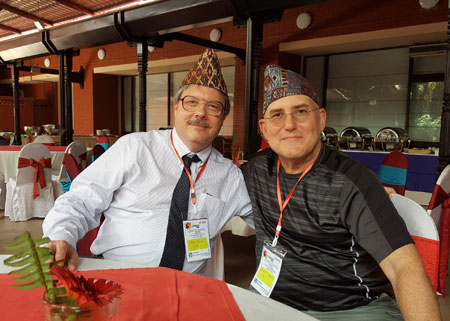 INFORMS members Jim Cochran (left) and Ed Kaplan delivered presentations at the 2018 APORS conference in Kathmandu, Nepal.
INFORMS members Edward Kaplan and James J. Cochran recently made presentations at the 2018 Triennial Conference of the Association of Asia-Pacific Operational Research Society (APORS) in Kathmandu, Nepal.
Kaplan, an INFORMS Fellow and a past president of INFORMS, gave a talk on operations research and public health. Kaplan is a professor of operations research at the Yale School of Management, a professor of public health at the Yale School of Medicine and a professor of engineering in the Yale School of Engineering and Applied Science.
Cochran, a co-founder of Statistics Without Borders, spoke on how to address big data issues in an introductory statistics course. Cochran is associate dean for research and professor of applied statistics at the Culverhouse College of Business, University of Alabama.
SHARE: