

April 8, 2019 in ReCAP
ReCAP: Jessica Weaver
SHARE: PRINT ARTICLE: https://doi.org/10.1287/LYTX.2019.03.06
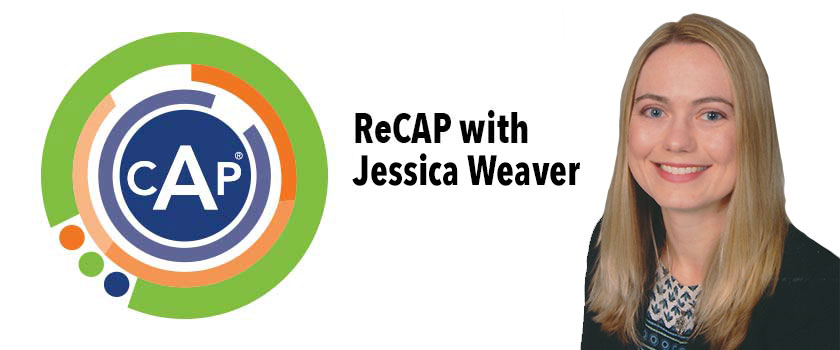

Name: Jessica Weaver
Job Title: Senior Workforce Analyst
Primary Job Functions
-
Human capital analytics practitioner

Date CAP Certification Was Earned
March 2015

Why did you choose CAP over any of the other analytics certifications?
INFORMS was introduced to me by my academic department while pursuing my master’s in operations research many years ago. I was well aware of the high reputation that INFORMS maintained within the operations research community and followed the development of the CAP program with interest when it began. In my professional experience, I have seen such a variance in analytical skills and literacy, with all things data analysis becoming “on trend.” What set the CAP apart were the five Es and the commitment to integrity and rigor. The CAP focuses on proper business problem framing, which many other certifications overlook, and in my professional opinion, is the most important step in any analytics endeavor. The most sophisticated models that solve the wrong problem are useless and can even be harmful to an organization.

How familiar were you with the “Seven Domains of Analytics Process” prior to pursuing CAP?
I was quite familiar with these domains as I work in them every day as an analytics practitioner. This was another reason that the CAP resonated with me. As I reviewed the study guide material, I thought to myself, “yes, this is how it’s done!”

Was there anything about the exam that surprised you?
Honestly, I was a little surprised by the more data engineering and database development focused questions. I am a user of data, but I do not build data cubes. The CAP exam is quite comprehensive and exposed some blind spots in my repertoire. I focused my studying efforts on those blind spots.

Do you think CAP should serve as a hiring mechanism?
I am not sure that the CAP should be used to limit candidates but it is a great tool to identify thought leaders in an organization to help lead the charge for maturing the analytics capabilities of the organization.
Describe any barriers you see for those entering or in the workforce who are not professionally certified?
I am not sure if it is really a barrier to avoid but more of a bridge, an opportunity for more interdisciplinary scientific analysis. Accredited certifications allow analysts from many different formal disciplines to collaborate in the space of data analytics, while maintaining a common denominator or set of standards. It allows for professionals to pass a sort of language or literacy test.

In your opinion, what will be the next "game changer" in analytics?
Honestly, I think our technology is outpacing our cultural readiness. While there are many inspiring advances in mathematical modeling and machine learning with applications in medicine and social science, we are still struggling as a society with evidence-based decision making. There is a psychological piece to the adoption of analytics, not just in reporting and predicting, but in cognition and behavior as well. There is also the concern of ethical uses of data and the unanticipated consequences. I anticipate some bigger push, whether it be legislation, public policy, or scientific metrics, that will begin to address some of these concerns in the next few years.
SHARE: