

April 16, 2019 in Analytics Conference
How Data Science is Revolutionizing the Future
SHARE: PRINT ARTICLE: https://doi.org/10.1287/LYTX.2019.03.17n
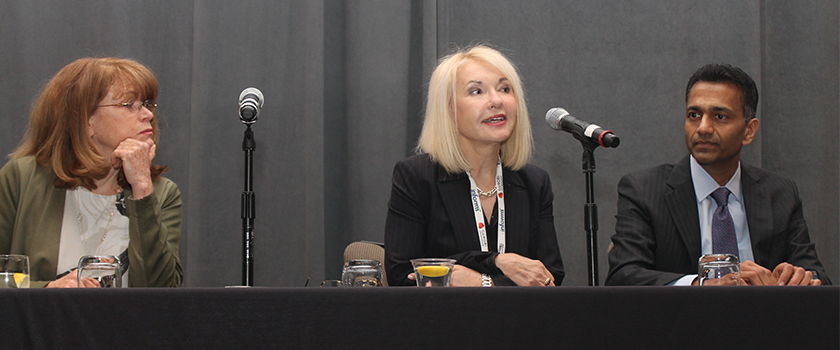
From the role of human talent in advancing data science, to the integration of data science into small and medium-sized organizations, to the future of data ownership, the Monday morning plenary panel session at the 2019 INFORMS Business Analytics Conference discussed the continually advancing and changing role of data analytics in the future.
Moderated by Noha Tohamy, Distinguished Vice President of Research at Gartner, Inc., the session’s panelists included Nada Sanders, Distinguished Professor of Supply Chain Management at the D’Amore-McKim School of Business, Northeastern University; Viju Menon, Group President, Global Quality and Operations, Stryker; and Katherine Rosback, President, Katherine Rosback Enterprises, Inc.
Tohamy began the session by sharing some predictions of how data science will advance in the next several years, including:
- Artificial Intelligence: Business value will increase 2.5 times to $5 trillion by 2025
- By 2021, 10% of new vehicles will offer autonomous driving compared with less than 1% in 2018
- By 2021, half of large industrial companies will use digital twins enabled by the Internet of Things (IoT)
- By 2022, 70% of enterprises will be experimenting with immersive technologies
- By 2030, blockchain will create $3.1 trillion in business value
- By 2021, 15% of customer service interactions will be handled by business intelligence (BI), a 400% increase from 2017
Data science is essential to artificial intelligence (AI), and to creating insights from data to transform our lives and businesses, explained Tohamy, and as analytics professionals, it is important to continue to learn what data science is about and the impact it will have in the future.
Each panelist then provided some background on their own work and how it is impacted by data science from their own research, from working with companies to implement their data and growing to be data science leaders, to the multitude of applications for data science from healthcare to industry and more, to connecting people in organizations and asking the right questions.
The session progressed with Tohamy posing questions to each panelist, offering them the opportunity to provide their own unique insight and experience.

answers a question during the plenary panel sessions
at the 2019 INFORMS Business Analytics Conference in Austin, TX.
Tohamy’s first question, with regards to how broad the term data science is, was posed to Menon, asking what he found to be the most exciting emerging technology in data science. Menon shared that machine learning, in terms of promise and delivery, holds the most interest. In particular, his role with Stryker provides him with the opportunity to witness how it can be used to improve quality of human life due to its crossover with healthcare. He provided an example of a robotic arm that can be used to assist surgeons in the operating room, providing feedback on incisions that has clinically proven to be incredibly beneficial.
Tohamy followed up with a question for Rosback, regarding her work helping organizations through significant changes, asking how she advises and educates what the change will look like based on data science. Rosback began by looking back to the 1980s, when computer power was truly coming online and she experienced the excitement and concern associated with the predictions of “lights out manufacturing.” During this time when much work was done by hand, she shared that you had to be especially careful and thoughtful with your questioning and actions, as there was little room for error and caution was key. She sees a similar situation today, where people are excited to move forward, but it’s still important to remain thoughtful in your work. Today, the concern relates to automation, so it’s important to know how to ask questions. Why are we doing this, why is this important? These provide clarity that are very important to the change management process.
Tohamy’s final question was for Sanders, regarding whether universities are supporting need for talent and providing strong data scientists. Sanders shared that while we are captivated by what data science can do, we have learned that human talent is what makes it work, and often that is forgotten. Despite the fear of jobs being lost to automation, the case is really more of a shift in skillsets. In particular, she mentioned that Northeastern University has brought in a new set of literacies for its students. In addition to data science skillsets, it is essential to also grow and support the human talent, and to grow them together.
Tohamy then opened the panel up to questions from the audience, the first of which asked the panelists, as most programs for data science are at the graduate level, is it important to push these opportunities down to the undergraduate level as well?
Sanders responded yes, and shared that Northeastern University has a co-op program, which created a five-year program that works with external firms to create unique opportunities, exposes students to data science earlier, and gives real world experience that helps the students better understand their data.
The next audience question asked the panelists if analytics, data science and AI are really all the same thing, or are there boundaries and differences? The panelists all agreed that while they are intertwined, what remains unique and relevant is how they are each applied, the impact, and the value. And despite the fact they often overlap, they can each offer new insights.
The next question concerned privacy and data analytics. Did the panelists feel that in the future we will own our own data, or will we be fighting to secure its ownership? The panelists discussed that, while we all value our data and our privacy, given the pervasive nature of access, it will continue be difficult to control, now and in the future. What will be increasingly important is addressing issues such as governance, legal issues, privacy, and identifying better ways to guard data, address biases, and ensure ethics is a significant part of the dialogue surrounding data ownership.
The next question referenced the slide of data science predictions shared by Tohamy, asking if the panel felt any of the predictions were over- or understating what the future would truly hold for data science. Rosback shared that initiatives over the past 30 years ran a failure rate at about 60-80 percent. Fast forward to today, and its tracking the same way. However, this is not due to a lack of technical rigors, the major barriers are lack of technical initiative not being in line with company strategy.
Sanders also shared that data science cannot simply be viewed as a new layer to add to a business strategy, but must be viewed as a change from business as usual to an entire strategy, with a new structure that requires new talent. Menon also offered that computing power is continuing to grow and heading in the right direction, so while the timeline of the predictions maybe flexible, they will ultimately be achieved.
Next, the panelists were asked to weigh-in on whether small to mid-sized companies, who may not have had the exposure to data science or the budget to support the new technology, will be negatively impacted as data science continues to advance. The panelists emphasized that actually, smaller organizations are more limber and can quickly implement new technology or strategies, where as it may take longer for a larger organization to do so. Also, the key is not trying to implement the entire “tool box” but selecting the appropriate tools for your organization’s needs. For data science professionals, the key when communicating to companies like these is to use language they will understand, as they are more likely to not have been introduced to data science jargon.
The plenary session closed with each panelist sharing what they felt was the most important success factor for an organization moving forward with data science. For Menon, this included having senior leadership that understood the value of data science who would be able to support a relationship between their business strategy and data toolkit, enabling them to truly unlock their talent. Sanders emphasized the importance of recognizing human talent, understanding who you are as a company, your strategy, and how to best grow talent with that strategy. Identifying potential areas of pushback from those who may not fully understand or embrace the potential impact of data science, according to Rosback, is important for any organization to truly implement and benefit from a data science program.
Ashley Kilgore has more than a decade of experience in nonprofit communications and public relations, to include print, radio, video, and web. Contact Ashley Kilgore.