

June 18, 2019 in Healthcare Analytics
State of the Healthcare Technology Industry: A Mid-year Review
SHARE: PRINT ARTICLE: https://doi.org/10.1287/LYTX.2019.04.06

Since it’s summer, now is a good time to take a look at how the healthcare analytics industry did during the first half of the year and what potentially lies ahead. So far 2019 is turning out to be a year when some of the exuberances of the last couple of years has come down to a more moderate level. We are going through a relatively quieter time on the healthcare policy front; the fate of the Affordable Care Act (ACA) is still waiting to be decided.
Robust Global Growth Projection
According to a recently published healthcare analytics market research report, the global market is expected to grow at a compound annual growth rate (CAGR) of 14.56 percent between 2019 and 2025, reaching a market potential of approximately $4.3 billion by 2025. The report suggests that Latin America, the Middle East and Africa are expected to provide the majority of the growth momentum over that period due to the rising awareness of the people and organizations in those regions about healthcare analytics and availability of analytics infrastructure. The governments of the countries in those regions are expected to make significant investment in the healthcare sector, which will escalate the number of pharma and biotech companies. This is an ambitious projection for sure, but the examples are seen already in several of those countries, including the United Arab Emirates, Saudi Arabia and Kenya. For healthcare analytics companies, an expanding global market is good news.
Venture Capital Investment Slows Down
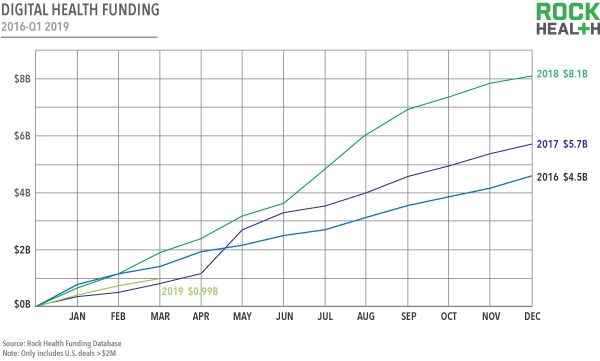
According to a report from the digital health accelerator Rock Health, investment in healthcare technology startups is down in Q1 of 2019 compared to the same time period in 2018. About $986 million was invested in Q1 of 2019, which is about half of what was raised by companies in Q1 of 2018. But it is in line with what we saw in 2017. It is unclear whether this is an indication of slowing appetite for the venture capital firms in this sector or if it is just a blip on the radar. Clearly, there are uncertainties in the marketplace caused by looming legal challenges for the ACA and how that would impact the industry overall.
However, this could be an indication that the economy is slowing, and healthcare is a leading indicator of that. Overall, in the healthcare space we are seeing improved sign of better reimbursement for newer care delivery models such as care coordination, remote patient monitoring and telehealth. The Centers for Medicare and Medicaid Services has released three new reimbursement codes for virtual care, which have considerably bolstered the market. We should see plenty of healthcare analytics getting bundled with those services as providers, payers and policymakers learn how this new model of care is being utilized and what kind of outcomes are being produced. Given this new development, it is no surprise that the bulk of the capital flow in Q1 of 2019 happened in companies operating in those areas.
Predictive Analytics and Data Visualization
According to a 2019 Predictive Analytics in Healthcare Trend Forecast report created by the Society of Actuaries, for many executives in provider and payer organizations, predictive analytics is still the main go-to tool to achieve the Triple Aim of improved patient outcomes, quality of care and lower costs. Sixty percent of executives surveyed are using predictive analytics within their organizations, which is a 13-point year-over-year increase from 2018 (47 percent) and a 6-point increase from 2017 (54 percent). Likewise, 60 percent of payers and providers are expected to dedicate 15 percent or more of spending to predictive analytics in 2019.
General expectation among the executives is that predictive analytics will pay off the investment by saving organizations 15 percent or more over a five-year period. According to the survey, this is not just a leap of faith; data and IT executives are feeling more confident about the capabilities of their vendors and their technologies. They also believe that data visualization and machine learning will be the future of predictive analytics. Machine learning algorithm are improving by leaps and bounds. Visualizing data in a meaningful way so that an executive gets an “aha” moment at a glance is also becoming a key driver for healthcare analytics adoption within enterprises. Additionally, the survey found that 92 percent of payers and 93 percent of providers agreed that predictive analytics will be important to the future of their business.
Major Policy Priorities
This review would be incomplete if I do not cover the major policy priorities facing the industry in 2019 and possibly beyond. While the future of Medicaid continues to be uncertain in these turbulent political times, what remains constant is that Medicaid provides financial security and quality healthcare to about 74 million Americans.
Numerous Medicaid-funded innovative initiatives are ongoing. I am actively involved with one, and I see firsthand how such an initiative spurs adoption of digital health and healthcare analytics at every level. State and federal policies governing Medicaid should continue to encourage such technology-enabled innovation to serve this huge population.
Out-of-control prescription drug pricing is another area where policymakers are expected to focus their attention, with the goal of creating better competition, transparency and accountability among drug makers. Data and analytics, along with targeted policymaking, can potentially and significantly improve the current situation. Meanwhile, as the national debate on this topic heats up and the country gets ready for another presidential election, I am hopeful that we will see continued application of technology and policy in this area in 2019.
Addressing social determinants of health (SDOH) for the holistic care of an individual is long overdue. SDOH is also getting its fair share of attention this year as it will in the future. Having been associated with a local government initiative to bring data from various social sectors into an aggregation platform and conducting analytics to drive better outcome, I can tell that this is the future of healthcare. The journey has just begun, and we are beginning to better understand the impact of SDOH on a person’s overall health.
Rajib Ghosh is the founder and CEO of Health Roads, LLC, a consulting company for enabling digital transformation in healthcare organizations. He has 25 years of technology experience in various industry verticals where he had management roles in software engineering, data analytics, program management, product management, business operations and strategy development. Ghosh spent a decade and half in the U.S. healthcare industry as part of a global ecosystem of medical device manufacturers, medical software vendors, telemedicine and telehealth solution providers. He’s held senior positions at Hill-Rom, Solta Medical and Bosch Healthcare. His recent work includes leading data-driven digital transformation in the public health space, including county-level healthcare agencies and organizations focused on underserved populations.
([email protected])