

August 12, 2019 in Healthcare Analytics
The world’s largest health insurance plan
While uncertainty over the ACA persists in the U.S., opportunities abound for healthcare analytics under India’s ambitious program.
SHARE: PRINT ARTICLE: https://doi.org/10.1287/LYTX.2019.05.12

What an eventful summer we are having here in the United States! On one hand the economy is still growing despite all the headwinds from the trade war with our large trading partners. Pundits are quite baffled by all of this since it seldom happened in the past. The obvious question: Does this mean our known economic models are no longer valid to predict the future? If yes, that’s not so good news because a country needs such predictions to be proactive in decision-making regarding its economy. If no, then when will that anticipated slowdown or recession hit, and how? Most economists believe in the existing economic theories, and predict the next nosedive might come before the 2020 presidential election. However, myriad factors could change that predicted timeline.
Uncertainty about ACA Persists
On the healthcare front, a decision about the Affordable Care Act is still pending at the U.S. Court of Appeals for the 5th Circuit and most likely at the U.S. Supreme Court after that. While the future of 20 million currently insured Americans is still uncertain and dependent on a handful of judges, politics is heating up in the presidential debate as some democratic candidates are asking the country to take the next step in healthcare in the form of various versions of “Medicare for all.”
We are on the cusp of a very tumultuous time. The nation can either try to go back to the pre-ACA era without a well-defined alternative plan, thereby creating havoc throughout the system, or it could go in the opposite direction toward another transformational and risky proposition that could jolt the entire healthcare industry. This political football is certainly taking the breath away from regular consumers who just want their families’ health expenses covered, thus saving them from healthcare-expense-driven bankruptcy.
During this decade of long economic expansion, the behemoth healthcare industry has led the way with year-over-year positive job growth. But as I have written before, like the fate of the mighty Titanic, a major unwarranted tip of the iceberg could cause serious detriment to the industry.
Another View: Healthcare in India
While the United States is trying to figure out how to best deal with healthcare uncertainties, let’s take a look at how another democracy, India, is expanding opportunities in this space by building a new framework of care delivery for its people. Healthcare is one of many critical challenges India faces.
Until recently, equitable distribution of healthcare and coordination of care involving multiple types of providers were all but nonexistent in India. Coordination of care used to happen through family members, if the patient had a family. For many people in the country, care beyond government healthcare facilities remained elusive. According to a McKinsey study published in 2012 regarding healthcare in India, the number of beds per thousand people was about 0.9 compared to 3.1 in United States. Only 27 percent of the Indian population was under any insurance scheme, and no organized safety net was available to cater to the poor until now.
Meanwhile, the Indian population is exploding; according to a UN report, India is on course to overtake China as the world’s most populous country by 2027. While India already has the largest under-25 population, by 2050, according to the same UN report, India’s over-65 population will account for about 13 percent of the population (Figure 1). Given the overall population of the country, this would be a very large number. Caring for such a huge number of senior adults would require India to rethink healthcare and move toward faster deployment of technology-enabled healthcare in a more coordinated but distributed manner.
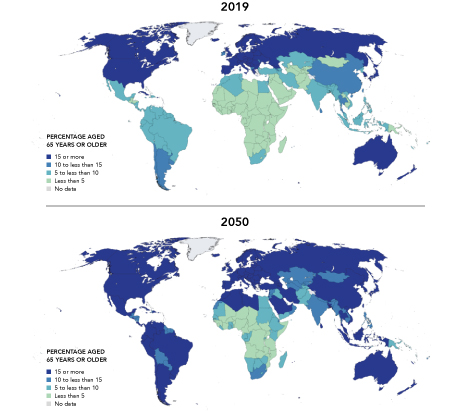
Figure 1: Percentage of world’s population 65-and-older by region – now and in 2050 (projected).
Source: United Nations, Department of Economic and Social Affairs, Population Division (2019), World Population Prospects 2019.
This situation is going to create many opportunities for data and technology aficionados involved in the healthcare value chain. Health information technology and rapid development of digital health solutions will be key drivers for the new era of healthcare in India. In 2018, India’s government announced a Medicaid-like insurance program called Ayushman Bharat or National Health Protection Scheme to cover 500 million underserved populations in the country. According to government estimates, about 300,000 people were brought under the program within 10 months. In a recently published digital health blueprint for India, the health ministry outlined a plan to bring a widespread data infrastructure to India, including rapid deployment of electronic health record systems, health information exchanges, health data clouds and personal health record apps.
It is an extremely ambitious plan with borderline unrealistic timelines in my opinion, but the vision is extremely admirable and broad. In the United States, where a unique, national-level, master-patient index could not be built around Social Security numbers due to privacy and security concerns, the dream of a national health information network remains largely unrealized. In contrast, India is planning to build its Master Patient Index by piggybacking on the Unique Identification Number (also known as Aadhar or Foundation in Hindi) infrastructure. Over the past 10 years, India has successfully rolled out the Aadhar number to the people and tied various government-run services to this number for identification. About 99 percent of the adult population of India is now enrolled in Aadhar. While more work is necessary to make the aforementioned digital health blueprint realistic from the implementation standpoint, this surely adds momentum toward driving digital healthcare in India.
Opportunities for Analytics and AI
With such large-scale initiatives, opportunities for analytics are also growing in India. With the ambitious plan to roll out the world’s largest safety net insurance scheme like Ayushman Bharat, the government acknowledged that the cost of fraud would be very high. In a country where corruption is rampant, government authorities will have to implement stricter enforcement measures aimed at preventing abuse of the insurance fund. According to the government, a sophisticated insurance fraud detection analytics solution or artificial intelligence platform is already being used to track down providers who are trying to file fraudulent claims for specialty care or hospital care services. According to reports, 48 hospitals in the country were given show-cause notices and 32 were suspended from participating in the program.
As the scope of the insurance program expands to catch more underserved people, it remains to be seen how the model of checks and balances scale. However, it is exciting to see analytics used for such an impactful initiative. The amount of transactional data that the program is generating would be immensely helpful in creating tools for broader public health management and monitoring disease prevalence in the future.
I am hopeful that more such use cases for analytics will be found in the near future, and government-private partnerships will grow beyond the nascent stage. Insurance is a relatively new phenomenon in India, therefore tremendous opportunity exists in that space. Thoughtful and long-term approach is required for implementation, but kudos to the Indian government for trying to implement such a game-changing program.
Rajib Ghosh is the founder and CEO of Health Roads, LLC, a consulting company for enabling digital transformation in healthcare organizations. He has 25 years of technology experience in various industry verticals where he had management roles in software engineering, data analytics, program management, product management, business operations and strategy development. Ghosh spent a decade and half in the U.S. healthcare industry as part of a global ecosystem of medical device manufacturers, medical software vendors, telemedicine and telehealth solution providers. He’s held senior positions at Hill-Rom, Solta Medical and Bosch Healthcare. His recent work includes leading data-driven digital transformation in the public health space, including county-level healthcare agencies and organizations focused on underserved populations.
([email protected])