

December 18, 2019 in Career Builder
How Powerful Writing Changes Lives
Military-analyst-turned-author Carla Bass explains how to present compelling analytics to a nontechnical audience. Hint: focused precision wins!
SHARE: PRINT ARTICLE: https://doi.org/10.1287/LYTX.2020.01.07
“Powerful writing changes lives. Here’s how.”
This simple message propelled Carla D. Bass (colonel, U.S. Air Force, retired) from the analytical ranks to a career as a multiple award-winning author, expert writing consultant, and acclaimed speaker and instructor. The recently released second edition [1] of her book, “Write to Influence!” includes new material on composing input for performance reviews, elevator speeches, reports, grant proposals and even college application essays. This is in addition to chapters on resumes, email and presentations.
Bass advises: “The cardinal rule in all writing is, ‘Know your audience.’ With this insight, you can snag and retain the reader’s attention, communicate in terms appropriate to that audience, and frame a winning argument to gain research funds, defend a budget, secure a contract bid or be selected for a competitive assignment. The goal is to make each word count and every second of the reader’s time play to your advantage. ‘Write to Influence!’ empowers people to open doors to opportunity through the strength of their own written words.”
Did you notice how the lead sentence of this article immediately got your attention and motivated you to continue reading? Bass and I had a similar concept for this article, but she conceived the concise, powerful lead. Her how-to principles are really good. Believe it.

for some well-deserved R&R, between book tours, workshops, consulting,
teaching and speaking engagements.
Born in Texas, and raised and mostly educated in Virginia, Bass describes herself as “a daughter of the Air Force” who lived where her father’s career took the family, and she followed her father into the Air Force. During her military career, Bass commanded a squadron in Hawaii and served as director of intelligence for a major operation in Turkey, as well as an air attaché in Bulgaria. Learning from her experience as a briefer and report writer, she developed and systematized her writing skills during her last 15 years in the Air Force before she retired in 2007. Since 2008, she has worked for the Office of the Director of National Intelligence.
The first edition of “Write to Influence!” was covered in the May/June 2017 issue of Analytics [2]. Since then, the book has been a consistent seller on Amazon and other platforms. It is also a recommended item at the Air Force Academy Writing Center, benefiting both cadets and faculty. “I’m especially proud of that,” Bass confesses.
Bass has been interviewed on many talk radio shows, podcasts and local live television (all available for viewing on the media page of her website [3]). In addition, she has written business-oriented articles for a variety of online magazines.
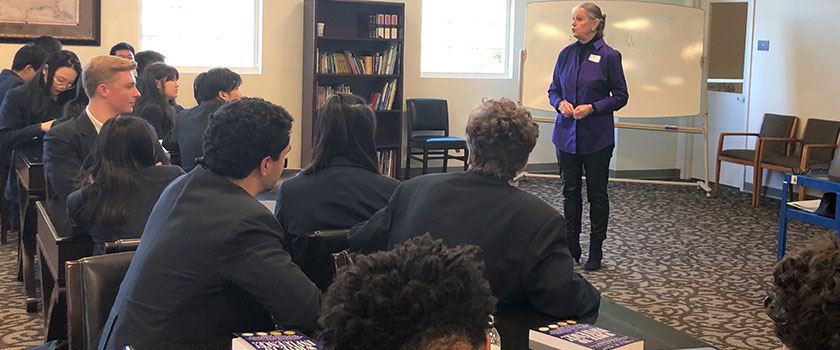
Her workshops, “Powerful Writing for Professionals,” include examples of ineffective writing (which she terms “bureaucratic blather”) based on actual resumes, proposals, marketing materials and other documents. Using her approach of “before, after and analysis,” Bass demonstrates how to transform these poorly written pieces into focused, concise and compelling products. Material she developed for these workshops constitutes much of the new content in the second edition of the book. These workshops range in length from one hour to two full days; clients include government agencies, corporations, private businesses, NGOs and private high schools.
A Secret to Success: Saying “Thanks”
One of the most important lessons from Bass’ workshops is surprisingly simple and often overlooked: how and when to say, “thank you.” She explains, “Both the job seeker and the prospective employer benefit significantly from writing a post-interview thank you note. With this communique, the job seeker demonstrates business etiquette and gains one last opportunity to achieve that competitive edge by reinforcing key points discussed. Those who arrange and conduct the interview appreciate the time invested in this communication. On the flip side, how can your company beat the competition to hire in-demand employees? Sending a note, thanking them for interviewing can help! The message is, ‘Our company values your skills and expertise! If this position doesn’t work, please keep us in mind for future opportunities. We want you on our team!’”
Hiring markets fluctuate between surpluses and shortages of qualified employees. Those who don’t take the time to be considerate when the balance is in their favor are likely to find the going much more difficult when the market swings the other direction.
Bass quickly adds that conveying “thank you” is also a strategic tool to reward outstanding performance, advocate for talented people, and mold your workforce by highlighting individuals whose careers you want to advance. As with other forms of writing, clarity, focus and precision are critical here, too. Specify what the individual accomplished and why the resulting impact was especially noteworthy. Carefully crafted and strategized for the appropriate level of signature, this message could be a powerful item in that individual’s performance review. “The third edition of the book,” she says, “will include a chapter on this topic because it is so relevant to the business community.”
Stand Out from the Crowd: Resumes and Performance Reviews
Many people, Bass observes, are uncomfortable touting their own accomplishments. Why? They consider it bragging. “Imagine you are writing about a stellar subordinate, who deserves a promotion,” she advises. “Then, approach this from an objective, fact-based perspective. Consider questions such as, ‘What did I do? What were my impacts? How did I advance the mission? What difficulties did I overcome?’ Take pride in your success and own it!”
The most effective language for resumes also applies as input for your performance review. Here are 10 of her tips to compose a standout submission:
- Avoid language that sounds like a job description or merely enumerates required skills. “Responsible for” does not equate to actual performance or indicate the quality of your work.
- Eschew vague verbs, e.g., assisted, provided, supported, participated in and contributed to. Not only do these fail to advance your case, they also prompt the question, “What exactly did you do?” … not the reaction you strive to elicit.
- Use descriptive, crisp, action-oriented verbs, e.g., planned, developed, initiated, implemented, briefed, represented, advised, organized and directed.
- Follow each verb with hard-hitting facts that convey impact and value added. If you were specifically selected for a task or commended for it, by whom and with what explanation?
- Quantify your accomplishments. Detail provides the reader a mental yardstick to understand the significance. Did you lead a team – how large and for what duration? Did you give a presentation – to how many people, at what level and what resulted? If you made recommendations, were they implemented and to what effect?
- Highlight awards, bonuses and other recognition that differentiate you from peers.
- Know what not to include. If most people could make similar claims or if the item cited is expected, you’ve placed yourself in the middle of the crowd, not in front of it. “Does what is right and takes personal responsibility” or “committed to delivering quality customer service” are prime examples found in actual resumes.
- Be consistent in opening words for listed items. When using verbs, maintain the same voice, i.e., singular or plural (“composes” versus compose) and tense, i.e., present or past (such as composes versus composed).
- Write clearly. Avoid run-on sentences, ill-defined terms and unexplained acronyms. Purge words that contribute nothing to the message. Use language appropriate to the reader. Technical jargon will suffocate your message if nontechnical people are evaluating this product. Conversely, lengthy nontechnical explanations are neither effective nor engaging if the audience is technical.
- Revise, edit and proofread. Sloppy writing will torpedo the opportunity you seek. Note punctuation, capitalization, parallelism, subject-verb agreement and duplication. Ideally, have someone else also review your document.
Technical Reports and Briefings
Of course, many readers of Analytics produce technical reports and briefings – maybe lots of them. The above-mentioned guidance about clarity, focus, brevity and quantification applies to these, as well. Here are some additional tips:
Develop the message by asking the key questions. Who is the audience? How familiar are they with your subject matter? What do they need to know? What is the goal of your briefing? Is it intended to prompt a decision or just to convey information? If it’s informational, how can the audience apply it? If the briefing was assigned to you, what does your boss expect you to accomplish? How much time do you have for the presentation?
Assemble your material, taking care to bring the audience along with you, step by step, from the problem description to your proposed solution. Delete distractors from the main focus. Many speech coaches recommend writing your conclusion first, as audiences at briefings tend to remember best what they heard last. Build to that conclusion. It is also wise to consider what you would delete – quickly! – to lead to the same conclusion if you suddenly discovered you had much less time than anticipated to deliver the briefing. Bass refers to this as “triaging the information.”
In preparing slides, conserve both space and time. One minute per slide is a good guideline for pacing. Avoid slides crammed with text and detail; display a few main points in short, crisp, single-line bullets – in a type size easily read. Substantiating detail belongs in the notes, not on the slides.
Graphics, too, need to be simple and clear. “Turkish carpets are beautiful,” Bass notes. “The intensity of color, depth of detail and complexity of design all relate to the number of knots per inch and add to its intrinsic value. But you’re not creating a Turkish carpet. Intense, complex graphics detract from your presentation.”
Engage the audience. Talk to them, not at them. Move around if you can do so without losing connections to the microphone or to the mechanism to advance slides. Observe their reactions and respond.
As with writing, it is helpful to have your material reviewed by others. In this case, however, having people view and listen to the briefing is much more relevant and valuable than having them read your text. It also affords you the opportunity to rehearse and become comfortable verbalizing the information.
This reporter would add, again, that having others read (or view) and comment is extremely helpful. They, perhaps, are better able to detect if the product includes terms inherently familiar to you but alien to the audience. A word of caution is in order, though, especially for technical writing: ensure that any editor or commentator you engage knows the difference between confusing jargon and your field’s terms of art. For example, in writing about applied probability, “event” has a very specific mathematical meaning. Having an editor change two-thirds of the appearances of this word to “occurrence” or “what happened” is not at all helpful. For knowledgeable readers, “This is a non-homogeneous Poisson process” replaces about two pages of nontechnical prose. However, don’t do this without some reference to a technical appendix or published source that the nontechnical reader can consult for an explanation.
Powerful writing often tips the balance between success and failure. Analysts who want their recommendations adopted and their work appreciated would do well to learn how to “Write to Influence!”
References
- Carla D. Bass, 2019, “Write to Influence!” (second edition), Marshall, Va. For further information visit: www.writetoinfluence.net.
- Douglas A. Samuelson, 2017, “The Write Stuff: New book explains how to present analytics to a nontechnical audience,” Analytics, May-June.
- https://writetoinfluence.net/
Elevator Speeches
The term “elevator speech” or “elevator pitch” has come into widespread use in the business world. The idea is straightforward: You are in an elevator with a major prospect, you have perhaps 30-60 seconds to describe what you offer and why he or she should care. What would you say? Developing an arsenal of short, high-impact presentations has many applications.
Bass’ checklist:
- Strategize your message. Focus on the benefit to the customer, not your product or cause. State the challenge you think the prospect faces, the consequence, your solution and the benefit.
- Hone your draft. Bass’ elevator speech, for example, is: “Powerful writing changes lives! It is also the lifeblood for successful organizations. ‘Write to Influence!’ teaches people to compose text – clear, concise and compelling – to beat the competition and achieve their goals.” That’s 32 words.
- Engage quickly. Rehearse your speech until it flows naturally, then pitch it at every opportunity. Even strangers in a checkout line may be prospects or know someone who is. “When someone asks how things are going,” she says, “don’t waste that opportunity by just saying ‘fine.’ Instead, leverage that moment and reply, ‘Great! My product is selling!’ or ‘I just won a contract!’ People enjoy good news; they’ll want to know more … and you’re happy to share!”
This reporter happens to know of an analyst-turned-entrepreneur who attended a trade show many years ago and was introduced to the marketing manager of one of his fledgling company’s biggest competitors. The analyst had the good sense to say, “Nice to meet you. Thanks for taking the time to chat with me about the features we offer. While we may be competitors now, perhaps we might partner in the future. Let’s stay in touch.” The phone call came less than a month later: “We can’t fill an order. Can you help us?” This turned into a $3 million deal.
– Doug Samuelson
Douglas A. Samuelson is president of InfoLogix, Inc., a consulting company in Annandale, Va. Samuelson worked as a paid campaign staffer in a U.S. Senate campaign in Nevada in 1970, as a county coordinator in a gubernatorial campaign and targeting analyst for a local campaign in California in 1974, and as a Federal Civil Service policy analyst from 1975 to 1982. He has been a longtime contributor of columns and articles to OR/MS Today and Analytics magazines.
([email protected])