

March 26, 2020 in ReCAP
ReCAP: Lisa Fox Sembach
SHARE: PRINT ARTICLE: https://doi.org/10.1287/LYTX.2020.02.11r
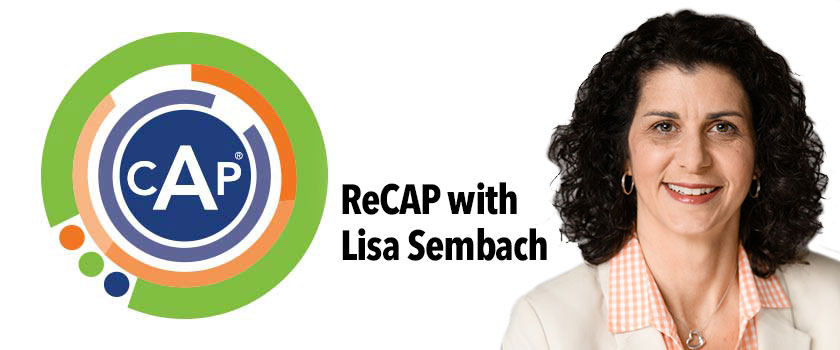

Name: Lisa Fox Sembach
Employer: Clemson University
Job Title: Strategic Data Manager
Primary Job Functions: I serve as a liaison between the Graduate School and the Office of Institutional Effectiveness to develop, analyze, and deliver institutional data and insights in support of the mission and vision of senior leadership within the Graduate School at Clemson University.
Date CAP Certification Was Earned
September 2015, and I recertified in September 2018.

Why did you become a CAP?
I had been out of school for almost two decades and wanted a way to take stock of the analytical skills and knowledge that I had been honing during my career.

How familiar were you with the “Seven Domains of Analytics Process” prior to pursuing CAP?
I was familiar with all of them but had more experience with some over others. I really appreciate that CAP encompasses the full analytics process, and not just the quantitative components. One of my former managers emphasized the importance of business problem framing, and we devoted training sessions to this skill. This was truly time well spent since the subsequent steps in the process can lead to ineffective analytics if the problem is not framed correctly.

What was your most valuable resource while preparing for the exam?
I certainly leveraged the handbook and study guide extensively. For me, being able to attach real-life examples to the different situations or techniques is crucial. I reached out to coworkers who I knew had specific experiences in the different types of analyses. This helped me build a story around the things with which I was less familiar. In this vein, and with the support of senior leadership and advocacy of our chief data officer at Clemson, I facilitated a CAP cohort last fall. We brought together 10 staff members who wanted to become CAP certified and we worked through the domains, which often included discussion of real-world experiences. Our first person to test was certified last October and we have more and more testing now.
Do you think that earning aCAP is important for students?
I think is it important because it can provide sort of a capstone to their education and set the stage for their future work experience. The certification itself lends credibility to knowledge and skill in an area where many are attempting to call themselves analytics professionals. It also lays a solid foundation that can help guide further professional development.
How could we promote CAP and the importance of being certified to students?
Data! I think anywhere you can show the connection between CAP (or aCAP) and getting opportunities as a result is very powerful. I also think there’s value in partnering with specific higher ed programs and/or companies who rely on these skills. The cohort model combined with the group pricing that is offered provides a win-win-win for CAP, individuals, and organizations.
I think we’ve all witnessed the power of good data and robust analytics lately with COVID-19. It’s probably safe to say that a broader portion of the general public is now looking at data and predictions more so than ever. Clearly, there is a need for people with strong skills in these areas and we can easily see what could happen as a result of incorrect data, analyses, or insights getting widely distributed. This only emphasizes the need to be able to assess analytics capabilities quickly and reliably.
SHARE: