April 10, 2020 in Supply Chain Disruptions
Today’s supply chain challenges require new solutions
New technologies are needed to build resilience in the face of disruption such as the COVID-19 pandemic.
SHARE: PRINT ARTICLE: https://doi.org/10.1287/LYTX.2020.03.02

Supply chains are interrelated, global ecosystems. While this delivers tremendous value in terms of connectivity and access, it also amplifies the inevitable risks that uncertainty brings. On an ongoing basis, supply chains experience challenges in terms of product recalls, shifting stocks, plant shutdowns and many others. Although there are many drivers behind these challenges, the underlying force that makes addressing them difficult is how sudden they are. Pandemics like COVID-19, political trade barriers or natural disasters send a shockwave through supply chains that leave businesses desperately searching for immediate solutions.
Furthermore, as these ecosystems continue to evolve in size and complexity, visibility across the value chain and through supplier tiers decreases. Hence, a setback for a low tier supplier often has a ripple effect downstream, which might only be felt months later. Shifting demand signals also pose a threat upstream, as misreading them could create a bullwhip effect. When shoppers decide to hoard all the toilet paper, they send a signal through the toilet paper supply chain to produce more. If companies produce more, extra inventory is pushed into the distribution channel. Inevitably, demand reverts to the mean, and when it happens, stores find themselves overstocked since customers are still exhausting their previous purchases.
The chaotic nature of disruptions means that many of these problems often get overlooked. Impulsive decisions, like ramping up production capacity to meet rising toilet paper demand, are detrimental without taking the full picture into account. Advanced supply chain planning tools aim to provide a holistic picture, by considering all the variables and constraints that make up the supply chain. Unfortunately, as we currently stand, research tells us that supply chain teams are not prepared for such planning, and managers often “lack clear guidance” on how to prepare for situations like a global pandemic. The tools currently in use may contribute to this lack of readiness.
Supply Chain and Spreadsheets
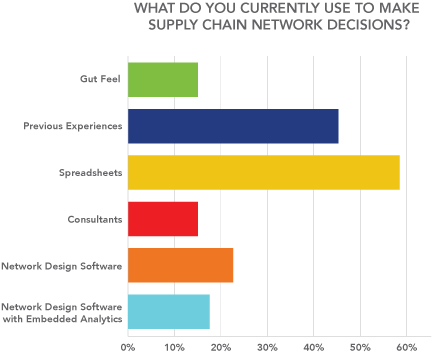
Research carried out by AIMMS shows that nearly 60% of companies still use spreadsheets for supply chain network assessments. Many others use gut feel or previous experience to make supply chain network decisions, as Figure 1 illustrates. Nearly 60% of professionals indicated that they did not use some form of advanced analytics to support their network design process. This may explain why it takes so long to address network disruptions.
Almost 40% of respondents answered that it took weeks or days (30%) to address emerging network-related questions. Only 13% found the answers they need in a matter of hours. Interestingly, more than half of the survey’s respondents use network design for project work or on a periodic basis. Only 26% of supply chain professionals stated that they use network design as part of an ongoing effort, and 18% leverage it for tactical planning on a monthly basis.
What the research shows is that most companies are not being proactive enough to address disruption. A surprising few are ready to react quickly when issues come up. For many, getting answers takes far too long.
AIMMS also investigated the current challenges teams experience with demand forecasting. In a recent survey, 31% of respondents stated that demand forecasting was an “extremely important” part of their business planning process.
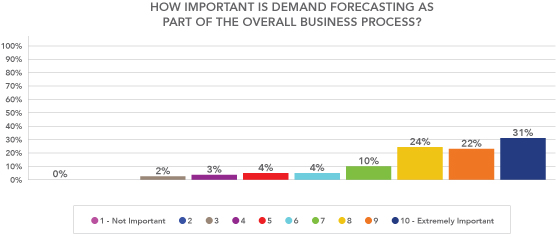
Yet, only 2% of respondents were “extremely satisfied” with their current levels of forecast accuracy.
At an item level, many organizations are seeing a margin of error of 20%-40% in their demand forecasts. What are they using to forecast demand? According to the survey, 39% of respondents stated that they use spreadsheets, followed by 30% who use a specialist forecasting package and 23% that use bundled ERP functionality.
Dissatisfaction with spreadsheets is understandable. Spreadsheets are error-prone, difficult to collaborate on, and they make version control tedious. But why is it that companies that use specialized tools are not highly satisfied by their use? Although emerging technologies and analytics aim to provide prescriptive solutions, time to value remains a big obstruction. Implementation can take a very long time – rendering quick, reactive decision-making useless. Even when technologies are implemented and available, many tools are too complicated and not intuitive for the average supply chain user. This acts as a major barrier for businesses trying to be resilient, since the number-crunching and complex optimizations are not being seamlessly translated into prescribed, realistic solutions. So, what can supply chain teams do to remedy this?
Solutions That Deliver Resilience
Investing in resilience can lead to supply chains that quickly respond and recover from costly disruptions. As Gartner states, “resilience is at the heart of current supply chain management thinking, and understanding the concept, and where to invest in resilience, can lead to supply chains that quickly respond to and recover from costly disruptions.” Such analyses should provide visibility across the entire supply chain and enable users to plan both reactively and proactively. In other words, businesses should look for technologies that put them in the best position to take immediate reactive actions if disruptions do occur.
According to the study, 39% of supply chain professionals found that network optimization enabled them to become “more proactive and less reactive in network decision-making.” An additional 22% found the biggest benefit to be “getting more transparency across their network.” Proactive planning is a result of evaluating multiple future uncertainties, such as politically imposed tariffs or natural disasters. The visibility, on the other hand, is achieved by creating a digital twin of the network where the effect of these uncertainties can be seen on every element of the supply chain including warehousing, suppliers, transport and customers.
In one such analysis, we studied how the utilization of different distribution centers (DCs) and cross-docs changes over time as an epidemic increases demand for certain products by 5% in year one, 10% in year two and 20% in year three. While most warehouses experienced the same, or slightly increased utilization as the years progressed, one of the DCs saw its production double. A resilient supply chain leader might recognize the strategic importance of this warehouse and begin ramping up its capacity to ensure that future disruptions can be dealt with.
Reactivity comes on a more tactical and operational level, but its full potential can only be exploited if the right structure has been set in place. For instance, an unexpected breakdown in a company’s plants caused a serious production issue that resulted in some production lines being shut down. Using sales and operations planning technology with embedded prescriptive analytics, they could swiftly simulate the impact of reduced production on their supply chain. By dynamically adjusting capacities and utilizations within the application, they were able to optimally reallocate volumes and develop a new production and distribution plan. All of this was done within an hour, with the management team interactively reviewing multiple scenarios during a meeting – an activity that would have previously taken them at least 24 hours with more cumbersome and less interactive tools.
We live in an unpredictable environment and cannot control many of the events that affect our businesses. However, we can certainly equip ourselves with the right tools and technology to make our supply chains more resilient. Designing a flexible supply chain and evaluating multiple scenarios not only reduces the risks posed by events like the COVID-19 outbreak, but also helps businesses leverage the strategic competitive advantages that resilience and preparedness provide.
Aanand Pandey is a supply chain analyst and consultant at AIMMS. He has a background in both engineering and supply chain studies, as well as practical experience in business and programming. Pandey has an MIT Graduate Certificate in logistics and supply chain management, and a master’s degree in supply chain and logistics from the University of Luxembourg. Gloria Quintanilla is a senior communications specialist at AIMMS. She writes regularly about supply chain transformation. Quintanilla has a bachelor’s degree in anthropology from Hamilton College and a master’s degree with a focus on social transformations from Vrije Universiteit Amsterdam.