April 21, 2020 in Coronavirus Chronicles
Defense Budget Post-COVID-19: Hard Questions Need Answers
SHARE: PRINT ARTICLE: https://doi.org/10.1287/LYTX.2020.03.04

As the impact of the COVID-19 pandemic continues to unfold daily, one thing remains certain – leaders within government will be faced with difficult choices concerning future discretionary spending, both in terms of topline amounts and internal departmental priorities. The sirens calling for a reduction in defense spending have already begun. The Pentagon’s $740.5 billion budget request for fiscal year 2021ill certainly be subject to scrutiny given the tremendous upheaval in both the public and private sectors.
Given the recently signed $2.3 trillion stimulus package – and the likelihood of more to follow – now is the time to consider what the post-COVID-19 fiscal landscape will look like for the Department of Defense. Heeding lessons from the past – including the last economic downturn and subsequent period of sequestration and budget caps – leaders should be prepared to make difficult choices. Anticipating these changes will give the department time to consider priorities for future spending and the likely austerity that lies ahead.
The notion of a “peace dividend” is often used to describe the cyclical nature of U.S. defense budgets, marked by a sharp decrease in real defense spending after conflict ceases. Conflict spending increases deficits, which has consequences on other parts of the budget and results in future downward pressure on defense spending and cyclical, significant reductions. Ranging from a 16% decline following the Korean War to a 34% decline at the end of the Cold War, cyclical reductions in defense spending have historically been significant. Many analysts and leaders have compared the COVID-19 pandemic to a war – except instead of fighting against another nation, we are at war with nature.
The financial approach to the COVID-19 pandemic has distinct differences from previous wars the U.S. has fought. Unlike a “peace dividend” that is reaped and distributed after crises has peaked, the nature of this pandemic has forced a general economic stimulus upfront – during the crisis – to prevent future economic hardship. In other words, COVID-19 has forced the United States to borrow the peace dividend in advance and committed it to a financial strategy that will return the payment. This dividend will come due at some point, so now is the time for leaders to consider the tough fiscal choices they will certainly face.
A New Topline
While it is difficult to name a precise figure while the pandemic rages, historical data can serve as a guide to make informed predictions (see Figure 1).
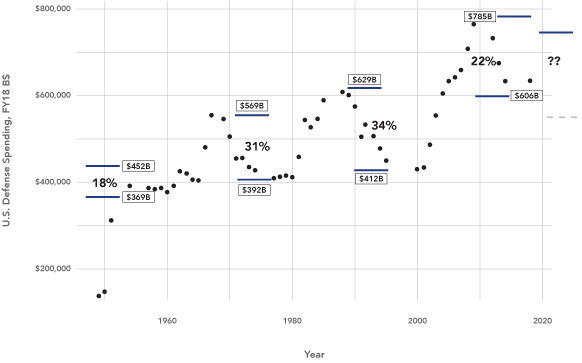
Figure 1: Defense budget upswings and dividends, 1949-current. Each dividend is taken from “peak” to “trough”; the average drop is 26% over a period of years.
Source: Data from SIPRI.
Defense spending is currently somewhere between a peak and a valley. Predicting its trajectory is like a blind man riding a roller coaster; he knows that he is going up or down but cannot tell when the current trend will end.
Therefore, applying historical drops – an average correction of 26% – to both the recent peak ($785 billion) and current budget, we estimate that the trough in defense topline post-COVID-19 will be between $540-$580 billion annually.
Post-COVID-19 Spending: Hard Choices
Ironically, the drop in topline budgets may not be the driver for hard decisions in defense spending. Instead, this pandemic will impact all aspects of American society, including what is expected from the military. Based on historic trends, it is reasonable to believe that spending on manpower will remain constant or continue to rise. However, congressional leaders – as well as the American public – will likely change what they expect from their military, focusing and expanding upon the traditional notion of “homeland defense.”
The American public and Congress will most certainly review the capabilities – hospital ships, engineering, medical workers, supply chains and transportation – that have been highlighted during this pandemic. These could be viewed as more necessary military capabilities post-COVID-19 than they were beforehand, taking a larger slice from a reduced defense budget pie.
Some high-end, “boutique” systems in development may be traded for more traditional capabilities. The Department of Defense needs to balance these expectations while continuing to man, train and equip a force capable of fighting and winning the nation’s shooting wars. What capabilities along these lines should be prioritized? The budget environment before COVID-19 all but assured that service priorities along the lines of 355 Navy ships or 386 operational Air Force squadrons were unaffordable. The fiscal environment ahead will increase the need for leaders to make well-thought-out strategic choices.
The Way Forward: Answer the Hard Questions First
With a reduction of resources of this magnitude on the table coupled with the changes that will be wrought from the pandemic, our current strategies and priorities will need to be seriously revisited – and quickly. This implies a review of the National Defense Strategy (NDS), which needs to happen before serious money is spent. The “hard questions” are:
- What will the role of the U.S. military be vis-à-vis support to the homeland in a post-COVID-19 world?
- How will the U.S. selectively reprioritize – and implicitly deprioritize – existing missions and capabilities?
Answering these questions will be hard and take time. Given the magnitude of post-COVID-19 challenges, the entire defense community needs to immediately think about the answers.
Harrison Schramm, CAP, PStat, is a senior lecturer at Naval Postgraduate School, splitting his time between Defense Management and Operations Research where, in addition to teaching, he runs the Contested At-Sea Logistics Lab (CASLL). He served as the inaugural chair of the INFORMS Security Conference and is a past president of the INFORMS Analytics Society. Kevin Chlan is the 2019/2020 Navy fellow assigned to CSBA as part of the Federal Executive Fellowship program. He is an active duty Navy commander with more than 19 years of service. As an F/A-18 Super Hornet pilot, Chlan recently commanded Strike Fighter Squadron Three One, where he deployed in support of Operation Inherent Resolve. In seven prior deployments, he participated in various exercises in the Western Pacific, Middle East and European theaters, as well as Operations Enduring Freedom and New Dawn over Afghanistan and Iraq. He has led more than 75 combat missions in the F/A-18. He holds an executive MBA from the Naval Postgraduate School and a bachelor’s degree in systems engineering from the U.S. Naval Academy. Peter Kouretsos is an analyst at CSBA, where his work focuses on U.S. defense policy and strategy, long-term competition, future warfare and Western Hemisphere security. Prior to CSBA, Kouretsos was a research assistant at the Philip Merrill Center for Strategic Studies and served in the Office of the Undersecretary of Defense for Policy’s Office of Strategy & Force Development. He has written for Defense One, Small Wars Journal and Strategy Bridge. He holds a master’s degree in strategic studies & international economics from Johns Hopkins School of Advanced International Studies and a bachelor’s degree in history from Loyola University Maryland.
([email protected])