

April 21, 2020 in Healthcare Analytics
COVID-19: A pandemic that humbled the human race
SHARE: PRINT ARTICLE: https://doi.org/10.1287/LYTX.2020.03.08

What a painful difference a couple of months can make! In the March/April issue of Analytics, I wrote about the emergence of a respiratory novel coronavirus that took China by storm. At that time no one knew the extent of global damage it would create for the human race in the next few months. There was widespread expectation within the World Health Organization (WHO) that the virus, like the Severe Acute Respiratory Syndrome (SARS) virus of the late 1990s, would remain contained within China. Little did we know that this time human civilization would be put to the utmost test of tolerance and misery at lightning speed.
It is incredible how much our world changed since the end of February. Streets of major cities such as London, Madrid, Milan, Paris, New York and San Francisco are all but empty. The world has suddenly come to a standstill, and humans worldwide have receded to the safety of their homes. Economic activities took a nosedive, stock markets crashed, and unemployment and misery rose to depression-era levels in most nations including the United States, Europe and China. An invisible enemy suddenly created a war-like pandemonium across the globe, but no nuclear weapon can end the war this time.
Powerful Blow to the Human Race
As of this writing, more than 2.2 million people globally have become infected by the virus, and close to 153,000 people have died in 185 countries (based on data tracked by Johns Hopkins University). Some experts believe that the numbers are grossly underreported, owing to various issues including not enough testing and people dying in nursing homes or their own homes due to this disease without being counted. These are mind-numbing statistics – both in terms of the scale of this pandemic and the impact (all but 10 of the 195 countries in the world have been affected). By the time this column is published, the numbers will be much higher. The United States has emerged as the epicenter of this pandemic with more than 700,000 confirmed cases and 33,000 deaths. The White House Coronavirus Task Force projects that the U.S. death count will climb to more than 68,000 by August. If there is a second wave in the fall, the numbers will be even higher.
To put this in perspective, during the SARS outbreak 8,098 people were affected globally and 774 died, and only eight laboratory-confirmed cases were reported in the U.S. with just one death. During the 1918 Spanish flu (H1N1 virus) pandemic, worldwide about 500 million people were infected and at least 50 million died. In the U.S. alone, 675,000 people died in absence of an antiviral cure, vaccines, ventilators and antibiotics required to treat secondary infection. This was the deadliest pandemic in recent history, but 100 years ago neither medical science nor medical device engineering was advanced enough to prevent such a fast propagating virus. COVID-19 has not reached that level yet, and hopefully it never will, but the disease is still unfolding, and it will be many months before it stops.
Origin of the Virus
Many theories are now circulating on the Internet regarding the origin of the virus, some of which are outright conspiratory. We know so far that it originated in Wuhan, China, during the winter of 2019. Wuhan’s wet market where exotic wild animals are sold as food and medicine was identified as the likely culprit. One theory suggested that the virus came from bats and was transformed into its current genetic makeup while inside another animal host such as a pangolin. Other theories suggested that the virus originated in a virology lab in Wuhan when someone was accidentally infected and infected others. Others theorized that the Wuhan lab produced a synthetically developed virus that was accidentally leaked into the populace, albeit the evidence so far heavily supports its natural origin. And some theorists went even further, suggesting that the WHO not only bungled its early response to the virus, but it had a hand in creating the crisis along with China.
Regardless of where the virus came from, the key right now is to find solutions to deal with it so that as a human race, we can emerge stronger and better from the global crisis. In the first phase of this war, several global leaders didn’t take the threat seriously. As a result, measures were not immediately put in place to flatten the infection curve and shore up healthcare facilities with equipment, protective gear, additional frontline people and testing capability. No country can do this alone; we need global organizations such as WHO more than ever. We all need to collaborate with transparency of data and information at a rapid pace rather than hiding things under the rug. In the end, no country is immune to a pandemic. David and Goliath both would fall when there is no mutual and fact-based collaboration to prevent a pandemic from wreaking havoc.
Data and AI: Key Tools in the Fight
Tracking a pandemic is all about data and epidemiological modeling to answer what is expected, when and where. We have made rapid advancement in processing big data faster than ever before and applying artificial intelligence (AI) software to determine potential disease prevalence, early disease cluster determination for rapid intervention and finding cures faster. Google’s DeepMind team, in collaboration with the Protein Data Bank and Benevolent AI teams, have helped virology researchers by very quickly identifying a handful of proteins that form the inner layer of the COVID-19 virus, as well as drug researchers at Eli Lilly to enter a randomized control trial of a cure faster than ever before.
China’s use of facial recognition is not without controversy and privacy intrusion, but the technology has been used to quickly identify people with fever or identify potential cohorts with travel history in virus hotspots. This helped the Chinese government to quickly quarantine potentially infected individuals even when they were not showing symptoms. Whether such invasive technology can be used in more democratic Western countries remains to be seen. At the moment, these countries, their leaders and citizens are faced with this dilemma: what comes first? Privacy or taming a public health crisis that can save lives and stabilize toppling economies? Can we do both or do we have to sacrifice one for the other?
Path to Recovery: Health and Economy
The International Monetary Fund (IMF) has projected that while in 2020 global GDP will have a 3% contraction, it will swiftly turn a corner by spring 2021, jumping to a positive 5.8% growth (see Figure 1). As of this writing, this looks like a fairly optimistic projection, especially because the vaccine for COVID-19 is still 12 months away from hitting the market for use on the general population and possibly 18 months before production and distribution can catch up with the goal of vaccinating a large percentage of the global population. Recently, the IMF announced that if the pandemic doesn’t recede in the second half of 2020 then the global GDP can fall by another 3%.

Figure 1. Global GDP growth forecasts before and during the COVID-19 pandemic.
Source: https://www.statista.com/
The IMF has also released projections for country-specific economies. A sharp decline happened owing to the lockdowns of all economic engines – most factories, airlines, other travel and entertainment businesses, restaurants, bars and retail stores. But there is no fundamental issue with the economy, so expectation is that once businesses are allowed to get back to normal, then the economies will also recover quickly and possibly end up at a better place with higher GDP growth.
Many assumptions are made in such forecasts that if proven untrue might change the growth trajectory. For example, the projection assumes that the world will find a vaccine by spring of 2021 or sooner. What if that doesn’t happen as predicted? Will people worldwide be able to defy the health risk in the fall and winter later this year, come out like before and crank up the economy? What happens if testing and contact tracing do not happen at scale and therefore a sudden surge happens leading to more lockdowns like what happened in Hong Kong, Taiwan or Singapore?
If the world leaders open up their economies in a staggered manner, which industries will snap back immediately, and which will be the laggards? I think more analysis from the early experiences of China and South Korea are needed to derive a more acceptable predictive model. I am sure data scientists at the IMF, World Bank and other world-leading financial organizations are already crunching numbers and doing scenario planning (see Figure 2).
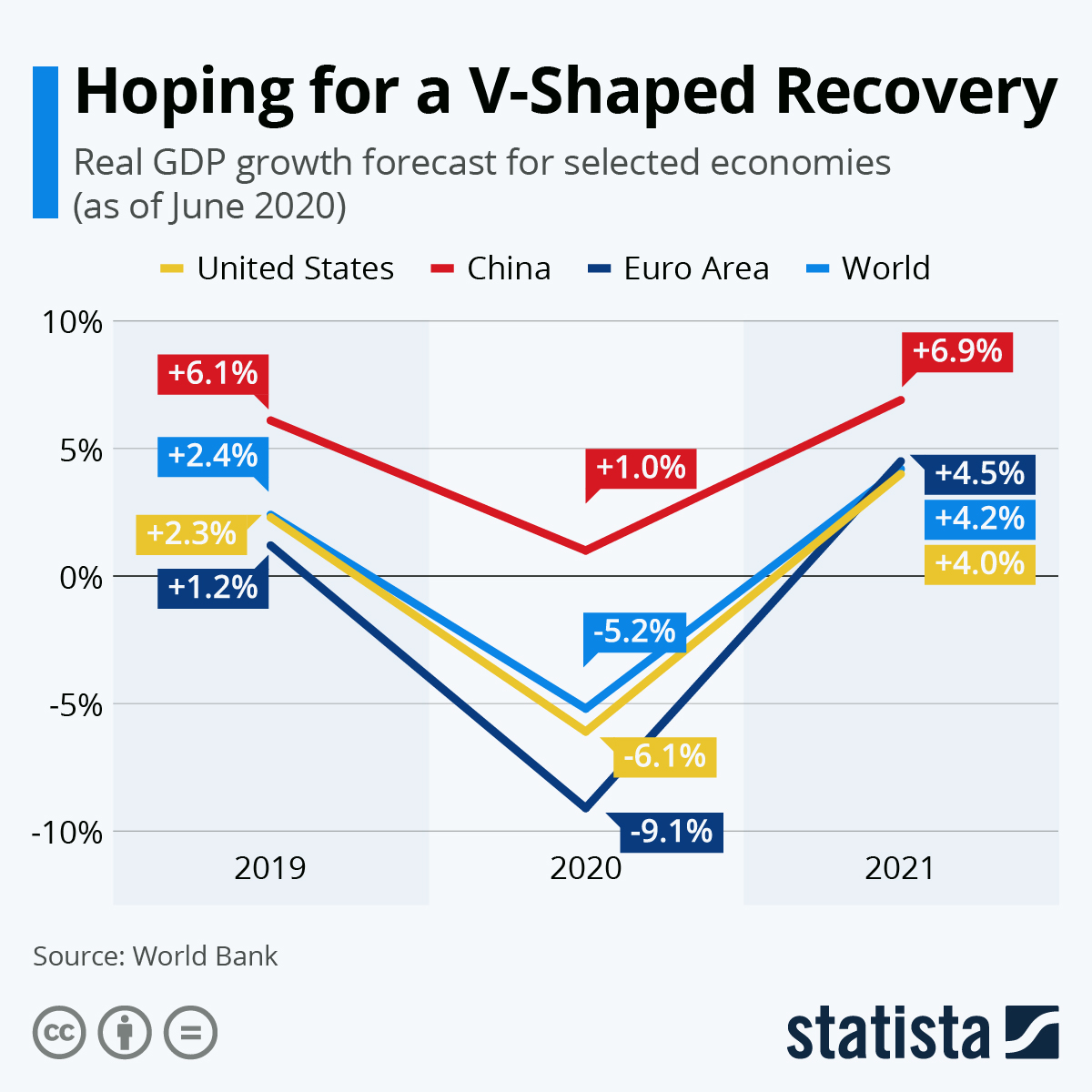
Figure 2. GDP growth forecast for selected economies (as of April 2020).
Source: https://www.statista.com/
I would like to end this article with some rays of hope. We will get through this. Despite grim news about infection, unemployment and death, this pandemic has taught us to reconnect again with fellow human beings on a different level. People of all ages distanced themselves socially but didn’t get lost in social isolation. Countries with populations so polarized that unification was once thought unthinkable are now rethinking their outlook. In a recent article, Robert Shmerling of Harvard Health Publishing wrote that legislation once thought impossible, such as paid sick leave and paid family and medical leave for some workers, was passed with bipartisan support once people realized that the true heroes of the crisis include minimum-wage workers who keep countries moving, as well as the healthcare workers who are willing to sacrifice their lives to care for the sick.
We see that appreciation happening worldwide, from Italy and Spain to the United States and India. Suddenly, a large number of financially well-off people around the world, including film, music and sports celebrities, found themselves facing the same fate and experiencing the same restrictions as the less fortunate. This sameness has suddenly made us more global, humbler and hopefully less nationalistic. I sincerely hope that as we march toward normalcy later in the year, we don’t forget this experience or this realization of sameness and continue to exhibit our humane spirit to make this world a better place to live.
Rajib Ghosh is the founder and CEO of Health Roads, LLC, a consulting company for enabling digital transformation in healthcare organizations. He has 25 years of technology experience in various industry verticals where he had management roles in software engineering, data analytics, program management, product management, business operations and strategy development. Ghosh spent a decade and half in the U.S. healthcare industry as part of a global ecosystem of medical device manufacturers, medical software vendors, telemedicine and telehealth solution providers. He’s held senior positions at Hill-Rom, Solta Medical and Bosch Healthcare. His recent work includes leading data-driven digital transformation in the public health space, including county-level healthcare agencies and organizations focused on underserved populations.
([email protected])