

May 4, 2020 in Data Analytics
The ABCDEs for Digital Transformation, But Don’t Forget the FGHIJs!
SHARE: PRINT ARTICLE: https://doi.org/10.1287/LYTX.2020.04.02
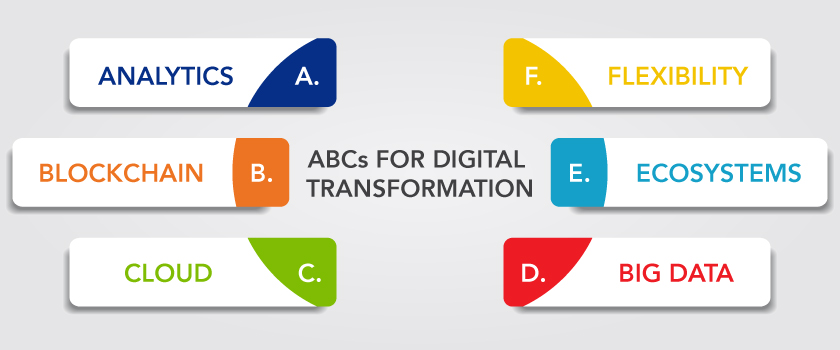
In today’s environment, organizations need to embrace digital transformation for survivability in the years ahead. We can think of this as the ABCDEs.
The “A” is for artificial intelligence and analytics. The era of cognitive computing, deep learning and machine learning is upon us. China wants to be the leader in AI by 2030. The Institute of Electrical and Electronics Engineers (IEEE) predicts that 75% of cars on the roads in the world will be autonomous by 2040. The Automated Vehicles 4.0 report, “Ensuring American Leadership in Automated Vehicle Technologies,” written by the National Science and Technology Council and the U.S. Department of Transportation, was published in January 2020. It highlights protecting users and communities, promoting efficient markets and facilitating coordinating efforts.
The “A” also refers to analytics. We can’t find enough data analytics and data science professionals to keep up with the demand for handling complex decision-making. Even with more than 100 master’s degree in analytics programs created within the past few years, we will still experience a shortage in this data-driven or data-informed environment, particularly in such areas as healthcare analytics.
“B” is for blockchain: According to Warburg et al. [1] in their book, “Basics of Blockchain,” blockchain is a decentralized database that coordinates agreement on an append-only history of transactions across a peer-to-peer network. Others have referred to blockchain as “distributed ledgers.” Asset tracking and identity management are excellent use cases for blockchain. Through using blockchain technology, we can efficiently track assets such as food, pharmaceuticals, artwork and land all the way from the producer to the consumer [1]. In addition, “self-sovereign identity” is an emerging area of blockchain innovation where the attributes about you are written and stored once but referenced as many times as needed without necessarily sharing any such information publicly [1].
“C” is for Cloud, Internet of Things, 5G communication. According to IDC [2], by 2021, over 90% of enterprises worldwide will rely on a mix of on-premises/dedicated private clouds, several public clouds and legacy platforms to meet their infrastructure needs. Mixed in with these communication trends is the Internet of Things (IoT) for Internet connectivity into everyday objects and physical devices. Smart homes, elder care, etc. use IoT technologies. And what we are also seeing is 5G communication referred to as fifth-generation wireless (5G). McKinsey [3] predicted that in 2020, the U.S. will see operators begin running out of capacity in at least 50% of the sites.
“D” is for big data: As we know, many organizations are drowning in the 4V’s of big data: volume, velocity, variety and veracity. Others have expanded the 4V’s to 7’s, adding variability, visualization and value to the big data characteristics. To compound this issue, the mantra is that about 80% of the data is unstructured, and only 20% is structured. Thus, organizations need to harness and leverage both unstructured and structured data to make informed decisions. Some businesses describe big data as 4M – make me more money!
“E” is for ecosystems: According to Investopedia and the CIO-Wiki.org, a “business ecosystem” is the network of organizations – including suppliers, distributors, customers, competitors, government agencies and so on – involved in the delivery of a specific product or service through both competition and cooperation. According to Gartner [4], organizations need to think about strategy, relationships and value exchange when considering digital ecosystems.
Ethics and Privacy Issues
The ABCDEs of digital transformation, as highlighted above, can be quite disruptive. We need to be “data-informed” (versus strictly data-driven) and also apply our experiential learning through intuition-based decision-making [5,6]. We also need to take a closer look at the ethics and privacy issues of AI and data mining, as highlighted in Agarwal [7]. UCLA Law, for example, is completing a two-year grant examining the role of privacy and ethics in terms of data mining and AI. The MIT Schwarzman College of Computing was announced in 2018 as a $1 billion commitment to addressing the opportunities and challenges presented by the prevalence of computing and the rise of artificial intelligence. Last year, at the University of Oxford, a $188 million gift from Stephen Schwarzman will create the Schwarzman Centre, which will also house the new Institute for Ethics in AI. This new institute will lead the study of the ethical implications of artificial intelligence and other new computing technologies. In addition, we need to take the best of all existing and new technologies to develop synergies between them [8]. Having an integrative framework would be most useful.
Many people may focus on the ABCDEs of digital transformation, but organizations also need to consider the FGHIJs. Instead of focusing mostly on the technology areas, as highlighted under the ABCDEs, it is just as important to consider the organizational and people issues. It’s similar to the study conducted by CEB/Gartner, which indicated the key skills for analytics professionals are: problem solving, intellectual curiosity, issue diagnosis, insight generation, synthesis of internal and external data, problem framing, and synthesis of financial and qualitative data. However, Liebowitz [9,10] believes that there are additional skills integral to becoming a good analytics professional, such as:
- collaboration abilities, including team building, project management and interpersonal communications (oral and written);
- creativity-enhancing skills to think outside the box;
- business-speak, summarization and data visualization techniques for the analyst to explain their results to C-level executives; and
- learning by doing or testing by learning methods to sharpen the analytical and decision-making skill sets.
Additional Skills
In this spirit, the FGHIJs of digital transformation should be part of the decision-making toolkit to accompany the ABCDEs presented earlier.
“F” stands for flexibility in terms of the organization being adaptive and agile to adjust to the changing business environment. In today’s crisis dealing with the coronavirus, we see organizations that have had to adjust quickly to the supply chain management dilemmas being created worldwide. According to Choi et al. in the Harvard Business Review [11], only a small minority of companies that invested in mapping their supply networks before the pandemic were better prepared.
“G” is for goals as related to the strategic goals of the enterprise. For digital transformation, there must be proper alignment between the organizational initiatives and strategic goals of the enterprise. Mapping of the outcomes of the initiatives to the organization’s strategic key performance indicators (KPIs) will allow senior leadership to better assess how fruitful and effective the digital transformation efforts are succeeding.
“H” is for human assets. Ask any CEO what their company’s competitive edge over others is, and invariably the CEO will say, “it’s our people.” People assets and associated people analytics, as shown by the Wharton People Analytics initiative (https://wpa.wharton.upenn.edu), indicate the importance of culture and collaboration. People like to be recognized, not simply rewarded, for their knowledge-sharing efforts. Even in Deloitte’s report [12] on “Digital Transformation: Are People Still Our Greatest Asset?” they conclude that “good leaders are our greatest asset!”
“I” is for intuition. Intuition and analytics are complementary components for making good decisions. In an interesting quote from the leader of a highly data-driven organization, Amazon CEO Jeff Bezos once said: “All of my best decisions in business and in life have been made with heart, intuition, guts ... not analysis. If you can make a decision with analysis, you should do so. But it turns out in life that your most important decisions are always made with instinct and intuition, taste, heart” [13]. Experiential learning should play a key role in making decisions, especially those strategic to the organization. A holistic approach to decision-making where both analytics and intuition are considered should allow the senior decision-maker to hopefully make the right decisions in the era of digital transformation.
“J” stands for judgment. Judgment in this sense relates to ethics, morals and core values. Aligning the organization’s digital transformation initiatives with the mission and core values of the enterprise is essential. Being ethical, socially responsible and thinking of others should be key underpinnings for decisions being made.
We have made it through almost half the alphabet (A-J) in terms of being successful for digital transformation. In these periods of crisis, organizations may be ill-prepared for such effects of pandemics and economic collapse. However, if organizations think creatively and try to anticipate possible failure points, then they will be better prepared to deal with the competitive marketplace. Certainly, the A-J components will help, and perhaps stay tuned for the K-Z elements to be determined in the future.
References
- Warburg, B., W. Wagner, and T. Serres, 2019, “Basics of Blockchain,” Animal Ventures, LLC.
- Della Rosa, F., M. Turner, D. Mohan, L. Carvalho, D. Tapper, W. Lee, A. O’Brien, and R. Villars, 2019, “IDC FutureScape: Worldwide Cloud 2020 Predictions” report, IDC, October.
- McKinsey & Company, 2018, “The Road to 5G: The Inevitable Growth of Infrastructure Cost,” February.
- Gartner, 2017, “Eight Dimensions of Business Ecosystems,” July 12.
- Liebowitz, J., Y. Chan, T. Jenkins, D. Spicker, J. Paliszkiewicz, and F. Babiloni, 2019, “If Numbers Could ‘Feel’: How Well Do Executives Trust Their Intuition,” VINE Journal of Information and Knowledge Management Systems, Emerald Intelligence.
- Liebowitz, J., Y. Chan, T. Jenkins, D. Spicker, J. Paliszkiewicz, and F. Babiloni (Eds.), 2019, “How Well Do Executives Trust Their Intuition,” Taylor & Francis.
- Agarwal, S., 2020, “Ethical Artificial Intelligence,” Analytics, Feb. 27.
- Liebowitz., J. (Ed.), 2020, “Data Analytics and AI,” part of the Data Analytics Applications Book Series (J. Liebowitz, Series Editor), Taylor & Francis/CRC Press, August.
- Liebowitz, J. (Ed.), 2019, “Developing Informed Intuition for Decision Making,” Taylor & Francis.
- Liebowitz, J., 2015, “Intuition-based Decision Making: The Other Side of Analytics,” Analytics, March 2.
- Choi, T., D. Rogers, and B. Vikal, 2020, “Coronavirus is a Wake-up Call for Supply Chain Management,” Harvard Business Review, March 27.
- Deloitte Leadership UK, 2020, “Digital Transformation: Are People Still Our Greatest Asset?”, https://www2.deloitte.com/content/dam/Deloitte/uk/Documents/about-deloitte/deloitte-uk-digital-transformation-are-people-still-our-greatest-asset.pdf.
- Jeff Bezos, 2018, remarks at the Economic Club of Washington, D.C., Sept. 14.
Jay Liebowitz recently served as the inaugural Executive-in-Residence for Public Service at Columbia University’s Data Science Institute. His main role was to infuse data science and analytics into the U.S. federal government, with support from the Partnership for Public Service. His recent books are “Pivoting Government Through Digital Transformation” (Taylor & Francis, 2024) and “Digital Transformation for the University of the Future” (World Scientific Publishing, 2023). His newest book, due to be published in mid-2024, is titled, “Regulating Hate Speech Created by GenAI” (Taylor & Francis).
([email protected])