

August 13, 2020 in ReCAP
ReCAP: Dave Saranchak
SHARE: PRINT ARTICLE: https://doi.org/10.1287/LYTX.2020.04.23
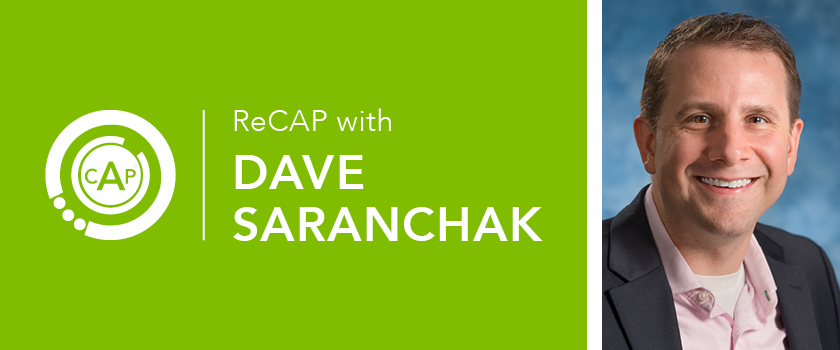

Name: Dave Saranchak
Employer: Concurrent Technologies Corporation
Job Title: Research Fellow and AI/ML Program Lead
Primary Job Functions
-
I am an eternal student learning the ways in which math applies to physical reality and am passionate about enabling others to do the same. I currently lead a research and development team focused on emerging analytical tools and techniques. One current area of interest of ours is the data security and privacy implications of training modern day machine learning models.
Date CAP Certification Was Earned
April 2017

Why did you become a CAP?
I observed a colleague, Alan Briggs, speaking about analytics in a way that really resonated with me. When I approached him about this, he introduced me to CAP and the Job Task Analysis (JTA). I immediately became interested and quickly read his hard copy of the CAP Study Guide. The structure and concepts confirmed my perspectives, obtained over many years of career development, on the field. This led to many more discussions on the applying the JTA and, eventually, to my CAP certification.

What is the best advice you can give to someone studying for the exam right now?
First, I want to congratulate anyone taking the initiative to achieve the CAP and encourage you to remain active in your career development, as no one has more of a vested interest. Regarding the exam itself, it is important to know that the questions were composed by experts to tease out your knowledge across a wide range of analytic knowledge. It is likely that you will have some gaps and you should obtain an honest assessment of your skills to identify where your gaps are. There are many ways to fill those in, but I feel the best way is to take assignments that challenge you, especially in the early years of your career. If you feel yourself getting complacent or becoming the expert in the room, it is a good sign to get uncomfortable again. If you do that, the test will be an easier barrier to overcome.

How does being a CAP help in your workplace?
I utilize my CAP certification and the JTA framework in various ways every day in my workplace. For technical projects, no matter the status or what researchers are involved, the JTA Domains offer useful guidance and insight for the entire team. As a scientist trained to seek understanding through experiments, it took me many years to understand and internalize why having 100% technical success will not guarantee project success for the organization. Being a CAP has aided me in expressing that lesson to both senior management and project stakeholders.
In your opinion, can CAP be relevant for data science or operations research practitioners to differentiate themselves in the government or military?
One important differentiator I see in the government and military realms is the CAP’s Ethics requirement for analytics practitioners. While the notion of a Code of Ethics for data science is only recently being discussed on several social media platforms and blogs, government and military professionals already expect a higher ethical standard and an Oath of Office. Having the CAP expresses to others your awareness of, and dedication to, the expectations of the INFORMS community.

Were there certain opportunities that you took advantage of that helped prepare you to become a CAP?
I worked and studied in the analytics field for well over 10 years before pursuing the CAP. Over this time, I sought out and completed assignments that forced me out of my comfort zone and never let myself get complacent. This allowed me to better understand all areas in the analytic production chain and how decisions in one area can have impacts upon the others.
SHARE: