October 29, 2020 in Industry News
Supply chains: How scenarios build resilience
Strategic and operational planning helps gain agility in an uncertain landscape.
SHARE: PRINT ARTICLE: https://doi.org/10.1287/LYTX.2020.06.05

The COVID-19 pandemic has exposed many risks and uncertainties in supply chains, but pandemics are only one of the potential disruptions businesses face today. Trade conflicts and natural disasters are also becoming more common. Scenario modeling capabilities are increasingly being suggested by analysts as a solution to deal with this rising volatility. How do you apply scenarios during strategic and operational planning? I will explore some examples in this article. First, let’s review some interesting stats.
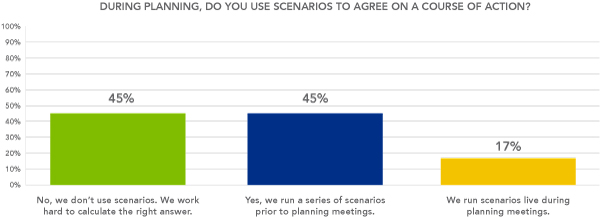
Nearly half of organizations (45%) run a series of scenarios prior to planning meetings, according to AIMMS research. The same amount (45%) do not use scenarios at all but strive to calculate the right answer instead (one number, one plan). Only 17% of organizations run scenarios live during their planning meetings to decide on a course of action. This is largely because most organizations are still not using advanced modeling tools that allow them to run scenarios in real-time. About 46% of organizations rely on spreadsheets for their planning efforts. For these organizations, weathering the storm of large-scale disruptions may not be as easy. That’s possibly why 30% of them are looking to remove their dependence on spreadsheets. Organizations that look to prescriptive analytics applications with scenario modeling capabilities are better prepared. How do you use scenarios in practice?
Scenarios for Sales and Operations Planning
Gartner’s “Improve S&OP Decision Making Through Scenario Planning,” published in May this year, offers helpful guidelines for organizations that want to learn to articulate and apply scenarios for S&OP. Thinking in scenarios reduces the response time required to adapt to changing business conditions, building resilience into the planning process. Scenarios also allow organizations to model how they can “bridge the gap” between their current position and their strategic plan, identifying the actions required to deliver opportunities and mitigate any vulnerabilities.
In the current context of COVID-19 disruptions, for instance, you may benefit from studying multiple resource utilization what-if scenarios to accommodate your production plan accordingly. With the right tool, you can quickly simulate the impact of capacity shutdowns and study other resource utilization scenarios to ensure resource requirements. This can be done during meetings themselves.
Another likely scenario today is the need to adopt new customer channels such as online grocery. These channels might not be able to adapt as quickly to volatile shifts in demand. With scenarios, you can also prioritize certain channels and visualize the impact on your resources and margin.
These are just two among many examples of how scenario planning can bolster S&OP decision-making. Companies have also been applying scenarios to make strategic network decisions for some time now. Let’s explore some use cases.
Scenarios for Supply Chain Network Design
In the ongoing pandemic, materials shortages, unprecedented demand fluctuations and plant closures have led many organizations to revisit their supplier relationships, as well as distribution and production locations. Logistics service providers are among the many companies whose operations have been affected. Due to the lockdown, many are seeing a decrease in demand in some business units while facing new constraints on the resource side in others. Using prescriptive analytics tools, they can model scenarios and perform simulations with all their products grouped together, taking variable costs, fixed costs, transport costs, different transport types and many other options into account. This would allow them to assess whether it makes sense to close a given distribution center or make more changes in their network.
Another use case we see for scenario modeling in the current context is evaluating new sourcing locations. A recent Thomas survey found that 64% of manufacturing companies are likely to “bring production and sourcing back to North America” in view of COVID-19. What we are seeing is not just a trend toward changing materials/part suppliers, but also warehousing and logistics suppliers.
Tools with mixed-integer programming capabilities can do the heavy lifting for you so you can easily find the most optimal combination of suppliers and resources. You can study optimal sourcing locations while minimizing both production and distribution costs.
Chris Gordon is VP and product lead for SC Navigator at AIMMS. He has worked in supply chain consulting and operations across Europe, the United States and India for more than 25 years.