

November 4, 2020 in Blog: Job Insecurity
Probability of Getting Laid Off During the Pandemic
Can statistical analysis help determine if you will keep or lose your job? A probabilistic Bayesian approach
SHARE: PRINT ARTICLE: https://doi.org/10.1287/LYTX.2020.06.11

COVID-19 has had a tremendous impact on the world, resulting in 43 million confirmed cases and 1.1 million deaths worldwide as of this writing. In addition to the health concerns and human toll, the pandemic presents countless individuals with significant financial insecurity and potential layoffs. While the economic reports are often grim, an individual’s probability of a layoff can be relatively low, even if that individual’s company is conducting layoffs. To explore this scenario, we’re going to use Bayes’ theorem to do some sample calculations and observe the result.
First, let’s define some events that we are interested in analyzing: You are laid off (you specifically lose your job) versus company layoffs (your company is conducting layoffs). Of interest is the probability of being laid off for the individual given ongoing company layoffs, i.e., the conditional probability P(You Are Laid Off | Company Layoffs). Per Bayesian analysis,
Pr (You Are Laid Off | Company Layoffs) = [Pr(Company Layoffs|You Are Laid Off) * Pr (You Are Laid Off)] / Pr (Company Layoffs)
Note: Pr = “Probability”
Now we make some assumptions. Suppose that the probability of company-wide layoffs is high, let’s say 90%. We will use the law of total probability to evaluate the absolute chances of an individual layoff and company-wide layoffs. We will condition the individual layoff event against a sample space set of events (partitions) on possible layoff reasons. In this example, NCS represents “noncritical skills” and CS represents “critical skills.”
Pr (You Are Laid Off) = Pr(You Are Laid Off | NCS) * Pr (NCS) + Pr(You Are Laid Off | CS) * Pr (CS)
Note: The sample space partitions are illustrative and can be extended.
Let’s make assumptions for illustrative purposes,
Pr(You Are Laid Off | NCS) = 50%
Pr(NCS) = X
Pr(You Are Laid Off | CS)= 15%
Pr(CS) =1 − X
P (You Are Laid Off) = 50% * X + 15% * (1 − X) ~0.35X + 0.15
For illustrative purposes, let’s assume a cloud-based company that is somewhat COVID-19 agnostic and in the Fortune 500 with strong leadership and cash flow. Assume,
Pr(Company Layoffs) = 35% = 0.35
We will make another assumption that the probability of a large-scale layoff at the company has occurred given the occurrent of your individual layoff is relatively high, i.e.,
Pr(Company Layoffs | You Are Laid Off) = 90%.
We now calculate the original probability equation:
Pr (You Are Laid Off | Company Layoffs) = [Pr(Company Layoffs|You Are Laid Off) * Pr (You Are Laid Off)] / Pr (Company Layoffs).
Substituting the values,
Pr (You Are Laid Off | Company Layoffs) = {0.90 * (0.35X + 0.15)} / 0.35 = 0.9X + 0.39
Also,
Pr(Critical Skills) = 1 − Pr(Noncritical Skills) = 1 − X = Z.
P(You Are Laid Off | Company Layoffs) ~ (1.3 − Z)
For instance, if your skills are moderately critical to the activities at the workplace, say ~50%, your layoff probability under a company-wide layoff stands at ~(1.3 – 0.5) or 80%. In comparison, if your critical skill level at is ~80%, your layoff probability stands at ~(1.3 – 0.80) or ~50%. Figure 1 offers a schematic plot of layoff impacts vs. necessary skills.
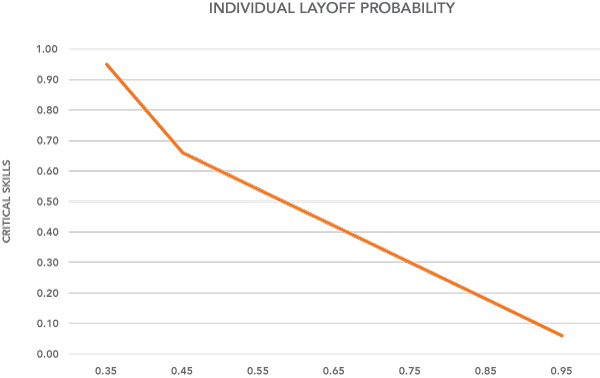
Critical skills play a vital role in determining your layoff probability in the event of a company-wide shake-up. Upskilling youself in a relevant field that maximizes your value proposition offers perhaps the best shield against the economic impacts of pandemics such as COVID-19.
Bharat Gera is a program manager at LinkedIn and a practicing business analytics professional holding an executive MBA from the Indian Institute of Management, Bangalore. He has worked extensively in the big data analytics domain for internet tech giants Amazon and IBM over the past two decades. He can be reached via email ([email protected]), Twitter (@bharat_gera) or LinkedIn (www.linkedin.com/in/bgera).
([email protected])