February 11, 2021 in Artificial Intelligence
Value Engineering
Cost-benefit analysis for AI-enabled digital programs
SHARE: PRINT ARTICLE: https://doi.org/10.1287/LYTX.2021.02.05

The power of artificial intelligence (AI) to enable multiple facets of business and digital ecosystems has long been anticipated; substantial research is underway on AI models, algorithms and associated technology. However, a majority of AI experiments have yet to scale and move beyond silos to enterprise-wide usage. Often, companies engage in AI proof-of-concepts without having a viable way of assessing its business value.
A holistic assessment of a company’s value chain and where AI can bring value (new revenue, cost savings or process automation) is necessary for companies to adopt AI at scale and realize the business value of embedding AI in its value chain. The methodology of value engineering or cost-benefit analysis to assess the strategic and financial aspects at the onset of AI-enabled digital programs, pursues this solution.
Medium to large AI-enabled digital programs require systematic assessment and estimates for business decisions given higher investment related to scale. Cost-benefit analysis facilitates AI-enabled digital efforts to become part of strategic initiatives by CEOs and line items in financial budgets of CFOs. Such analysis also develops business justification for investors and C-level executives keeping a long-term vision. Systematic identification and estimates of benefits, costs and monetary implications, along with value drivers and cost drivers, show a holistic view of AI-enabled digital for sound business and investment decision-making.
Cost-benefit analysis is a systematic process for comparing benefits and costs of a project/program to determine if it is a sound investment (justification/feasibility) and see how it compares (ranking/priority assignment). An immediate outcome of the cost-benefit analysis is a clear understanding of the benefits that can be obtained by value drivers of AI-enablement – monetarily tangible and intangible – as well as costs that will be incurred while achieving the benefits over a longer time horizon. In concrete monetary terms, benefits from value drivers and investment schedules calculated from cost drivers help develop financial models and cashflows for a five-year or longer time horizon of the AI-enabled program.
This is immensely useful as the financial model and cashflows form the basis of decision-making financial metrics for investments in AI-enablement programs, which are familiar with C-level stakeholders and investors:
- Internal rate of return (IRR). What is the estimated IRR for AI-enabled digital projects compared to internal company/industry benchmarks?
- Payback period. What is the estimated payback period from the AI-enabled digital?
- Net present value (NPV). What is the NPV of the AI-enabled digital projects for a five-year period? Is the NPV positive or negative?
Since cost-benefit analysis is a value chain-based holistic assessment, it also considers risks associated with the value drivers. With a clearer picture of costs and investment schedules now available, it enables the corporate finance and FP&A team to do appropriate budget and capital allocation for different years of the AI-enabled digital program.
An additional benefit of performing value engineering or cost-benefit analysis at the onset of an AI-enabled digital program is that now there is a framework in place with business and financial metrics to perform annual or bi-annual monitoring of the program including implementation and impact risks. This helps executives make business decisions or take necessary actions in case of deviations while the AI-enabled digital program is in place. Overall, with these tools, methods and metrics, AI-enabled digital becomes part of the senior management of the business or organization.

Approach & Methodology
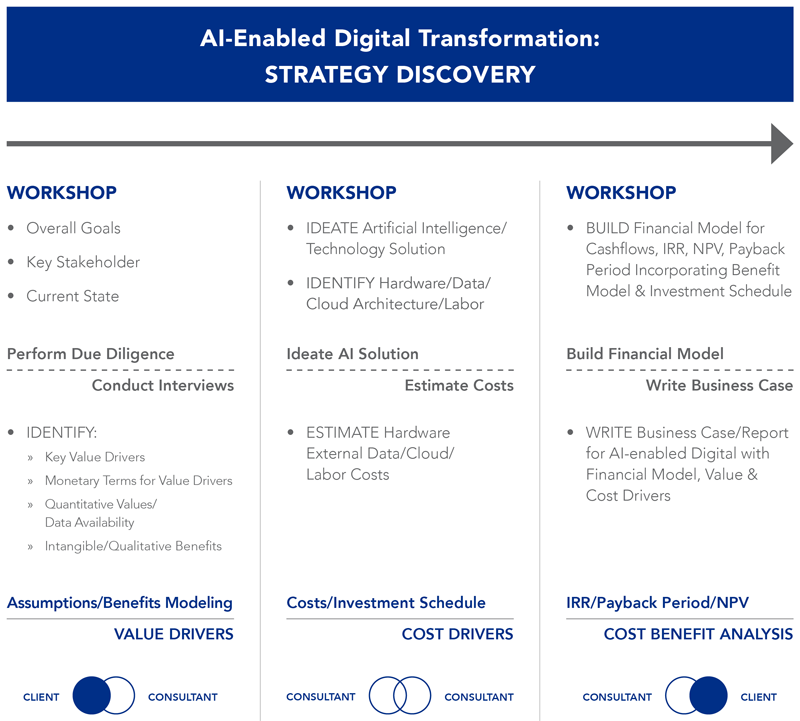
Discovery: The first stage starts with performing a due diligence and asking key questions about the company or organization whose leadership is looking to embrace AI-enablement throughout its ecosystem. This is the discovery phase, which involves conducting workshops and interviews about overall objectives of AI-enablement with executive stakeholders involved, and find the current state. This is a joint exercise between consulting firm and the business that intends to embark on AI-enabled digital.
The individuals involved in this phase are the key executive stakeholder along with representatives of different departments (finance, marketing, operations, technology) who would benefit by AI-enablement. Some example questions that would facilitate discussion and discovery in this phase include:
- What are the overall goals of the organization?
- Who are the key stakeholders and the executive sponsor for AI-enabled digital program?
- What is the current state of activities/services?
- What are the key value drivers/activities associated with AI/digital intervention (employee, operations, customer, technology)?
- How can key value drivers be measured and converted into monetary terms (in dollar value)?
- Who can provide quantitative values/data for key value drivers (finance, marketing, operations and market research)?
An outcome of the discovery workshops, due diligence and interviews includes clear understanding of the current state along with identification of company-specific value drivers that would benefit from AI-enabled digital. The value drivers enlisted show tangible and intangible benefits along with KPIs. The tangible benefits convert to monetary values for individual value drivers based upon the internal company inputs, as well as external market research data. The quantified, tangible monetary benefits form the basis of modeling cost-benefit analysis of AI-enablement.
The benefits model differentiates the value drivers into new revenue or cost savings and breaks them into categories: customer, employee, operations and technology. Data plays a key role in the value drivers whether identifying data-driven insights leading to process improvement or using data through pipelines for AI-driven models and automation. The benefits model further considers the high-low boundaries along with a baseline for scenario planning for individual value drivers that comes from subject matter expertise.
Follow-up: After the value drivers for AI-enabled digital have been identified based on a company’s objectives and long-term goals, the next phase is ideating and solutioning the value drivers to come up with the cost drivers that would be required to implement them along with cost estimates and year-over-year (YoY) investment schedule. It starts with:
- Ideate AI/technology solution to achieve key value drivers. During this step, high-level solutions for each of the value drivers of AI-enablement and overall solution architecture are ideated. This is high-level solution architecture considering the analytical and technological requirements for implementing AI-enabling value drivers.
- Identify hardware, data, AI cloud infrastructure and labor/human capital required for building and using the solution. Once the high-level solution architecture is in place, hardware, data, AI cloud infrastructure and labor requirements are identified to implement the solutions at scale. Both the components and their quantities are estimated.
- Estimate hardware, external data, cloud, labor costs (CapEx/OpEx) for multiple years/lifecycle. In the next step, for the components that have been identified for AI-enablement, their costs are calculated for multiple years based on quantity and usage estimates.
These three steps form the basis of cost drivers and cost estimates, which is converted to YoY investment schedules required for implementing the value drivers at scale as part of AI-enabled digital.
Data forms the major raw material of AI-enablement. If the company has internal data, the costs incur in collecting, storing and processing the data. External data costs are accounted for by the value drivers that require third-party data; infrastructure, storage, computation, security and applications/subscriptions are the primary components of AI-cloud infrastructure costs. In terms of labor costs, the substantial cost components are full-time employees, professional services, training or up-skilling and ongoing system administration costs, along with costs involved if external contractors are hired.
Machine learning models and algorithm development costs form a part of human capital costs, which can be either internal- or external-based analytics consulting.
Once the monetary benefits for value drivers and the YoY investment schedule for cost drivers are in place, it’s time to perform financial analysis on the AI-enabled digital program. Value drivers, benefits modeling, cost drivers and investment schedule form the building blocks of the financial cashflow model for AI-enabled digital program. Based on monetized benefits and the YoY investment schedule, cashflows for the different years of the AI-enablement program are obtained.
The cashflows are fundamental for deriving the values of the three financial metrics (IRR, Payback period, NPV) as part of assessing the financial aspects of AI-enabled digital programs. Further, once the financial model with cost and cashflows is in place at the onset of the program, this can be used for ongoing monitoring and accounting as part of assessing AI-enabled digital program performance, as well as implementation and impact risks.
Sovik Kumar Nath is an AI/ML and generative AI senior solution architect at AWS. He has more than a decade of extensive experience designing end-to-end machine learning and business analytics solutions in financial services, capital markets, operations, marketing, healthcare, supply chain management and IoT as a solution architect, data scientist and manager of AI/ML teams.