

June 27, 2022 in Cloud Computing
How Enterprise Cloud Applications Accelerate Digital Transformation
SHARE: PRINT ARTICLE: https://doi.org/10.1287/LYTX.2022.04.05

The digital revolution started decades ago with organizations looking for disrupting technologies to redefine their operations across different levels. Organizations globally pursue the new IT architectures and operating philosophies leading to equipping next-generation IT solutions. Over the last decade, cloud computing technology has emerged as a key enabler for building a digital-first organization.
Enterprise cloud applications accelerate the digital transformation from remote working environments to online classes, cloud-enabled kitchens and financial transactions across diverse industry verticals. Organizations can begin their cloud journey by migrating customer-facing applications to cloud-native applications.
More companies adopt the cloud to augment insights-rooted innovation, rapid marketing, scale efficiency and cost optimization while reducing technology risks. With a hybrid cloud operating model in a mission-critical environment, enterprises can more effectively mine supply chains, sales and marketing data, and business insights to deliver new services and applications to target users.
Moreover, a multicloud strategy accelerates business transformation by influencing technology selection, adopting new business models, developing innovative solutions, etc. Multicloud environments optimize enterprise applications and deliver a remarkable ability to match the right workloads to the right cloud service providers.
According to Gartner, more than 45% of the IT expenditure on system infrastructure, application software, infrastructure software and business process outsourcing will shift from traditional to cloud by 2024.
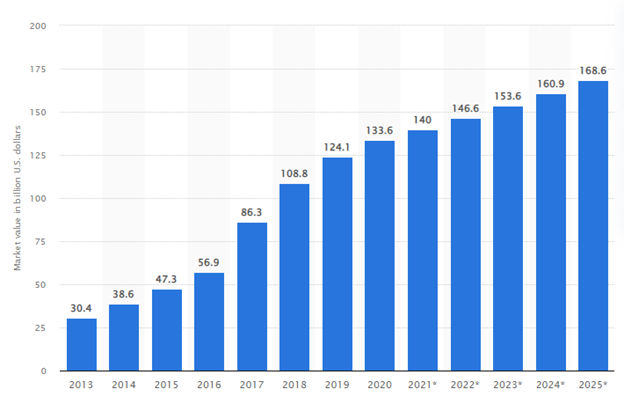
Interestingly, as per another forecast by Statista, the cloud applications worldwide market size is expected to reach $168.6 billion (USD) by 2025 at an anticipated compound annual growth rate (CAGR) of 4.8%. These statistics showcase how rapidly organizations choose the cloud to stay ahead in the digital age.
Digital Transformation with the Cloud
Cloud computing technology has broadened the scope of digital transformation, and it is more than shifting record-keeping methods from paper to digital files. In the current digital landscape, the implementation of new-age devices, apps and storage allows business to modify their existing processes to intuitively connect and engage with customers.
At a glance, cloud technology ensures:
- Remote workers stay on the same page.
- Large enterprise project completion without in-person IT support dependency.
- Crucial data remains secure even if accessible to anyone who needs it.
Let’s understand how enterprise cloud applications are accelerating digital transformation for businesses.
1. Enhances Security
Organizations are the new-age data banks; losing control of data and infrastructure is prevalent during the digital transformation process. However, migrating data to the cloud significantly reduces the risks of data losses and unauthorized access. A public cloud protects data, applications and entire infrastructures from potential threats. As backups are automatically created, the risk of losing data is eliminated to the grassroots level.
At an industry level, cloud service providers are making positive developments securing the cloud. A few of the additional cloud security strategies that enterprises can employ in their business include:
- Full-fledged training of end users about cloud data criticality.
- Enabling multifactor authentication to access data.
- Adhering to strict compliance standards.
- Forecasting and planning for a cloud-to-cloud backup and disaster recovery.
- Partnering with managed security operations center providers for 360 data security coverage.
2. Improves Cost Efficiency
Cloud computing applications reduce the cost of purchasing hardware, software and operational data centers, which is crucial for every business. Cloud brings in the PAYG (pay-as-you-go) model that empowers companies to innovate and deliver new applications and systems that swiftly integrate into the existing ecosystem.
The property of paying for what you use offsets the growing expenditure on IT infrastructure, workforce and other initiatives. On average, cloud migration saves around 15% on overall IT spending, whereas small to medium-sized businesses procure the benefits of the cloud by spending 36% less money on IT.
3. Unmatched Accessibility
Business appetite for applications is exponentially increasing. Users rely on applications because of various benefits they administer, such as fewer manual processes, enhanced ROI and less complexity. With businesses adopting applications, the need to manage the integration of multiple applications increases. Cloud computing helps these applications communicate inside a business environment and empowers end users to utilize them efficiently.
Companies quickly turn to APIs and system integration platforms offering different models for integrating multiple applications using cloud computing technologies. Moreover, cloud-based applications are accessible from anywhere with any internet-connected device.
4. Higher Scalability
Scalability is defined as the application’s characteristics that manage increasing on-demand loads. Cloud works on the virtualization principle that machines can be scaled as per business needs, and cloud infrastructure allows vertical and horizontal scaling. In horizontal scaling, the business can add more servers according to increasing demands and divide workloads, ensuring business continuity with maximum performance output.
In vertical scaling, computing power such as storage or processing power can be increased as per business requirements. Dynamic scaling features regulate the changing user’s needs without compromising IT departments’ speed and scale operational efficiency.
5. Increased Speed and Reliability
Speed and reliability are two fundamental functionalities of enterprise cloud infrastructure. Services are instantly delivered after opt-in purchasing access. Cloud apps run faster, making the working experience better and faster for users. Also, you gain functionalities instantly that would consume ample time to acquire on your own.
Moreover, cloud services are independent of hardware damage. Cloud visualization and proper planning enable you to address and resolve faults quickly. Resources can be added or removed and allocated for redundancy.
6. Automation Opportunities
Compared with traditional information-exchange server systems, the cloud offers tremendous business automation opportunities. Cloud automation involves using built-in tools and processes to streamline smooth workflow execution in a cloud environment. With cloud computing applications, one can quickly establish infrastructure as code practices, automate backups, control workflows and administer security controls at an extensive level.
Also, the cloud effectively handles the scalability and complexity of cloud environments and focuses on automating services and overall virtual infrastructure. This, in turn, helps businesses create a well-oiled orchestration system, reaping huge benefits later.
Conclusion
Digital transformation for businesses continues among enterprises, with cloud application poised to reach a notable milestone as the epicenter of business change. The cloud’s new channels allow businesses of all sizes to keep pace with changing digital trends. With disrupting technologies such as IoT devices, AI/ML, big data analytics, AR/VR and more, the requirement for a heavy amount of computing power increases. Cloud offers hefty processing capacity and enhanced security mechanisms, enabling organizations to scale their business on demand. The cloud also eliminates the need to purchase and maintain physical servers or a facility to house them, resulting in cost savings for businesses.
Ahana Pearl is a business solutions consultant.