

September 1, 2022 in Five-Minute Analyst
No More Easy Outs: MLB’s Universal DH
SHARE: PRINT ARTICLE: https://doi.org/10.1287/LYTX.2022.05.06
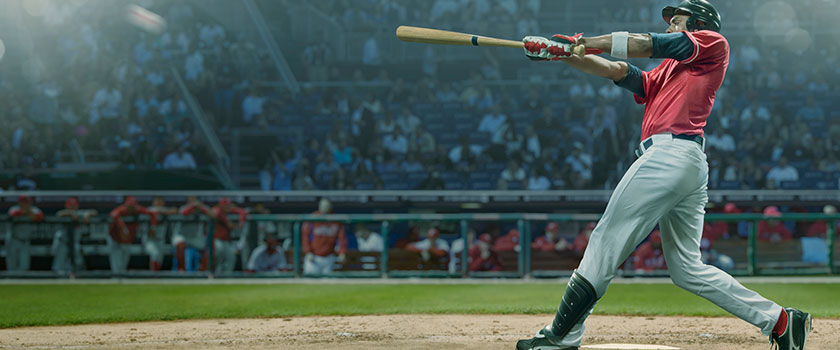
Baseball is a popular topic around my house and was the primary sport I played growing up. There are lots of rules as well as stats for just about everything. And the sport continues to evolve. Recently, Major League Baseball (MLB) finally put into place the universal designated hitter (DH). To those unfamiliar with baseball, the DH position in the batting lineup is a player whose sole purpose is offense. In the American League, teams have enjoyed having the role of a permanent DH to bat for their pitchers. The National League, until recently, required pitchers to bat. There is a point when a team could put in a DH for the pitcher, but that would require that the pitcher not go back out to the pitching mound the next inning. This involves a lot of strategic decisions by the teams’ coaches during games. In 2020, the MLB played a shortened season and during that season made DHs universal across both leagues. They reverted in 2021 and then brought back the universal DH in 2022.
There are a couple alleged reasons for adopting the universal DH, the first one being the increase in offensive excitement in the games. In other words, historically, the pitchers in the National League were viewed as easy outs. Pitchers are drafted and traded because of their pitching, not because they are great hitters. Thus, they spend most of their time honing their primary talent. If you have the choice to put in any player to hit the ball, you’d naturally pick someone more likely to get a hit, maybe even someone more likely to get a home run. High-scoring games are commonly viewed as more exciting, and this change should result in more runs and home runs. I recently had to do some examples in Microsoft Excel, so I’m going to use that tool here to make some plots. I used data from the Baseball Databank on GitHub [1]. The data included seasons from 1876 to 2021 – more than I needed, but not all that I needed. I went to baseball-reference.com to get the current season’s data. After some data cleaning and combing of files, I achieved one table in which I could pivot and observe some interesting points about the offensive stats. I chose to go back as far as 2012 to provide enough but still relevant data to assess the impact of the universal DH change.
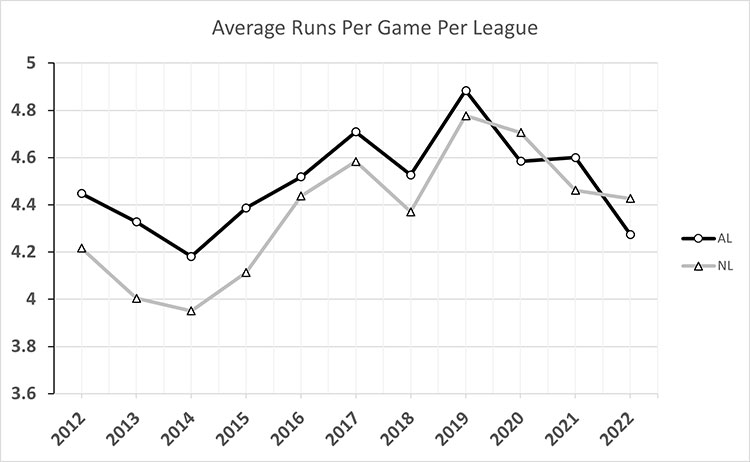
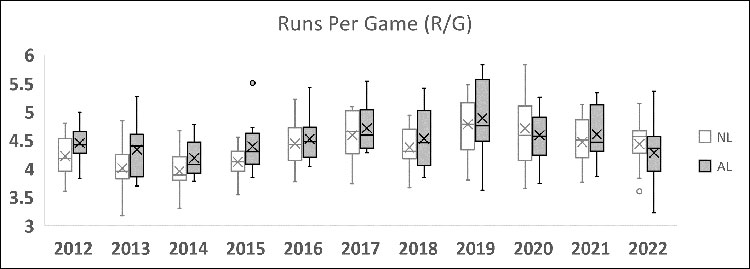
Figure 1. Runs scored per game (R/G) on average in the National and American Leagues from 2012 to 2022 (as of July 26, 2022). Notice that in 2020 and 2022, when the universal DH change is in effect, the National League achieves a higher R/G average than the American League. This indicates that the rule does indeed make a difference, although the overall trend for R/G is downward. The box plots show a more muted version of the data and illustrate the R/G distribution across all teams.
When you plot the average runs scored per game (R/G) for the past 10 years plus the current season and compare the National and American Leagues, you can see interesting results. During the two years in which the National League did not have to let their pitchers bat (i.e., the universal DH was in effect), they have a higher R/G than the American League. This is an exciting discovery that perhaps lends credit to those who might hypothesize that this change is producing the results desired. However, one needs to take a step back and realize that the overall trend for the last few seasons is fewer R/G.
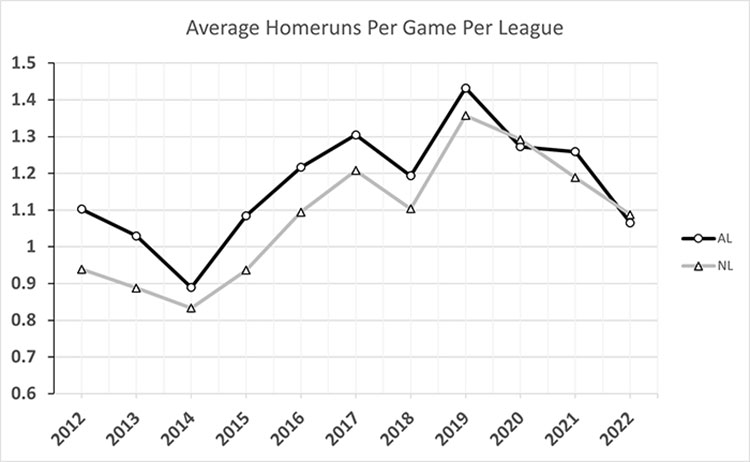
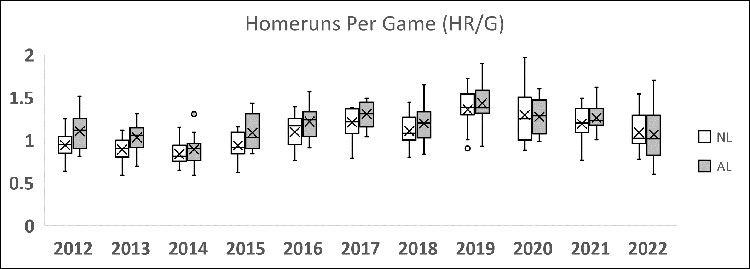
Figure 2. Home runs hit per game (HR/G) on average in the National and American Leagues from 2012 to 2022 (as of July 26, 2022). Notice that in 2020 and 2022, when the universal DH change is in effect, the National League achieves a higher HR/G average than the American League. This indicates that the rule does indeed make a difference, although the overall trend for HR/G is downward. The box plots show a more muted version of the data and illustrate the HR/G distribution across all teams.
Another statistic of interest is home runs per game (HR/G). The plotted results are similar to those of R/G. The National League again benefits from the change, whereas the overall trend the last few seasons is downward. The next thing I did was plot the entire history of both R/G and HR/G for the MLB. This shows a clearly upward trend in HR/G and a less obvious one in R/G. This is likely due to many factors, but not least of which are decisions to change rules such as the one being analyzed here.
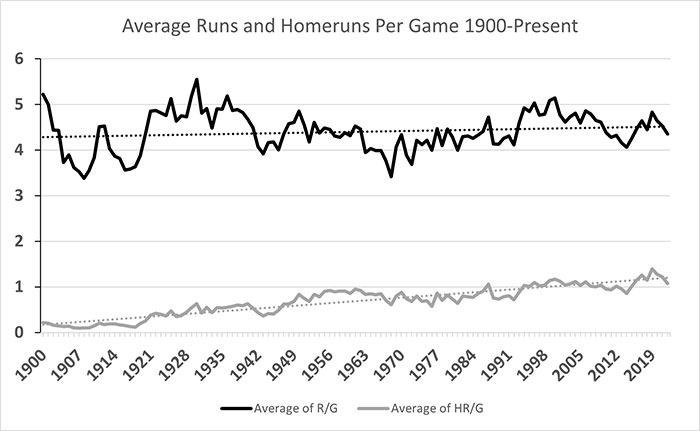
Figure 3. All years. R/G and HR/G both trend upward. Over 100 years ago, the average number of HR/G was near zero. Today that average is above one.
Are 2 of 11 seasons the appropriate number of times for the National League to outperform the American League in these two metrics? I will use the binomial random variable test statistic. Let’s propose the hypothesis that the teams have an equal chance of being better in this metric, thus probability of 0.50, and the p-value is P(X ≤ 2 | p = .5 and n = 11). I used the MS Excel function for a binomial distribution, =BINOM.DIST(2,11,0.5,TRUE), which produced the value 0.0327. This is less than the typical 0.05, leaving us with some confirmation that this is not purely chance. So maybe there is something to this rule change and how it affects these two metrics.
I now bring in another alleged reason driving this change – the hypothesis that having pitchers removed from the batting lineup would result in fewer injuries. I was able to find player injury stats for the current season and back to 2020 on fangraphs.com [3]. I cleaned the data and then added a column for league. I filtered out all the nonpitchers on the injury list. The data reveals when charted that the National League has had more pitcher injuries in each of the last three seasons. Note that 2020 only had 60 games and 2022 is only a little over halfway done at the time of this data pull. The overall numbers indicate that there is little to no impact on pitching injuries. However, I recommend obtaining additional data. More than a five-minute work on this topic could explore the length of time a player is out for an injury, the types of injuries and repeat injuries of the same players.
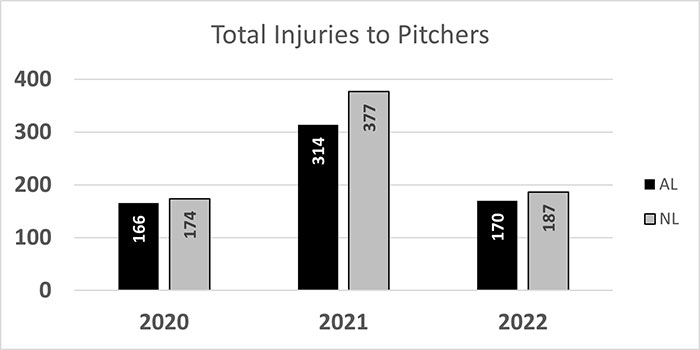
Figure 4. Pitching injuries. The National League leads in pitcher injuries, but the total of the shortened 2020 season and partial 2022 season is close to the amount for the full 2021 season. Further exploration of injury time, type and repeats should be done for a more in-depth analysis.
How should one feel about the new universal DH change? I think my favorite team in the National League will be in a better position overall. And I expect to continue watching, supporting and analyzing baseball. What is your favorite analysis topic?
Notes and References
- Baseball Databank is a compilation of historical baseball data in a convenient, tidy format, distributed under Open Data terms and is licensed by Chadwick Baseball Bureau under the Creative Commons Attribution-ShareAlike 3.0 Unported License. For details, see http://creativecommons.org/licenses/by-sa/3.0/.
- https://www.baseball-reference.com/
- https://www.fangraphs.com/
Nick Ulmer, CAP, has been an operations research analyst since 2014. He is the inaugural chair of the INFORMS Military Veterans Interest Forum and a Principal Operations Research Analyst for CANA LLC, leading teams of analytics professionals to produce high level analytics products across federal and commercial domains.
([email protected])