

October 7, 2022 in Cryptocurrency
Cryptocurrency: What is on the minds of our students?
SHARE: PRINT ARTICLE: https://doi.org/10.1287/LYTX.2022.06.01

Cryptocurrency is certainly a hot topic these days. President Biden issued an Executive Order on Ensuring Responsible Development of Digital Assets in March 2022. The European Union (EU) is also introducing a wider framework, known as MiCA, to regulate all issuers and service providers in the EU dealing with crypto assets. Asia’s financial services hubs will seek to strengthen cryptocurrency regulations and maintain their balancing act in attempting to minimize speculative and compliance risks. The Bitcoin 2022 Conference in May in Miami had more than 25,000 attendees, and the World Crypto Conference is scheduled for January 2023 in Switzerland. More universities are starting to offer courses on cryptocurrency/digital assets (even some universities have students paying in bitcoin for their cryptocurrency course). Some governments are likely to rein in the adoption of cryptocurrency, opting for a central bank digital currency (CBDC) or stablecoins (a cryptocurrency whose value is pegged to another asset) issued by domestically registered banks. As of August 2022, there were more than 500 cryptocurrency exchanges and about 21,000 crypto assets.
According to the 2022 Crypto Confidence Survey by The Voyager Team, one-third of Americans (37%) say that it is moderately or very likely that they will purchase cryptocurrency in 2022. Whereas American men are twice as likely as American women to currently own crypto (30% versus 15%), men and women are equally likely to consider buying crypto in 2022 (60% versus 62%). In June 2022, the Coinbase Institute and the University of Michigan Survey Research Center announced that they will partner to issue an annual cryptocurrency survey nationwide.
On May 25, 2022, U.S. Commissioner Hester Peirce said that the U.S. dropped the ball on crypto regulation. Certainly, there needs to be a trade-off between reducing risk for crypto crime but, at the same time, not inhibiting innovation in the crypto space. We are also seeing active involvement by other countries in terms of using cryptocurrency and associated regulations. Bhutan has partnered with an existing crypto provider, Ripple, to develop CBDC. Hong Kong has high regulatory standards, but regulators will engage with businesses. Cambodia has initiated a semi-CBDC project. Myanmar’s shadow government recognizes Tether (a stablecoin) as legal tender. Singapore has banned advertising by retail investors but is supportive of wholesale/tech crypto businesses. El Salvador became the first country in the world to use bitcoin as legal tender, since September 2021. The list goes on.
With such movement in the crypto industry, an interesting research question for future crypto buyers is better understanding what is on the minds of students in the U.S. regarding cryptocurrency. On June 30, 2022, the University of Cincinnati received a large gift to introduce a pair of new programs in cryptocurrency as well as starting a cryptocurrency fund to promote student learning of blockchain technology and digital assets. The author, as part of his summer 2022 research on this topic at the American Institute of Economic Research (AIER), conducted his own survey on cryptocurrency using four business schools in New Jersey. Before discussing these results, we can take a look at the recent literature regarding student reactions to cryptocurrency.
Students and Cryptocurrency
Phillips (2021) conducted a survey of 439 undergraduate students at the University of Arkansas [1], which revealed that the general opinion about cryptocurrencies among University of Arkansas students is positive (60%). The survey clearly conveys a positive leaning toward cryptocurrencies that rises when even one course is taken in blockchain. The students stated that the most significant barriers were related to lack of information of usage (62%), lack of technical expertise (59%) and, in general, difficulty of using cryptocurrencies (52%). More than half of the students agreed that investing in cryptocurrencies should be one of the core competencies of students graduating with degrees in accounting, economics, management or finance from the Sam Walton College of Business.
Some other recent studies indicated:
- Perceived benefits of cryptocurrency enhance its perceived values as well as the behavioral intention to use cryptocurrency (Pakistan, 350 university students) [2].
- The expanded theory of planned behavior (TPB) model explains 63.5% of the variance in intention to adopt cryptocurrency for transactional usage (492 individuals) [3].
- Findings of structural equation modeling (SEM) reveal a significant positive effect of attitude, subjective norms, perceived behavioral control and trust on intention to adopt cryptocurrency (IACR) (334 in sample) [4].
- Attitude is a significant factor, at 0.05 level of significance, in explaining possible adoption (p = 0.027), whereas awareness is only significant (p = 0.082) at 0.10 significance level (339 in sample) [5].
- Behavioral intention to use bitcoin was significantly influenced by power prestige, retention time and distrust (395 in sample) [6].
- Factors such as the use of social media, analysis of stock/cryptocurrency performance and peer influence, among others, have a significant cumulative (about 77%) precision-based impact in educating the young investor and determining the level of investments made in cryptocurrency and the stock market by undergraduate-level students, along with showcasing other individual trends (India, 142 students) [7].
Based on Liebowitz’s summer 2022 study [8] of 179 undergraduate and graduate students across four business schools in New Jersey, the following survey data was collected.
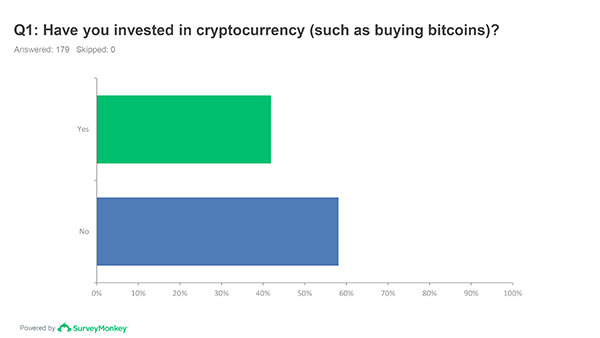
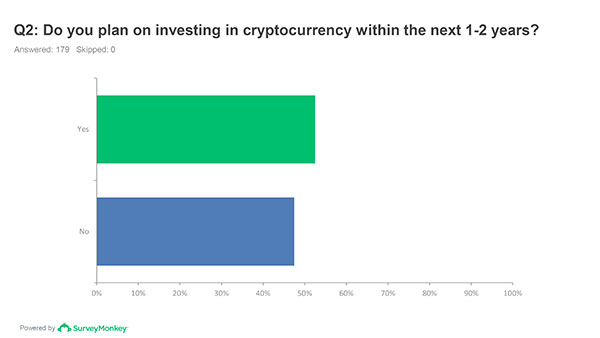
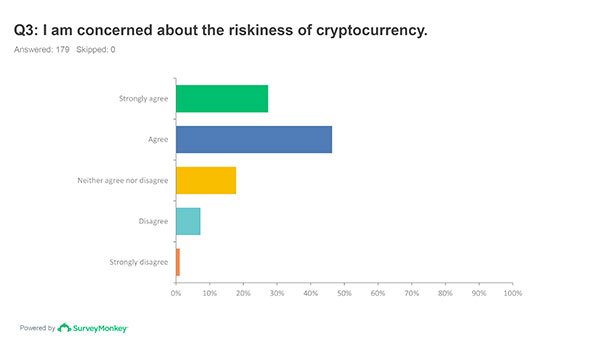
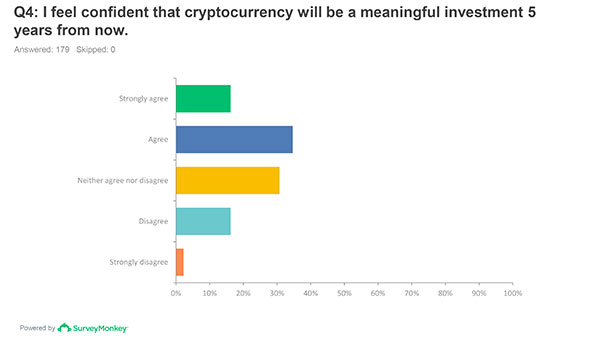
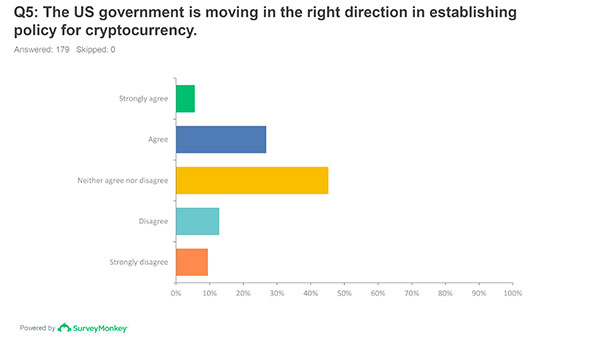
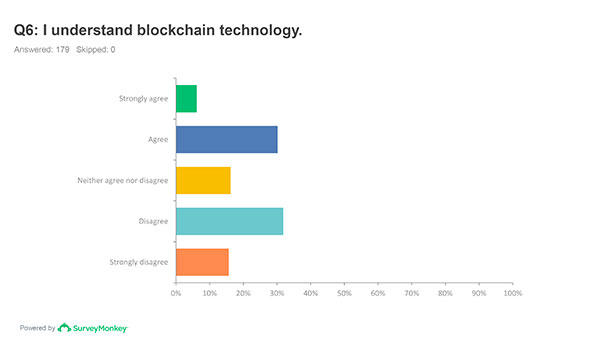
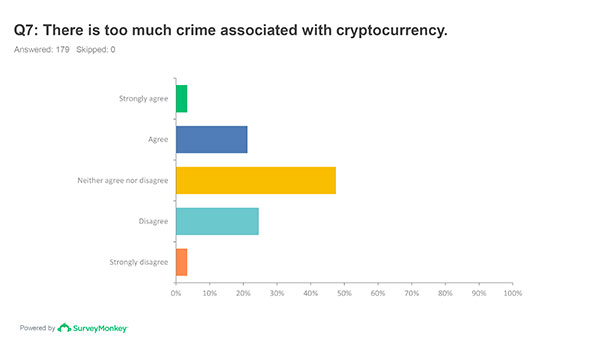
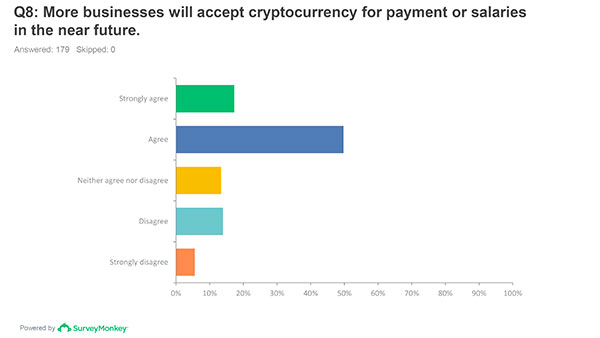
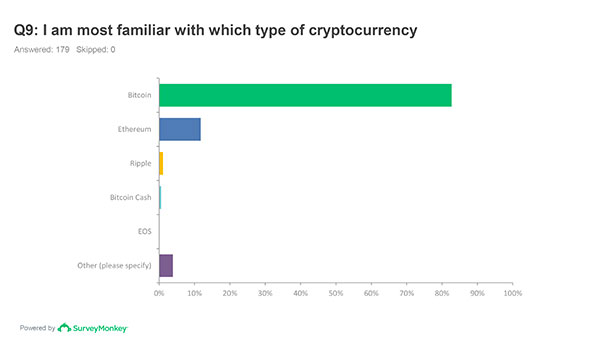
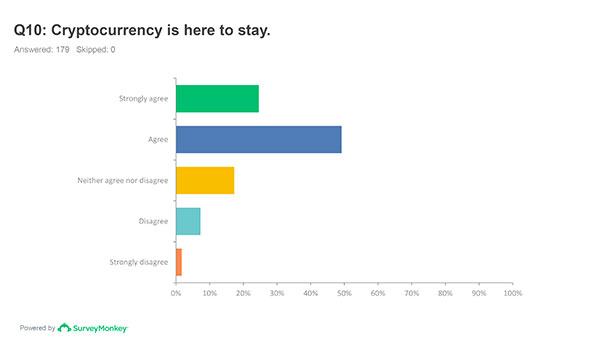
Based on Liebowitz’s survey results, the following findings and recommendations can be made:
- Even though cryptocurrency has its ups and downs, this topic (digital assets) will continue to be important in the years ahead.
- The younger generation seems to be intrigued by cryptocurrency, and universities/colleges should offer more courses on the topic.
- The risk for crypto crime is still apparent, so buyers of crypto must be aware of the potential risks.
- Perhaps a U.S. federal government policy on crypto should be more descriptive versus prescriptive, similar to the U.S. policy on autonomous vehicles, so that innovation is not stymied.
For future university courses on cryptocurrency, here are some starting areas that should be covered (based on interviews at AIER):
- Currency and investing.
- Blockchain, decentralized finance (DeFi) and non-fungible tokens (NFTs).
- Metaverse (Web 3.0), where some or all components of metaverse games are built on blockchain technology.
- Personal security and transferability.
- Use cases.
- Taxonomy of types of coins and purchases.
- Where cryptocurrency fits with gold, silver, dollar, as a hedge against inflation.
- Future directions for cryptocurrency.
- Failure case studies.
- Decentralized autonomous organizations (DAOs).
- Business ethics and public choice.
- What blockchain means to the economy (e.g., reducing transaction costs).
- Crypto crime.
Acknowledgments
Special gratitude and acknowledgment to Ryan Yonk and other colleagues at AIER.
References
- Phillips, E., 2021, “Cryptocurrency Awareness Among Students at a Premier Academic Institution in ISYS: The Razorbacks of Arkansas,” Journal of Educational Sciences: Theory & Practice, Vol. 21, No. 4, December.
- Hasan, S., H. Ayub, A. Ellahi and M. Saleem, 2002, “A Moderated Mediation Model of Factors Influencing Intention to Adopt Cryptocurrency among University Students,” Human Behavior and Emerging Technologies, Hoboken, NJ: John Wiley.
- Schaupp, L., M. Festa, K. Knotts and E. Vitullo, 2022, “Regulation as a Pathway to Individual Adoption of Cryptocurrency,” Digital Policy, Regulation, and Governance, Vol. 24, No. 2.
- Soomro, B., N. Shah and N. Abdelwahed, 2022, “Intention to Adopt Cryptocurrency: A Robust Contribution of Trust and the Theory of Planned Behavior,” Journal of Economic and Administrative Sciences, January.
- Doblas, M., 2019, “Awareness and Attitude Towards Cryptocurrencies in Relation to Adoption Among College Students in a Private Tertiary Institution in Cagayan De Oro City, Philippines,” International Journal of Advanced Research and Publications, Vol. 3, No. 4, April.
- Kim, M., 2021, “A Psychological Approach to Bitcoin Usage Behavior in the Era of COVID-19: Focusing on the Role of Attitudes Toward Money,” Journal of Retailing and Consumer Services, Vol. 62.
- Ashish, V. and S. Fazalbhoy, 2022, “Impact of COVID-19 on Investment Education and Behavior in Cryptocurrency and Stock Market: A Study of Indian Undergraduate Students,” Annual Research Journal of SCMS, Pune, Vol. 10, March.
- Liebowitz, J., ed., 2023, “Cryptocurrency Concepts, Technology, and Applications,” Philadelphia: Taylor & Francis.
Jay Liebowitz recently served as the inaugural Executive-in-Residence for Public Service at Columbia University’s Data Science Institute. His main role was to infuse data science and analytics into the U.S. federal government, with support from the Partnership for Public Service. His recent books are “Pivoting Government Through Digital Transformation” (Taylor & Francis, 2024) and “Digital Transformation for the University of the Future” (World Scientific Publishing, 2023). His newest book, due to be published in mid-2024, is titled, “Regulating Hate Speech Created by GenAI” (Taylor & Francis).
([email protected])