December 15, 2022 in Artificial Intelligence
Seven Ways to Get the Most out of Supply Chain Analytics in the Age of AI
SHARE: PRINT ARTICLE: https://doi.org/10.1287/LYTX.2023.01.05

Many people are talking about supply chain risk, but more people are talking about artificial intelligence (AI). I recently gave two talks, one at GE Research and one at INFORMS, that provided insights for supply chain analytics teams. Here are seven lessons.
1. Don’t overengineer the solution.
With all the hype around AI, there is a temptation to want to apply deep learning (or reinforcement learning) to supply chain problems. However, I don’t think AI is just deep learning. People typically use AI in two ways: artificial general intelligence (AGI) and practical AI. AGI is dominated by talk of deep learning, whereas practical AI is about applying the right algorithms. Make sure your team is on the same page and talking about the same thing. (See this blog on practical AI for more details.) You don’t want to overengineer the solution.
2. Be creative.
The book “Prediction Machines: The Simple Economics of Artificial Intelligence” by Ajay Agrawal, Joshua Gans and Avi Goldfarb taught me to think creatively about reframing many business problems as prediction problems. The book suggests that most business problems are in fact prediction problems, and I’ve seen this advice used effectively over the years.
For example, we worked with a company that was having problems understanding why they weren’t hitting 100% complete orders. Instead of just diagnosing the issue, our team realized that predicting next week’s order could help get out in front of the problem. Forecasting demand is common, but using a prediction algorithm to reverse engineer what the customer might order is creative.
In another example, we used prediction models to help determine risks within the supplier base and overall supply chain. Companies also use prediction models to help prevent worker injuries in industrial settings.
3. Don’t forget about optimization.
Prediction without optimization can be useless. You need the optimization algorithm to decide what to do with the prediction. DoorDash wrote a blog on exactly this topic. They needed to predict how orders would play out and then feed that into an optimization to help make decisions. Many new analysts and data scientists may not be familiar with optimization – and optimization is critical to supply chain analytics.
4. Keep your eye out for the real objective.
We worked with a beverage company that wanted all their customer points in Germany to be within 75 km of a distribution center, so they wanted to know how many distribution centers they needed (see Figure 1).
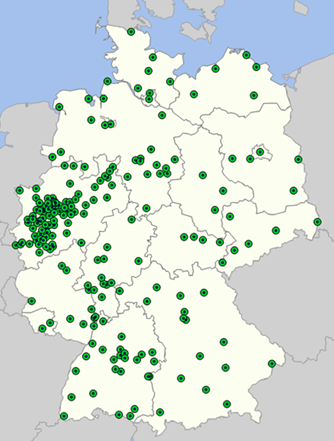
This is a straightforward facility location problem. However, when a customer tells you that “all” customers need a certain service, be wary. We ran the service objective against the total number of facilities (Figure 2).
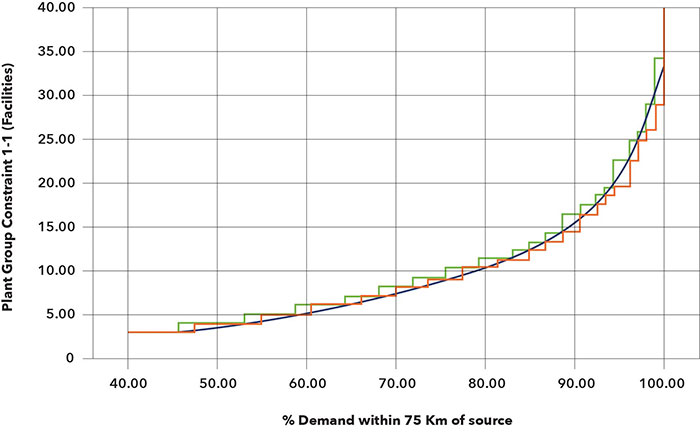
If 100% of customers had to be within 75 km, they would need 33 facilities. But the trade-off curve shows that they can reach 90% with less than half that number. Now, they can make a better decision.
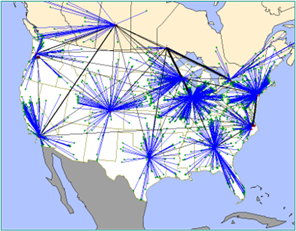
Another case that comes up in supply chain optimization is when you think that the objective is all about minimizing the cost (the big costs are transportation and facility costs). This is, for sure, the big driver of supply chain optimization. But when you minimize cost, you often see solutions that don’t make sense or would be hard to implement (e.g., Figure 3).
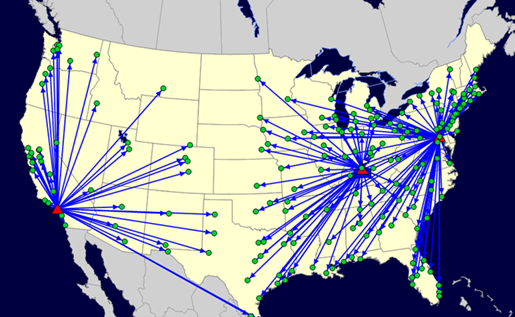
I’ve seen many solutions like this. The crossing lines always invite questions and confusion. In this case, the answer is correct. The facility on the East Coast has a lower facility cost, more capacity and some favorable transportation lanes. Therefore, it is cheaper than the facility in the Midwest. But many managers won’t like this.
Part of the reason is that this solution will be hard to implement and difficult to explain. Even though the cost is the major objective, simplicity and service are also important.
This is where hierarchical optimization comes in, which is a second objective that says something like, “Have all customers served by the closest warehouse as long as costs go up by less than 1%.” If you apply this logic, Figure 4 is a solution that is 0.47% higher than the original but much cleaner.
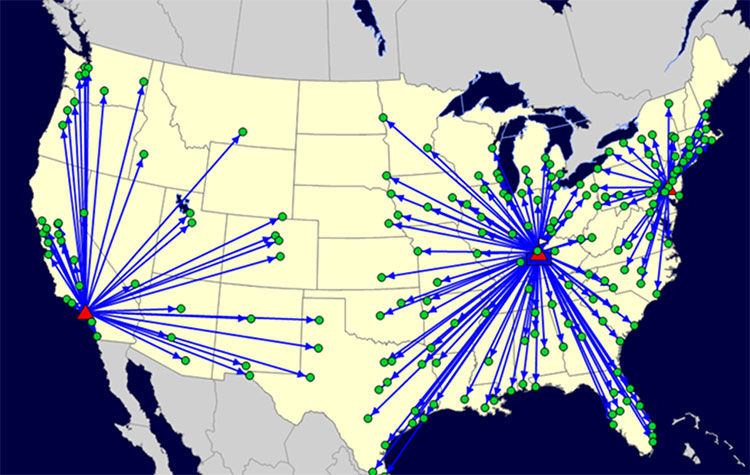
I like to think of hierarchical optimization as giving your model the ability to think like a manager. A manager is usually willing to give up a small amount on the primary objective to get big gains in a secondary objective. Hierarchical optimization allows you to find those solutions.
5. Your traditional supply chain modeling tool can help with risk analysis.
There are many innovative ways to think about supply chain risk. However, your supply chain modeling tool should still be used. Modeling tools are great for understanding how products flow, where facilities should be and where to make products. Figure 5 is a typical view of a solution.
Running different scenarios can help you understand risk and build a more resilient supply chain. I worked with a paint company that used their network model to understand the impact of a fire at each of their plants. They took a plant out of the model to see how much costs would go up and what demand would go unmet.
In another case, we were building a five-year plan for a chemical company. Something happened that caused a plant to close. The CEO came to our team and said: “Forget your five-year plan; I need you to take your model and focus on the next five weeks. Figure out which other plants can help and what customers will be impacted.”
If you keep an active model (sometimes called a digital twin), you can react and quickly mitigate problems.
6. Learn from the deep learning community and push for clean data.
The deep learning community does a great job of making sure that IT teams budget for and work on keeping large data sets. Supply chain analytics teams should fight for the same thing. I’ve seen too many cases where the supply chain team struggles with data on every project. With leadership teams recognizing how important the supply chain is, now is the time to build the data foundation that is needed.
7. Keep an eye out for new trends.
The practical AI space moves fast. There are probably hundreds of trends. Here are a few I like:
- In my time at Coupa, I came to love their strategy on community data. I see the idea as an extension of the big data movement from 10 years ago. Instead of data from one company, you can combine your data with other companies to do things that weren’t possible before. The CEOs of Coupa and Accenture talked about using community data to identify child labor in the supply chain – easier to do with community data. The Wall Street Journal published an article about banks sharing data to counter cyberattacks, which is more effective with community data.
- Although I knocked deep learning (and reinforcement learning) earlier, keep an eye on it. I’m not sure how these trends will help supply chain analysts, but I’m sure a few will.
- It is solving big problems like AlphaFold (for folding proteins).
- Natural language processing (NLP) is moving fast. Just now, in late 2022, OpenAI’s ChatGPT is creating quite a buzz.
- Finally, many supply chain researchers are exploring reinforcement learning. I would expect some interesting developments.
Author's note: A version of this article first appeared on https://miketalksai.substack.com/p/get-the-most-out-of-supply-chain.
Michael Watson is a decision scientist and faculty member at Northwestern University, and an entrepreneur. His last company was Opex Analytics, which was acquired by LLamasoft and then Coupa.