

April 12, 2023 in Healthcare Analytics
Healthcare and ChatGPT: What Lies Ahead?
SHARE: PRINT ARTICLE: https://doi.org/10.1287/LYTX.2023.02.12

The informatics world is currently being rocked by a single technology item. Can you name it? Yes, it is ChatGPT – the new wave-making generative artificial intelligence (AI)-based chatbot that is being targeted by all, from technology aficionado and entrepreneur-turned-investor Reid Hoffman to technology mogul-turned-billionaire philanthropist Bill Gates and healthcare technology pundits on the stage of SXSW in Austin, Texas. Everyone seems to be in awe of the tool and speculating about what it could do for humanity and its future potential. In a recent podcast interview, Bill Gates opined that the improvements in AI are the “most important” innovation at the moment. “This will change our world,” said Gates. He certainly knows a thing or two about technology and how it can change our world. Long before Steve Jobs came up with the iPad, it was Gates who proclaimed that the future of computing is not going to be the laptop but would be a much smaller device like a tablet. He could not make the right product at the time. Jobs nailed it a decade later, but Gates is a visionary, nonetheless. This explains why Microsoft’s current CEO, Satya Nadella, dashed after OpenAI, the developer of ChatGPT, to make a multibillion dollar investment in the company and later integrate its ChatGPT product into Microsoft’s beleaguered search engine Bing to beat Google in the search business. The Bing app even calls itself “Your AI copilot.”
In an interview right after the launch of the new Bing search engine, Satya Nadella said, “It’s not just a search engine; it’s an answer engine – because we’ve always had answers, but with these large models, the fidelity of the answers just gets so much better.” The answers, if given correctly, would be the game changer.
Therein lies the attraction for the healthcare industry. This column is not about technology. I discuss how new technology is shaping or about to reshape how healthcare is delivered, paid for and operationalized. Therefore, I thought this column would be a good opportunity to begin a discussion on this supposed game-changer technology, its evolution, promise and potential adoption paradigm in healthcare. I am not sure this is a single article topic, and I may have to come back to it multiple times as things change, new information emerges and my knowledge about this latest buzzword increases over time. I will share my journey here with my readers along the way.
What is ChatGPT After All?
I am quite sure that readers are well versed with this technology by now, even though a few months ago it was just a discussion item among the AI enthusiasts and some very early adopters. Once the chatbot was released, the proliferation of information happened like forest fire. Regardless, it may not be a bad idea to begin with a brief description of ChatGPT – what is this after all? Sometimes, the results of the technology dazzle us so much that many of us forget the origin story. ChatGPT is essentially a chatbot – the automaton or robot that can answer natural language questions. Many of us are accustomed to chatbots on websites such as product and service companies, which, for many years, have mostly replaced direct access to human customer service representatives with chatbots. I personally have not come across a single chatbot that can adequately answer my questions beyond some basic queries, and for most interactions, I actually either ended up getting transferred to a live agent or picked up the phone to call the customer service number and press “0” to talk to a live agent after waiting for 10 minutes or more.
That said, chatbot interactions did not enthuse me at all – not sure where readers stand on this. So, why is ChatGPT such a big deal? For starters, ChatGPT’s internal learning model is quite different from the traditional chatbot experience. Over many decades, AI has evolved from being basic rule-based to learning-based. Learning became deep and wide as new algorithmic models emerged and evolved, computing power exploded and learning data sets became abundant. All of this contributed to the development of ChatGPT, which is based on a new algorithmic model called “large language model,” or LLM.
LLM is a deep learning algorithm that can recognize, summarize, translate, predict and generate text and other content based on knowledge gained from massive data sets. These models are the successful application of “transformer models” that were pioneered by researchers from Google in a paper published in 2017. A transformer model is a deep learning model that learns from the context and sequential data such as the words in a written sentence.
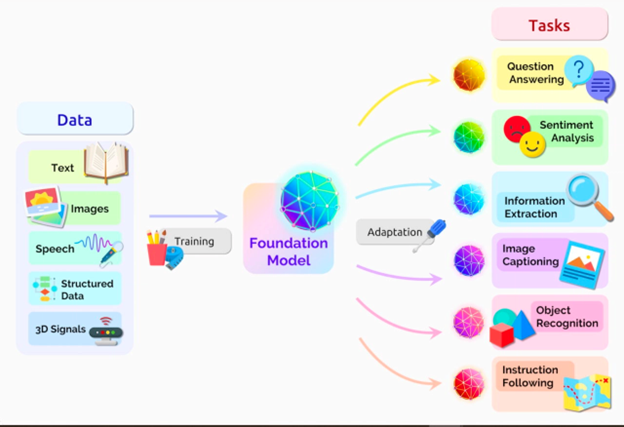
Transformer models are fast and can be run on parallel computing machine architecture, which makes it possible to create generative AI in real time without a long wait for the output.
In a transformer model, “positional encoders” are used to tag data elements coming in and out of the network followed by “attention units.” Mathematical calculation is done to create an algebraic map of how each element relates to others. Such attention queries are typically executed in parallel by calculating a matrix of equations. This kind of neural computing enables computers to see patterns and meanings in written sentences, similar to what a human brain would see. For example, let’s consider the following two sentences:
I poured tea in the cup from my kettle until it was full.
I poured tea in the cup from my kettle until it was empty.
Human brain knows that the meaning of “it” in the first sentence is “the cup,” whereas in the second sentence, “it” is “my kettle.” Transformer models with self-attention units help the computer understand meaning in the context of the sentence in the same way. That’s the real power of the transformer and hence ChatGPT, which is based on that, and why the output generated by ChatGPT is dazzling to so many people in so many professions and industries, including healthcare.
ChatGPT and Healthcare: A Blissful Marriage?
There is no dearth of training data in the world wide web to train generative AI algorithms like ChatGPT. It can also learn quickly. Hence, the chatbot has gained instant popularity among students, job seekers and even writers because it can easily produce meaningful output, including high school or college application essays, letters to a prospective employer or even book chapters. Reid Hoffman, founder of LinkedIn, recently published a book that he claimed to have “co-written” with ChatGPT. Interesting concept, isn’t it?
When it comes to healthcare, the promises are enormous. The ChatGPT algorithm can learn from electronic health record (EHR) data and physician digital notes to create new notes in the future from recorded vital signs or lab test results without involving a physician. It can create discharge instructions for post-acute patients, learning from instructions provided in the past with similar diagnoses, procedures performed, medication lists, problem history and lab results, eliminating the need for a discharge nurse. If the instructions are accurate, a less qualified or less trained caregiver in a post-acute facility can simply follow the instructions and administer all necessary steps for a recuperating discharged patient. In a country like the U.S., where the number of caregivers – family or otherwise – is dwindling compared with the aging population, this is the holy grail. But there are significant risks here. In some ways, ChatGPT is an improved model of what we have experienced in the failed experiment with IBM Watson. IBM tried to make Watson the savior of the healthcare industry and soon realized that it needed the support of the same people that it tried to replace – the clinicians. Clinicians had to train Watson’s decision support AI with data and knowledge before the AI could do anything meaningful in a clinical setting. Healthcare is not about producing a dizzying artwork of “me, the wolverine, the ocean and the thunderstorm” from a mere written statement or about writing an analytical high school essay. Healthcare is all about accuracy. Human life depends on it. Garbage going into the algorithm cannot be allowed. Despite the sense of context and meaning, ChatGPT, even in its current incarnation of ChatGPT 4.0, does not have the “common sense” that is “common” among humans, albeit some readers may want to argue against the last part. I get it, but in general, the above statement is true. One needs to train ChatGPT for all possible “common” scenarios. Ironically, it is also poor in logic and math! For example, it can’t answer: If 4 out of 5 people have 10 fingers and 1 person has 9 fingers, how many total fingers are we talking about? I am sure over time, human minds will solve these silly limitations, but not today. The stages of SXSW 2023 were lit up with the possibilities of generative AI, and several innovative companies are looking into this new technology to integrate into their digital health portfolio, but my belief is they will take baby steps. Much like ChatGPT, they will learn over a long period of time how to make this useful for human care. In the short term though, ChatGPT could find possible use cases in areas where multiple explorative ideas or pathways need to be generated and further researched (for example, in drug discovery or development).
Last Words
Let me conclude with a recent thought-provoking Twitter argument about AI made by Marc Andreessen, the famous co-founder of Netscape and partner of the venture capital firm Andreessen Horowitz. According to him, AI will bring down the price of products in all unregulated industries but will not be able to make a dent in regulated industries such as healthcare or education. Government will protect these industries from AI invasion and make AI illegal. In other words, he agrees with the argument I have made that healthcare may not see the uptake of ChatGPT anytime soon, but he is blaming government and regulation for that – not the inherent inaccuracies of the technology and the skepticism around that. This part is thought-provoking, but it is his perspective. I have mine, and I am sure readers have theirs. ChatGPT is already here. The future may not be evenly distributed, but the question is: How long will it stay that way? Do you think Marc Andreessen is right? Please feel free to continue the conversation via email to [email protected], on Twitter @ghosh_r or on LinkedIn when I post this article.
Rajib Ghosh is the founder and CEO of Health Roads, LLC, a consulting company for enabling digital transformation in healthcare organizations. He has 25 years of technology experience in various industry verticals where he had management roles in software engineering, data analytics, program management, product management, business operations and strategy development. Ghosh spent a decade and half in the U.S. healthcare industry as part of a global ecosystem of medical device manufacturers, medical software vendors, telemedicine and telehealth solution providers. He’s held senior positions at Hill-Rom, Solta Medical and Bosch Healthcare. His recent work includes leading data-driven digital transformation in the public health space, including county-level healthcare agencies and organizations focused on underserved populations.
([email protected])