July 11, 2023 in Generative AI
Adapt or Perish: Navigating the Evolution of Human-Machine Teaming
SHARE: PRINT ARTICLE: https://doi.org/10.1287/LYTX.2023.03.07
Key Takeaways
- Generative artificial intelligence (AI) is revolutionizing the way humans and machines work together.
- Businesses that fail to adapt to human-machine teaming will perish in the current technological landscape.
- As machines become more capable of generating new solutions and ideas, businesses need to develop new human-machine teaming models to stay competitive.
- By transitioning to two-way human-machine engagement models, augmenting leadership decisions with machine intelligence, reskilling the workforce and using generative AI with surgical precision, businesses can create an adaptive advantage.
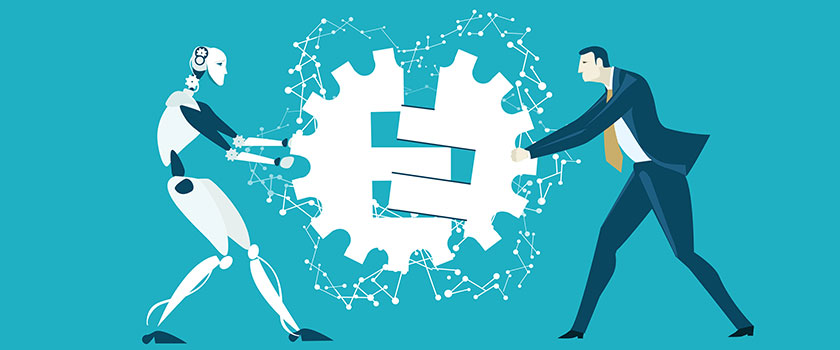
Technological advancements have been the cornerstone of human progress for centuries. From the Industrial Revolution to the present day, machines have helped humans improve their productivity by taking over lower-value tasks. However, the relationship between humans and machines has been characterized by a largely unidirectional relationship, with humans providing direction and machines carrying out tasks. This paradigm is rapidly changing with generative artificial intelligence (AI), and businesses that fail to adapt to human-machine teaming will perish.
Generative AI will force a change in the mental model of how we think about machines. Machines are now capable of generating new solutions and ideas, blurring the lines between what humans and machines are responsible for. This will revolutionize businesses and lead to more effective and efficient solutions. However, businesses will need to quickly develop new human-machine teaming models. Humans will continue to complement machines but in vastly different ways.
Industrial machines, animation tools, analytics software, surgery robots and more all revolutionized the way we work. But generative AI will be much more disruptive with its bidirectional paradigm and rapid pace of change. Just as with species, businesses and workforce participants who quickly adapt will thrive. To create an adaptive advantage, businesses need to consider four key levers. This article explores specific examples of how businesses can adapt to the evolution of human-machine teaming.
Transitioning to Two-way Human-Machine Engagement Models
The solution-finding process still needs human-machine collaboration, but the nature of the process will change. Generative AI can now provide a very good starting point, especially for repeated tasks. For example, in responding to a customer complaint, instead of having generic text, generative AI tools trained on past service responses and specific customer history could generate a very customized text that needs little editing. This would free up time for customer service (CS) employees to focus on more complex issues and challenges of the customer experience – for example, instead of sending emails, CS employees can make phone calls for critical issues and provide a more human touch. This might not have been possible earlier because of the customization effort needed by humans for all email responses.
Generative AI can also be applied to very complex areas in which machines can help wade through data to run thousands of scenarios and present only the most plausible ones for human evaluation. For example, Toyota Research Institute (TRI) and Northwestern University collaborated to develop a nanomaterial “data factory” to expedite the discovery of new materials using AI. The process helps explore vast parameter sets and collect data, enabling AI to search for the most appropriate materials for specific applications. The factory’s first application is to discover catalysts that can enhance fuel cell vehicles’ efficiency and find wider applications, including hydrogen production, carbon dioxide removal and solar cells, opening exciting possibilities for the future of clean energy.
It is common to think that all these efficiency gains and automation could have a severe impact on the job market. There will no doubt be some jobs that will become redundant, but, as with the past technology revolutions, there will always be a need for human-machine teaming, just in new ways. It is hard to predict which jobs and industries will see the most impact. On one hand, some of the most mundane jobs with repeated tasks seem to be prime candidates; on the other hand, the impact could even be seen in the creative field, in which generative AI might be able to think through more creative options than a human mind. Regardless, our thinking will have to emerge from a one-way to a two-way engagement model. The organizations and workforce constituents who quickly become comfortable with this idea and identify the specific use cases in their organizations in which AI can be leveraged will have an edge.
Augmenting Leadership Decisions with Machine Intelligence
Leadership decisions are critical to the success of any business, and they are often made based on experience, intuition and assimilation of information. However, with the advent of generative AI, machine intelligence can augment leadership decisions and provide new insights that may not have been apparent. The typical data-driven decision process today entails the creation of reports and dashboards that are presented to the leadership. Even the most advanced of these dashboards only have the precreated ability to do deep dives. This limits the number of insights one can glean from the data. Generative AI tools are developed to tackle this analytics problem and would be able to understand the nuanced drivers behind internal trends, combine them with market and competitor trends and then be able to present scenarios that could happen to assist in decision-making.
Reskilling Workforce and Rewarding Skills: Creativity, Collaboration and Empathy
Generative AI will change the nature of work and require a new set of skills. As machines take on more routine and repetitive tasks, skills such as creativity, collaboration and empathy will come to the forefront. For example, in engineering jobs today, a lot of time is spent writing code and researching ways to solve a problem. For tough problems, several hours a day could be spent on researching, sifting through Stack Overflow and searching Google to identify a solution or the right syntactical way to structure the code. Similarly, much time is spent on code improvements, efficiency improvements and documentation. Even with tools such as GitHub Copilot, an expert engineer is necessary to make effective use of the tool. This could change in fundamental ways.
First, even for complex problems, an engineer would spend less time writing the code but more time working with all the stakeholders in the organization to understand the right issue to develop the right solution. Today, there is a lot of organizational complexity with product managers, project managers and analysts in the mix. In the future, a single engineer would have the bandwidth to complete several of these tasks, hence changing the nature of the job and the skill set required. Second, for less complex tasks, an engineer might not even be needed. Generative AI would enable anyone to write code with simple English instructions. In such an environment, being creative in using these tools, collaborating with others in the company and being a “people person” and team player will become paramount. To reward this, companies would need to change their performance metrics and reward systems as well as provide the requisite support for employees to reskill or upskill.
Using Generative AI with Surgical Precision – Only Where It Creates a Competitive Advantage
One of the biggest challenges of adopting generative AI is knowing where and when to use it. With its ability to generate new solutions and ideas, generative AI can be a powerful tool in many industries. However, it is important to use AI with surgical precision and only in areas in which it creates a competitive advantage. One of the first-priority areas for organizations to leverage AI should be to fix their data fundamentals. Once that is done, even simple descriptive analytics can serve a majority of the business use cases. Then, organizations can leverage predictive analytics and analytical AI technology for many use cases, such as churn detection or predictive maintenance. For generative AI to work well, there has to be robust data available to train the models for organization-specific use cases. It is only when the models can be trained in a custom way for the organization that the true power of these technologies can be unleashed. However, if the organization is not there yet, AI can still be useful for certain generalized use cases such as code improvements, documentation, marketing messages development, etc. This can certainly improve organizational efficiency through human-machine teaming. Generative AI is currently in a “hype cycle”; therefore, it is important to differentiate between initiatives that will create distraction versus competitive advantage.
Generative AI is revolutionizing the way humans and machines work together. As machines become more capable of generating new solutions and ideas, businesses need to develop new human-machine teaming models to stay competitive. By transitioning to two-way human-machine engagement models, augmenting leadership decisions with machine intelligence, reskilling the workforce and using generative AI with surgical precision, businesses can create an adaptive advantage. However, it’s important to note that generative AI is not a silver bullet. It remains important to use AI in areas in which it creates a competitive advantage, and is a need to balance it with human decision-making. By doing so, businesses can navigate the evolution of human-machine teaming and thrive in the new era of artificial intelligence.
Shreshth Sharma is a technology strategy and operations executive specializing in human-machine teaming and data-driven decision-making. He has 15 years of experience across management consulting, technology and media industries in leading firms such as BCG, Sony Pictures and Twilio. Currently, he is senior director of strategy and operations at Twilio and leads Twilio’s Enterprise Data team.