December 6, 2023 in AI and Education
How to Create an Advanced Artificial Intelligence Platform for Education
SHARE: PRINT ARTICLE: https://doi.org/10.1287/LYTX.2023.04.18

The utilization of advanced artificial intelligence (AI) technology holds significant promise for revolutionizing education. AI has the capacity to enhance learning experiences and deliver tailored instruction, thereby affording educators and students access to highly efficient and impactful learning tools. In this article, we will explore the implementation of AI in education and showcase instances of AI applications currently integrated into educational settings. Furthermore, we will delve into the creation of AI programs and consider important factors to keep in mind when developing educational AI initiatives.
Values of AI for Students
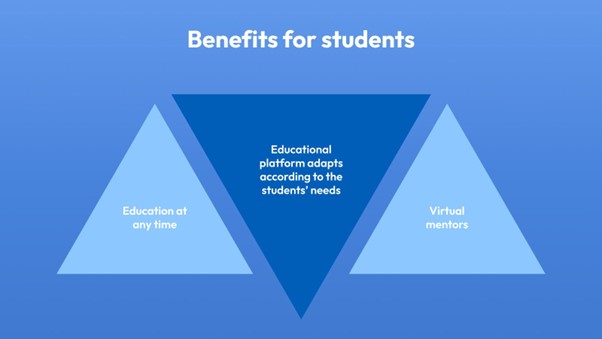
The advantages of AI for students have become increasingly apparent. AI programs are emerging as indispensable tools that provide students across diverse educational backgrounds with valuable assistance in tasks such as learning, research, problem-solving and communication.
One of the most evident benefits of AI is its ability to save students valuable time. Instead of investing hours in research or essay writing, AI can swiftly and accurately search for information, compile relevant content and even help generate essays. This liberates students to allocate more time to conceptual learning or engage in creative endeavors.
Furthermore, AI technologies are progressively employed to deliver personalized instruction and assessment. By analyzing data derived from students’ interactions with educational materials, AI can track their progress and adjust the learning experience accordingly. This empowers educators to craft tailored curricula and instructional plans that cater to the distinctive needs of each student.
In addition to academic advantages, AI offers a variety of social benefits for students. By furnishing an engaging and interactive learning environment, AI can inspire students to learn more effectively. Interactive chatbots, for instance, enable students to seek real-time answers to questions and receive feedback, creating opportunities for further discussion and collaboration with their peers.
Advantages of AI for Teachers and Programs
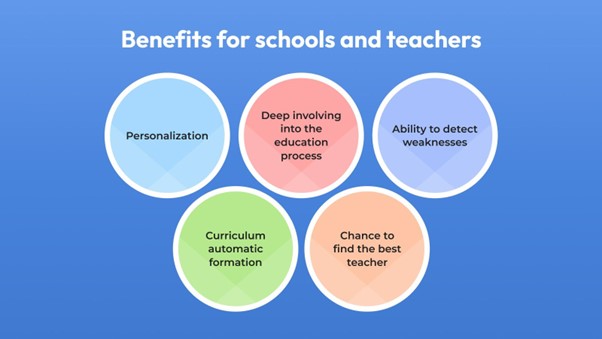
AI technology has numerous advantages if you need to create an educational website and address the needs of teachers. One significant benefit is that it allows educators to allocate more time to curriculum planning rather than administrative duties. AI can automate tasks such as grading, assessment and record-keeping, enabling teachers to prioritize their primary objective of facilitating student learning.
Another advantage of AI is its ability to assist educators in developing personalized curriculum plans by analyzing student data. By doing so, educators can identify students’ areas of strength and weakness and adapt their teaching methods accordingly. This individualized instruction has the potential to enhance academic performance and improve overall educational outcomes.
AI can provide cost savings for schools by automating such tasks as grading and assessment, reducing the need for manual labor and saving money in the long term. Furthermore, AI technology enhances student engagement with course material through interactive learning experiences that students find stimulating and enjoyable.
The Use of AI in Education
Google’s AI-based classroom management system, Google Classroom, has changed the way educators assign and distribute tasks to their classes. With an effort to make learning more interactive and accessible, Google Classroom aids teachers in assigning tasks while also providing feedback to evaluate student performance. By utilizing AI algorithms for grading assignments, Google Classroom can save time for educators and deliver safe and secure assessments with an automated regimen. Recommendations on course material can also be personalized to a student’s individual requirements. Additionally, student data can be examined using AI models to deliver insights into a student’s growth and performance.
In addition to Google Classroom, Google Translate and Google Scholar are two other popular tools that leverage AI capabilities in education. The integration of language translation technology takes online language learning applications to new heights. English as a second language students can receive instantaneous translations of written or spoken words along with well-defined definitions and context information on unfamiliar words. Similarly, the use of Google Scholar has been beneficial to students by providing access to academic papers from leading universities around the world, which are used for research projects and as supplemental materials for courses.
Machine Learning Applications in Education
Thanks to technological advancements, the integration of AI into the field of education is on the rise. AI has found its place in education by leveraging enhanced computing capabilities, and its popularity stems from its ability to swiftly and accurately process vast amounts of data.
AI offers a diverse range of education applications that streamline various tasks and enhance the learning process. For instance, personalized learning paths in which AI learns from individual inputs and continually improves its capabilities. This approach tailors educational content to students’ unique comprehension levels and recommends the next steps in their learning journey. Moreover, AI can facilitate tutoring systems that offer audio feedback for tasks like speech recognition, video playback for teacher interactions or language-learning apps that provide pronunciation guidance. Robotics also come into play, aiding in the teaching of subjects such as physics, mechanics, electronics, programming and sensors, all while delivering an engaging educational experience.
Furthermore, AI-generated intelligent agents supplement traditional teaching methods, allowing teachers to provide mentorship experiences 24/7 at a significantly lower cost compared to human tutors. Finally, natural language processing is used in online forums and AI-driven chatbots, ensuring prompt and accurate responses to student queries.
The mentorship experiences can be provided through the following education digital strategies:
- Automated Grading: AI-based automated grading systems can assess student work quickly and accurately, freeing up instructors’ time to provide more personalized feedback.
- Personalized Learning: AI can be used to track and analyze data about each individual student’s learning habits, allowing teachers to tailor lesson plans for their students’ exact needs.
- Adaptive Learning Platforms: AI-based adaptive learning platforms can provide a customized learning path for each student, allowing them to progress at their own pace.
- Robotic Tutors: AI-powered tutors can help students learn complicated topics with visual and interactive teaching methods.
- Digital Classrooms: AI-driven digital classrooms are ideal for online learning, providing an interactive and engaging learning environment.
- Intelligent Agents: AI-based intelligent agents can supplement traditional teaching methods by offering 24/7 support to students.
- Intelligent Search Engines: AI-powered search engines can help students find relevant information quickly and easily, reducing the need for them to manually sift through search results.
- Natural Language Processing: These technologies can be used to understand student queries and provide appropriate responses.
- AI-based Chatbots: AI-driven chatbots can answer student questions quickly and accurately, providing instant feedback.
- Automated Writing Evaluation: AI-based writing evaluation systems can assess written work quickly and accurately, allowing educators to focus on providing quality feedback rather than just grading assignments.
How to Make an AI Platform for Education
Many organizations and institutions are exploring ways to create AI platforms for education that can help educators and students overcome challenges in the classroom.
Creating an AI platform for education requires a multifaceted approach that takes into account the needs of various stakeholders, such as students, teachers, and administrators. Generally, the process of creating an AI platform can be broken down into four main steps:
- Identifying Use Cases: The first step is to identify potential use cases for AI in education. This includes understanding the challenges that educators and students face on a daily basis as well as identifying areas in which AI could provide a solution or improvement.
- Developing Technology: Once the use cases have been identified, the next step is to develop the necessary technology that will enable AI-driven solutions. This includes developing algorithms and writing code for an AI platform that can handle the identified use cases.
- Deployment: After the technology has been developed, it needs to be deployed on a platform in order to make it available for use. This could involve deploying the AI platform on a cloud-based system or an on-premise solution.
- Continuous Improvement: Lastly, the AI platform needs to be continuously improved through testing and data collection to ensure that it is providing an effective solution for educators and students. This includes running experiments and collecting feedback from users in order to improve the platform over time.
With these basics about advanced educational AI-based solutions, the next step toward creation is finding a skilled education software development vendor to help achieve your goals.
Yuliya Melnik is a technical writer at Cleveroad, a web and mobile application development company in Ukraine. She is passionate about innovative technologies that make the world a better place and loves creating content that evokes vivid emotions.