April 18, 2024 in 2024 INFORMS Analytics Conference
From Data to Action: Plotting, Stage Setting and Directing Your Data-driven Ecosystem
SHARE: PRINT ARTICLE: https://doi.org/10.1287/LYTX.2024.02.04n
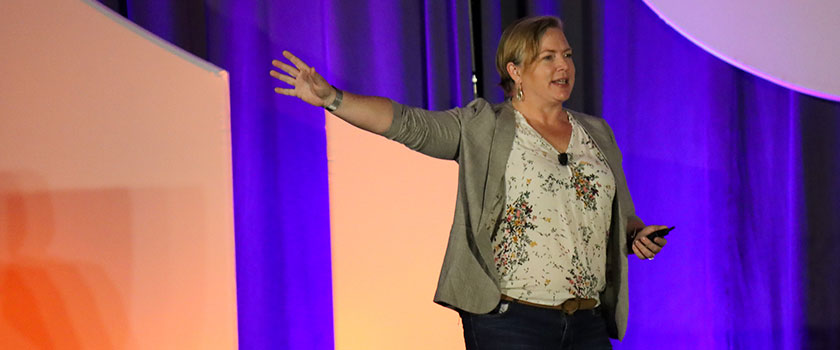
When you tell a story, you start by setting the scene, which is best illustrated using a plot map showcasing each step in your story process from the beginning to rising action, then the big moment and finally, the resolution.
It’s the same construct when talking about turning data into action, according to Col. Kristin Saling, the INFORMS 2024 Analytics Conference day two keynote speaker.
Saling is the acting director, Innovation Directorate, U.S. Army Recruiting Command. Her talk, “From Data to Action: Plotting, Stage Setting and Directing Your Data-driven Ecosystem,” delved into the inner workings of military data collection, process and takeaways.
She described the landscape of data within military environments as a road trip from data collection to transformations, whether they succeed or fail and why, the building blocks and modernization spiral, and key takeaways.
Saling began by detailing the landscape of data and what that means. She said this can be anything from data collection to statistical analysis, text analysis, machine learning, data visualization and/or intelligence process automation.
From there, you move to transformations. Saling first discussed when things fail and why. In an instance of “we bought software to improve processes,” failure may be associated with an adoption rate of less than 6%, or the head decision-maker or boss decided to go with their gut rather than do their due diligence. In other scenarios, it could be a failure associated with something as simple as slide deck malfunction or executives simply changing their minds.
With these possible failures in mind, it’s important to always understand the key components of the analytics ecosystem. This starts with people. Here, Saling is talking about business leaders, data scientists, etc. Next comes understanding your platform, processes and lastly, factoring in the culture.
Saling said that the Army in particular is typically stubborn. It takes time to see movement. “We need to have a lot of people understanding what we’re working on,” she said.
Saling continued, “the hard part is never the analytics, it’s the culture, the decisions, the conversations and getting your decision-makers to buy in on it.”
These components of the analytics ecosystem are illustrated in what Saling calls, “The Modernization Spiral.” It’s the same four components she previously mentioned; however, when illustrated, it really showcases how each one feeds right into and builds upon the other. If you don’t start by understanding the people involved, you can’t accurately identify your processes and so on.
Saling wrapped up her discussion by summarizing her thoughts on turning data into action and how to do so effectively. She said it’s essential to understand that you can’t buy your way to modernization. To turn data into action in a way that will last, you have to factor in that real people use platforms for processes and culture. It’s a series of ideas, tests and assessments – on repeat.
“It’s okay if it doesn’t work. It’s worth it to try, then let go of things that don’t work in order to find the things that do,” said Saling.
“Data has no context, give it a story. Ready, set … action!”