

April 19, 2024 in 2024 INFORMS Analytics Conference
2024 Edelman Award Winner Reprise: O.R. Enhances Data-driven Ferry Operations at Molslinjen
SHARE: PRINT ARTICLE: https://doi.org/10.1287/LYTX.2024.02.05n
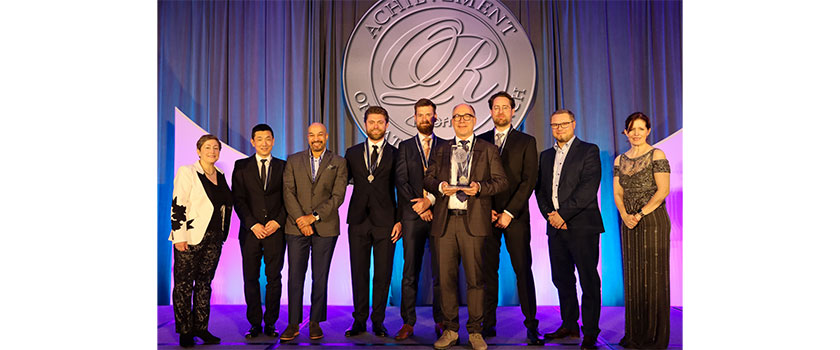
Still surprised, excited and humbled by the Edelman Award win, Pierre Pinson took time during Molslinjen’s award-winning reprise to properly accept the win and give thanks Tuesday morning after an emotional evening.
Molslinjen is the Nordic ferry industry leader and is transforming ferry operations with data and artificial intelligence (AI). Although their name might be hard to pronounce, it’s a name that will become well known as the 2024 Edelman Award winner.
Molslinjen partnered with Halfspace to develop and operate a bespoke forecasting and revenue management toolbox for data-driven operation of ferries in Denmark. The system allows for better and faster packing of vehicles in the cargo area and increased utilization while reducing delays, fuel costs and emissions. The dynamic pricing engine for revenue management allows better set prices based on contextual information and regulatory constraints. The program was rolled out operationally in 2020 and has resulted in up to $3.2 million in yearly savings. It has also contributed to a 60% time reduction in operations planning, and 3% reduction in fuel costs and emissions.
The ferry industry can be overlooked, but the Nordic Ferry Infrastructure Group ferries 22 million people annually – similar to commercial airline industry. In 2023, Molslinjen moved 15 million passengers and 7.8 million car equivalent units (including motorcycles, cars, large trucks, etc.) with 21 ferries among 10 routes.
Using Data and AI to Rethink Passenger Ferry Operations
Molslinjen was established in 1963 and became an efficient way to connect the eastern and western sides of Denmark. Throughout the years, Molslinjen expanded and engaged operations research to help with the growing demand. In 2019, forecasting and packing engines became operational, with the ability to predict demand for a specific departure up to one year in advance. According to Molslinjen COO Jesper Skovgaard, the company was acquired by EQT in 2020 to strengthen efforts in the digitalization of its operations. Two years later, Molslinjen’s revenue management engine was operational with the help of Halfspace.
Now, in 2024, Molslinjen has been established as a visionary leader in digitalizing ferry operations and has set out an AI roadmap. This digital ambition was brought by an experienced team brought over by the airline industry to help the ferry industry reinvent itself.
Claus Bek Nielsen, CEO of Halfspace, said they were just as driven and ambitious, and found a unique value proposition with Molslinjen. Halfspace considered themselves outsiders with “no baggage” – anything was possible in this partnership. The AI company started in sports and then healthcare, retail, marketing and the energy sector. But their success is most closely tied to its partnership with Molslinjen. But how do you go from being a traditional ferry operator to a leader?
Think Big, Start Small
Molslinjen needed to solve a vehicle packing problem through optimization, and needed a forecasting engine for packing, which was also used to move the ferries, and then forecasting for passengers and vehicles. Time to optimize!
Halfspace learned everything it could about Molslinjen and the passenger ferry industry, and in turn, Molslinjen was able to learn what AI can do. Nielsen said that 5-6 years from now, every single one of Molslinjen’s 10 routes and 15 million passengers will be green and have optimized capacity, and use AI tools from price setting and commercial operation of the ferry routes.
This was made possible by taking the way you think in the airline industry and bringing it to the ferry industry by applying analytics and AI. More efficient operations, forecasting and price setting touch every part of the ferry operating organization.
Data, Forecasting, Optimization and Operational Practice
But it wasn’t as simple as applying the exact methods from the airline industry to the ferry industry. Changes needed to be made, particularly due to departure complexity. In ferries, there can be up to 1,000 passengers and 300 vehicles per departure. Customer classes also need to be taken into consideration (e.g., business customers who can board without booking, arrive late and are guaranteed the first to disembark). And you have to allot for only 20-30 minutes between ferry departures.
Vehicles arrive in multiple lanes and weight needs to be evenly distributed. Operators guide cars in the ferry and its various parking compartments. To make packing configuration decisions, operators need to know what types of cars will be coming and their customer class. For example, operations can assign a 2x2 (2 lines of cars, side-by-side) or Zipper configuration (3 lines, staggered). Capacity usage must be maximized!
According to Mikkael Bjorn (Director of Data Science at Halfspace), their tool is usable on an iPad/tablet on the wrist of the ferry operators ready to pack cars – as cars arrive, they see the car in real time on the tool. Now that they know what cars have arrived, they must decide how to price each of those tickets; a ticket isn’t just one ticket – a person versus an entire car.
The data platform and decision tools have been built and executed but they aren’t done yet! They are working on incorporating an innovative forecasting system. Forecasting demands does not just mean quantity in the ferry industry, but types of vehicles and customers.
Molslinjen used a nonlinear regression tool for a three-step forecasting approach: initial, iterative and real-time. Timeline data and decisions (1 year prior) were used to inform current decisions. There was a 20%-35% improvement compared to the status quo benchmarks from 2022-2023.
Before: Manual process
After: AI-powered process
Dynamic Pricing Strategy
As noted, Molslinjen’s pricing strategy was inspired by the airline industry and cruise ships. Two key technical challenges were addressed (remaining capacity for ticket sales was unknown, and all low-fare tickets were the same). Bjorn said they didn’t want to reinvent the wheel, but taking a process from one project (industry) to another, there were necessary changes.
Halfspace built an intelligent and efficient revenue management system that maximizes revenue from all departures based on customer willingness-to-pay. One platform for dynamic pricing. Successful outcomes included:
- 5% decrease in the number of delayed departures
- 90-second reduction in average departure delay
- 3% reduction in overall fuel consumption
- 6% increase in available capacity utilization
- 60% time reduction in planning time
What’s next for the passenger ferry industry, and it’s 4 billion passengers (similar to airlines per year) and nearly 400 million vehicles?
Passenger ferries emit on average 226 gCO2 per passenger per km – high speed ferries emit 2x that amount (and ferries represent 3% of shipping industry).
If all passenger ferry operations followed Molslinjen’s 3% reduction, global reduction would amount to 3.3 million tons annually in passenger ferry emissions.
The solution developed by Molslinjen and Halfspace is 80% generic and 20% needs tailoring to the specifics of individual ferry operators, local practice, etc., which means 80% is transferable to other ferry companies!
In closing, Pinson said, “In five years, we came so far, and in five more years, could go even further. Our mission and hope is that others follow and do what Molslinjen has done to help continue transforming the ferry passenger industry.”
