June 17, 2024 in Network Design Analysis
A Practical Guide to Network Optimization: Identifying the Minimal Number of Distribution Locations to Achieve a Target Service Level
SHARE: PRINT ARTICLE: https://doi.org/10.1287/LYTX.2024.03.04

“How many distribution locations should our business have if we want to strategically position ourselves to be within 200 miles of 90% of our customers?”
Determining the most optimal distribution network is a common business problem, and one that is crucial to satisfy the growing market for a quick last-mile delivery. Because the last mile accounts for 35% to 50% of the total delivery cost across all modes of transportation, it goes without saying that setting up an effective network of distribution centers is a necessary part of supply chain strategy. The stakes are high: Opening too many centers in wrong locations will drive up fixed costs and erode margins; not having enough centers will result in delivery delays and unhappy customers.
But, despite its seemingly straightforward nature, finding the optimal solution to the question at hand is not easy, although not because of the optimization techniques themselves – those are very well known and have been used by supply chain practitioners and academics for many years. Instead, there are several unspoken uncertainties that could easily become caveats for an analytics team. In this article, I will examine three main follow-up questions one should ask to make the task at hand completely clear.
[The data used for all demo analyses is the population by county code per U.S. Census Bureau.]
Question 1: Does the business need to achieve the target service level for the entire United States or for every state?
The difference in wording is subtle, but these are actually two different strategies, and the business needs to understand the downstream impact of picking one over the other. To illustrate this point, let’s look at the population heat map for a group of U.S. states in the Southeast: North and South Carolina, Tennessee, Kentucky, Virginia and West Virginia. The population density is very uneven, with several pockets of higher density located quite far from each other.
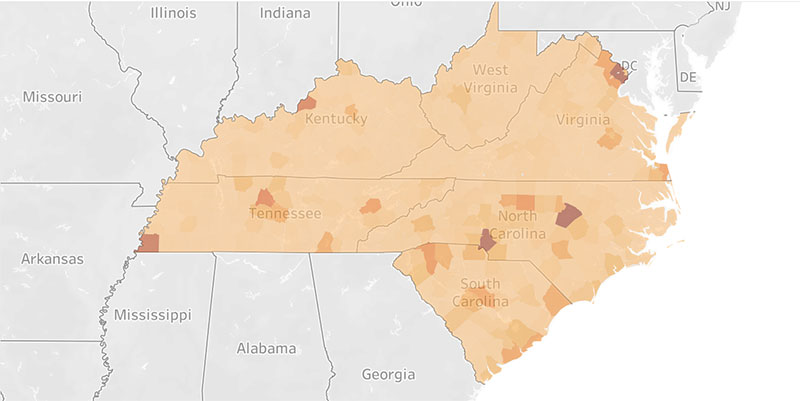
If the business needs to build a network of distribution centers that will enable a 200-mile coverage of 90% of the total demand, then it is not important to cover the areas with less density. An optimal network would consist of only five distribution centers, with none located in sparsely populated West Virginia. On the other hand, if the business needs to maintain the 90% service level in each state, then the optimal number of locations increases to seven. Therefore, Network 2 would have a 40% increase in the fixed costs, assuming those are relatively the same within the target geography.

It is a slight change in the verbiage but a big difference in the business logic and big implications for the business. Without realizing it, the stakeholders who adopt Approach 1 will end up with a dense network on the East Coast and a very sparse one on the West Coast (see Figure 3). This could have long-term consequences for market share and overall profitability.

For the West Coast of the United States, with its long distances and scattered population, the number of distribution locations required to maintain the target service level increases from 9 to 15 if the business uses the “state” logic. This is a substantially different network and a much more costly one as well, so being aligned on the strategy is critical.
Question 2: Do we account for 90% of customers or 90% of demand volume?
Some regions can have a high density of customers but low overall volume, whereas other regions could have the opposite. It is important for the stakeholders to be aligned on which one is the priority: serving as many customers as possible, regardless of the volume, or focusing on the largest regions.
To illustrate the difference these two approaches take when it comes to network strategy, let’s look at three U.S. states: California, Arizona and Nevada.
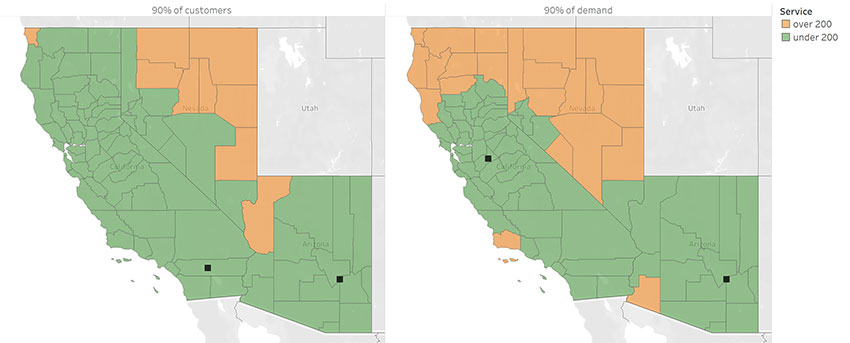
Similar to the previous question, choosing one logic over the other is the matter of business strategy and market dynamics. There is no “right” or “wrong” approach. Prioritizing total demand over the count of customers favors a network configuration with the optimal site located closer to the smaller, denser county codes. The supply chain team needs to discuss the long-term implications of each strategy and consider potential pitfalls.
For example, if a business has few customers overall, and some of them have significantly higher volume than others, using the “total demand” approach could be risky because the resulting network will be tailored toward the few outliers. What happens if the business loses those customers? New customers, provided the business acquires them, could be located elsewhere, so the previously designed distribution network would not be able to provide the desired 90% service level.
This would create a need for a swift, costly rework of the distribution network that would inevitably impact the bottom line and customer satisfaction.
Question 3: Is there a minimum and maximum throughput for each potential distribution center?
While analyzing the network for the target group of southeastern states and “all” optimization logic, it becomes clear that there is a big difference in the volume throughput between the suggested optimal locations: 4 million for the smallest one and 10.1 million for the largest (Figure 5). Although this could be acceptable for some businesses, for others, it would make the results of the optimization inactionable. The logical next step is to apply a minimum and a maximum threshold.
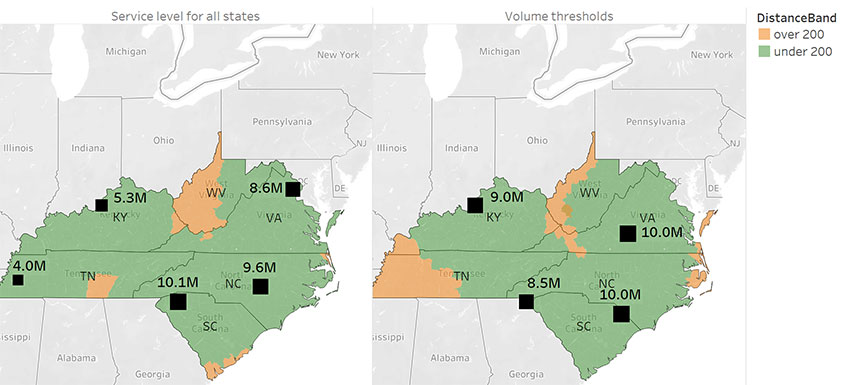
The number of optimal locations and their geographical position significantly change between scenarios. The scenario with volume throughput constraints has a much more balanced load by distribution location, with a minimum of 8.5 million and maximum of 10 million.
Running an optimization without a maximum volume threshold per distribution location has large implications for businesses. It could result in an optimization model that suggests an impossibly large single location. No minimum, on the other hand, might not be realistic either because of the associated fixed costs on administrative tasks.
A prudent approach would be to have a prior-to-modeling estimation of what an average throughput should be and to run the optimization with incremental percentage deviations, e.g., 15% above and below. Some of these scenarios will be infeasible, but that’s an inevitable part of the process. This is the part of the process in which the entire supply chain team can learn about business dynamics, constraints and the degree of what’s possible. It also enables the team to calculate the trade-off of having a minimal number of locations with a balanced throughput volume. Understanding these relationships between business variables is what makes a network design analysis extremely beneficial.
Conclusion
The questions analyzed in this article are by no means exhaustive. There are multiple other considerations that vary depending on business practices and stakeholder vision. Some additional questions that are useful in the discovery phase of a project include:
- How will the future business expansion influence current decisions regarding the distribution network?
- How do regional regulations and taxes influence the decision regarding where to locate distribution centers?
- What are the environmental considerations of different distribution strategies?
Regardless of the questions themselves, it is extremely important to understand the underlying business logic to make sure the whole team is aligned. Then, each and every piece can be incorporated into an optimization analysis. The team can then design the most cost-effective network that is tailored to the unique needs of the business in question.
Marianna Vydrevich is the manager of Operations Research & Network Optimization at GAF, North America’s largest roofing manufacturer. Marianna is a seasoned supply chain expert with a decade of global experience, specializing in supply chain network design and data science.