

July 30, 2024 in Healthcare Analytics
Cost-Effective Management of Revenue Cycle with Data and Analytics
A New Frontier in the 1115 Medicaid Waiver-Driven Social Care Landscape
SHARE: PRINT ARTICLE: https://doi.org/10.1287/LYTX.2024.03.10

I recently attended a conference in sunny San Diego, Calif., where leaders from different states, counties and community-based nonprofit organizations discussed the best ways to handle cross-sector coordination of care for the most vulnerable communities in the U.S. It was certainly an eye-opening conference. Opportunities to bring together healthcare and social care were discussed, as well as the development of more analytical solutions to adequately bridge the two.
However, there are several challenges. Managing the revenue cycle within smaller community-based organizations is a critical hurdle that several organizations are still learning. The excellent news is that owing to a growing nationwide awareness, health-related social needs are no longer the pariah in healthcare that seldom gets funded. For decades, policymakers, practitioners and social workers have recognized that to improve the health outcome of the most vulnerable communities in the country, health-related social needs should be handled as the fundamental building blocks. There was no shortage of recognition and acknowledgment of this, but not much sustained funding was associated with the two major government programs: Medicare and Medicaid. Several social determinants of health (SDOH)-related bills, on some occasions bipartisan, died on the Congress floor. Political analysts can look for the root causes of such failures. Still, the bottom line remained for the organizations providing health-related social needs services; they must rely only on philanthropic funding.
Since the passing of the Affordable Care Act (ACA) and subsequent expansion of Medicaid in many states, the situation has started to change – slowly but steadily. Many U.S. state health departments now realize that the cost of avoiding health-related social needs will hurt their ability to support the growing demand for healthcare among the Medicaid population. The states that have expanded Medicaid to include a broader population (a total of 40 states, so far) have started to ask the Centers for Medicare and Medicaid Services (CMS) – the federal agency under the broader U.S. Department of Health and Human Services – to allow them to utilize a small percentage of the Medicaid budget to fund specific “innovative” programs to pilot effective intervention mechanisms addressing health-related social needs. These “waiver applications” are called 1115 Medicaid waivers.
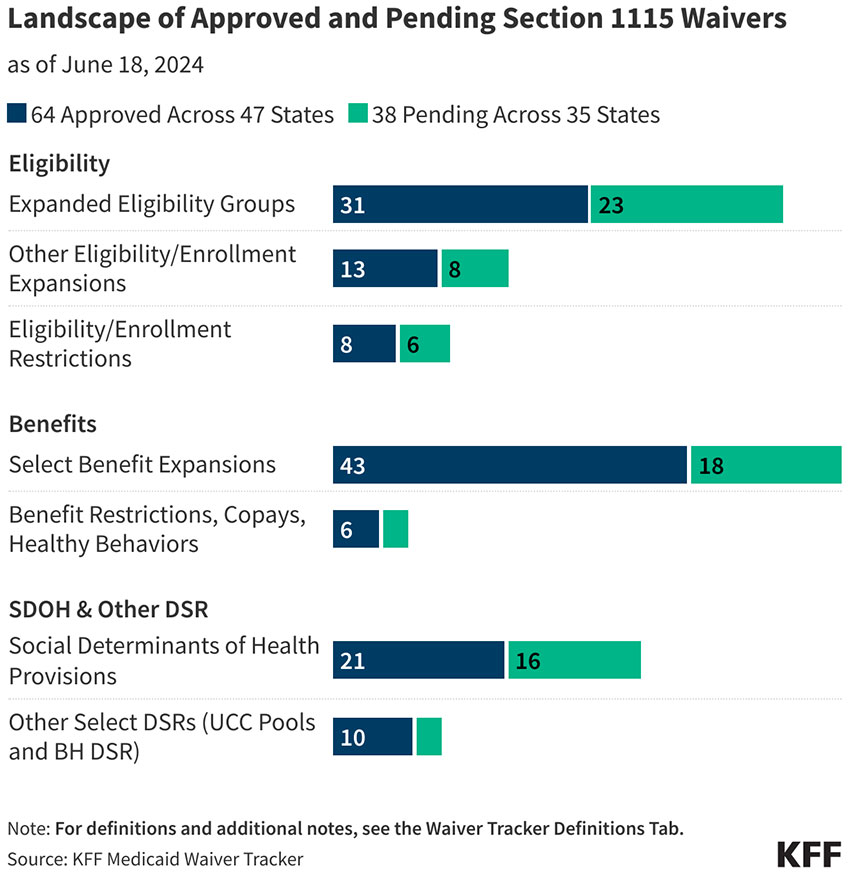
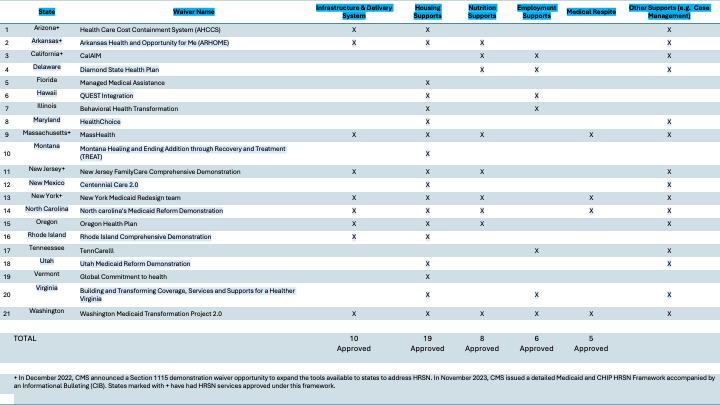
Currently, 21 states have 1115 Medicaid waivers approved by the CMS, including supporting programs with SDOH or health-related social needs (HRSN) – both terms are used somewhat interchangeably in the literature.
What are the Major Hurdles?
These waivers are supposed to be “budget neutral;” i.e., they can’t increase the Medicaid budget of a state. Additionally, the funding cannot exceed 3% of the state’s annual Medicaid budget. These guardrails have been put in place by CMS to control runaway expenses. However, despite the fiscal discipline the 1115 waivers demand, they act as lifelines for small, medium and large community-based organizations hungry for sustainable funding for their myriad social care programs. As shown in Figures 1 and 2, the waivers can support various kinds of social care programs. Around the country, many providers operate in those spaces. The critical question is how they can tap into this new revenue stream. Typically, 1115 waivers are approved by CMS for three to five years, with an option to renew for another five years. Therefore, the funding can run for about a decade. It is not a bad runway for many such organizations to sustain and ramp up their operations. Distribution of this funding differs from state to state, depending on the state’s implementation of the Medicaid system. In some states, like California, effort has been made to convert Medicaid into a managed-care organization (MCO) service, moving away from the traditional fee-for-service model. This move toward a “value-based” healthcare system is also being followed in states such as New York, Minnesota, Massachusetts and Oregon. In some other states, the traditional fee-for-service model is still prevalent. All Medicaid 1115 waiver money in California is currently distributed through the state’s contracted managed-care health plans, which were selected via a competitive bidding process. Community-based organizations are expected to contract with those managed-care health plans to provide services related to the 1115 waiver program. Regardless of the money distribution and management framework, challenges remained for the actual providers – how do they get paid efficiently, timely and accurately without needing to invest enormous amounts of staff time in learning the medical billing process or navigating the complexity of the health insurance world?
Why is Revenue Cycle Management Complex?
Managing a revenue cycle is one of the most fundamental building blocks of doing business and running an organization. Every organization should know where its revenue comes from, how its expenses are recorded and its bottom line. So, why are we even talking about this in 2024? Well, the framework of Medicaid reimbursement is new to the U.S. social care services industry, and the phenomenon is still unraveling. CMS has recently taken a step forward to instruct the managed-care health plans in the U.S. to reimburse service providers for health-related social needs services, also called “in-lieu-of-services” (ILOS). It is still a relatively soft approach. The MCO insurance framework for medical services has many complexities, from receiving authorization for certain services to submission of “encounter data” to measure “utilization of services.” The latter is a typical mechanism for conducting population health analytics and rate setting for “per member per month” value-based capitation contracts for services with providers. The same framework is extended to small, medium and large social care organizations providing ILOS or 1115-funded HRSN services. However, these organizations have never worked in this framework, unlike the medical providers who have learned the tricks of this business by sweating for decades. Despite that, medical providers still criticize prior-authorization requirements in medical services imposed by insurance companies as part of their utilization management.
What I am learning from the organizations in the social care landscape is that the learning curve is not just steep; it is expensive and often untenable. They do not have appropriate systems, such as electronic health records with practice management, sophisticated analytics systems or headcounts, to deal with the bureaucracies of the new framework through which the new funding is being distributed. Health insurance companies do not want to create a new IT system or “concierge service” model to help the newbies cross this chasm. I often use an analogy to describe this scenario – social care organizations are like a middle school basketball team, where insurance company “coaches” expect them to perform like LeBron James!
Emergence of New Models, Organizations and Companies
Challenges bring new opportunities. Opportunities bring people and organizations together to create something new. Plenty of initiatives are happening at the county or regional levels in which communities are bridging gaps by building networks called a Community Information Exchange (CIE). CIEs are multistakeholder nonprofits that try to weave value propositions for the participants using technology, shared governance, collaborative leadership and data exchange. Participants, which in most cases include social care organizations, can benefit from not having to do the heavy lifting of some of the administrative burden – for example, referrals to and from health insurance plans for service or submission of claims.
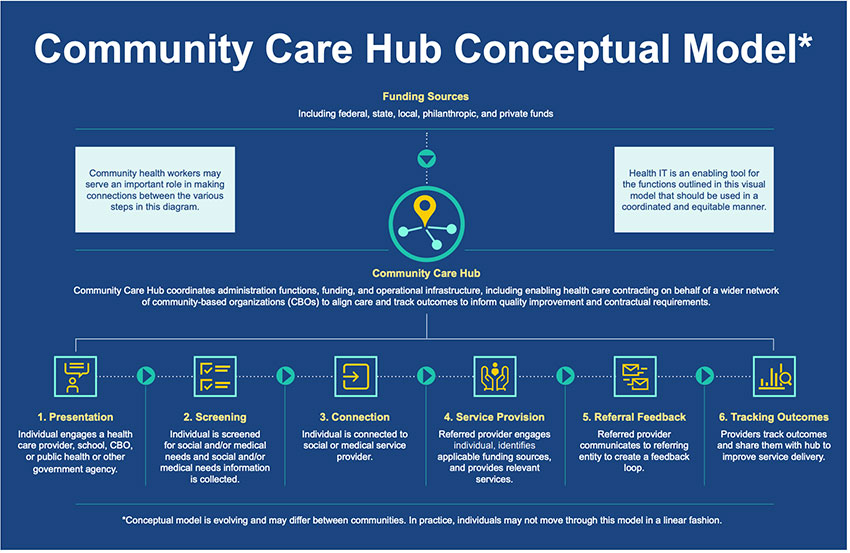
Another emerging model is a service aggregator model called “Community Care Hub” or “Accountable Community of Health,” which is led by a local nonprofit that is lending a helping hand by offloading some of the administrative burden of people, processes and technology to participate in the managed-care Medicaid. An excellent opportunity exists to utilize analytics in such aggregator models to understand what is happening across a large community of participating social care service organizations. New startups are forming that can help Community Care Hubs scale their operations, provide cost-effective revenue cycle management solutions and make this model sustainable for a broad range of social care organizations using analytics such as predictive models and generative AI.
Finally, I have noticed that these social care organizations are obliterating the dividing line between medical, behavioral and social care services, which is what they are expected to do when a client with various needs walks through their door! There is “no wrong door” for a vulnerable person in need, and the juxtaposition of services is a social reality that these organizations face daily.
Key Takeaways
I found three key takeaways from the recent conference I attended, and I hope the readers will agree. First, the world of healthcare is changing by breaking artificial barriers for the first time and embracing the concept of treating “the whole person.” Policy-wise, this was a taboo for a long time, but it seems slow. Indeed, the needle has started moving in the right direction. Second, considerable pain exists among service providers that want to take advantage of the new Medicaid funding scheme of 1115 waivers or ILOS reimbursements. The square peg is still being driven through a round hole and is not working well. Last, but not least, new networks and companies are emerging to tackle this problem with an attitude of holding the bull by the horns. My company, Health Roads, falls into that category, and I am delighted to find ourselves in the august company of such willing innovators.
Rajib Ghosh is the founder and CEO of Health Roads, LLC, a consulting company for enabling digital transformation in healthcare organizations. He has 25 years of technology experience in various industry verticals where he had management roles in software engineering, data analytics, program management, product management, business operations and strategy development. Ghosh spent a decade and half in the U.S. healthcare industry as part of a global ecosystem of medical device manufacturers, medical software vendors, telemedicine and telehealth solution providers. He’s held senior positions at Hill-Rom, Solta Medical and Bosch Healthcare. His recent work includes leading data-driven digital transformation in the public health space, including county-level healthcare agencies and organizations focused on underserved populations.
([email protected])