October 10, 2024 in Case Study
Decoding Klarna’s $40 Million AI Secret: 3 Steps to Enterprise AI Success
How a fintech giant transformed customer service and saved millions with AI – and how you can too
SHARE: PRINT ARTICLE: https://doi.org/10.1287/LYTX.2024.04.10

Imagine handling 2.3 million customer inquiries in one month, slashing resolution times by 80%, decreasing repeat inquiries by 25% and saving $40 million – all with the help of artificial intelligence (AI). That’s the reality that Klarna achieved. In a recent interview with Sequoia, Klarna CEO Sebastian Siemiatkowski said he cannot reveal the secret sauce. It is a source of competitive advantage. This article tries to decode Klarna’s “secret sauce.” Learn how to replicate this success in your enterprise in three steps.
Step 0: Go Beyond Technical Architecture – A Holistic Approach
Although Klarna’s technical implementation would have been crucial, its success story goes beyond mere technology adoption. The fintech company seems to have cracked what most will fail at. Klarna got the data engine, the organizational engine and the AI engine to work together.
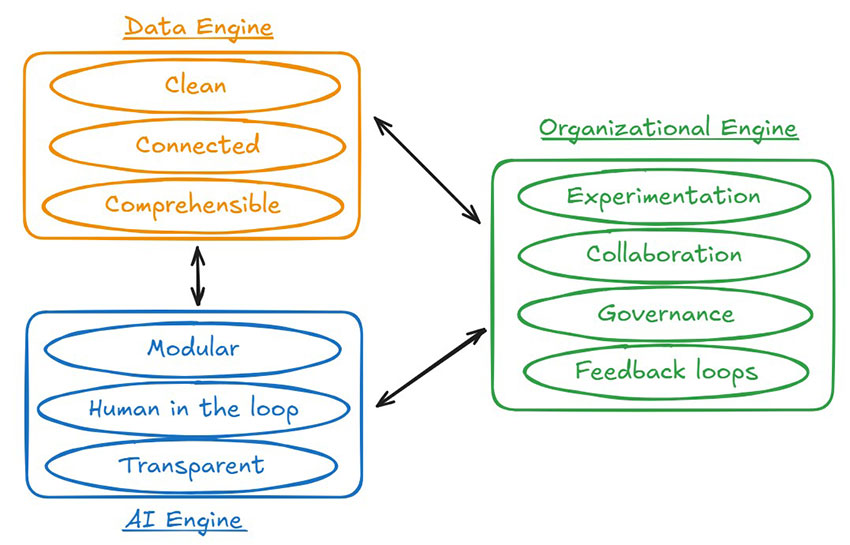
Step 1: Data Engine – The Foundation of Success
There are plenty of vendors and research available for any motivated tech team to implement AI. But feeding it with the right data is the biggest challenge. The data engine is therefore the most important step, but also the most difficult. This is because most enterprises have bad-quality data and data sets do not connect. Hence, setting up the data engine correctly is the most important thing.
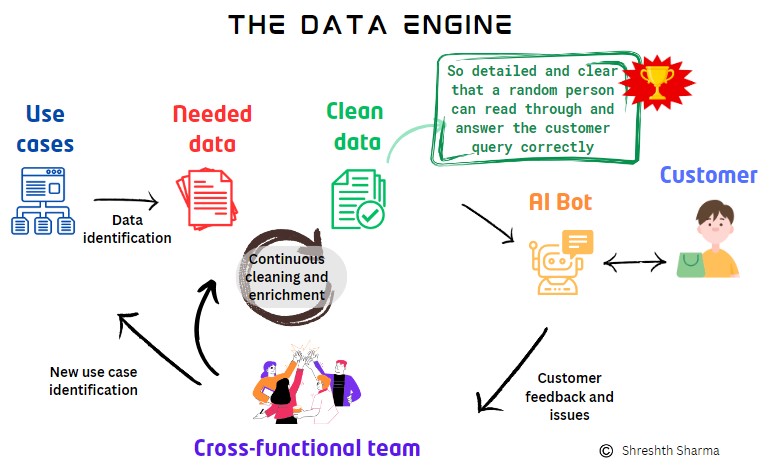
The three levers to get this engine running correctly include the following:
- In the context of large language models (LLMs) and service chatbots, the documentation it is fed is the most important data. Klarna’s CEO Siemiatkowski said they made a “documentation that is detailed enough so you could…put any random individual, and they could slowly go through your FAQ and manuals, but actually answer a question correctly because it was documented at level.” And it makes sense: If you don’t provide your bot with enough information, then it will not perform.
- The data needs to be connected and easily referenceable. A knowledge graph is a powerful way to store data based on relationships between data.
Here is an intuitive example of a knowledge graph:
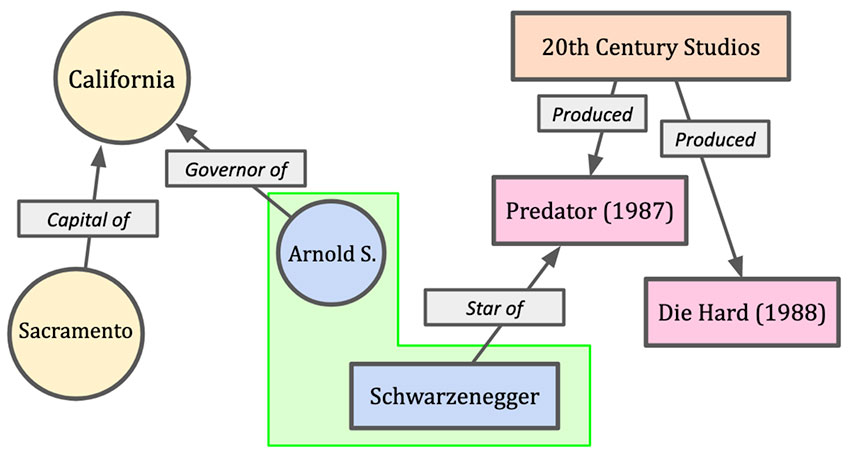
One should identify the following data sets and then get them into a knowledge graph: customer profile, support tickets, spend information, previous offers and uptake, previous call and chat transcripts, etc.
- Identify two to three business use cases. For example, in Klarna’s case, dispute resolution was one of the most powerful ones they identified. Once the use cases are identified, get a suitable cross-functional team together. They should then identify the data gaps and process improvements needed and build out the data set for the use case implementation.
Step 2: AI Engine – Beyond Basic Chatbots
Klarna’s partnership with OpenAI would have helped them, but it is not a competitive advantage. Many standard chatbots exist today. However, they can also cause problems, such as with Canada Airlines, whose chatbot promised a discount that wasn’t available to passengers.
Klarna’s competitive advantage was actually their creative problem-solving for their use case. For example, Klarna implemented a RAG-type system before it was common. One needs to create an architecture suited to the situation.
Klarna’s operational approach to an AI engine was also very customer-centric. They were transparent with customers about AI interactions, which built trust and ensured high satisfaction. The company also aimed for scalability by using AI to handle more customer inquiries without a large staff increase.
Figure 4 shows the architectural components of the AI engine. The unique recipe is created by either including or excluding a component or by increasing or decreasing the importance of their role.
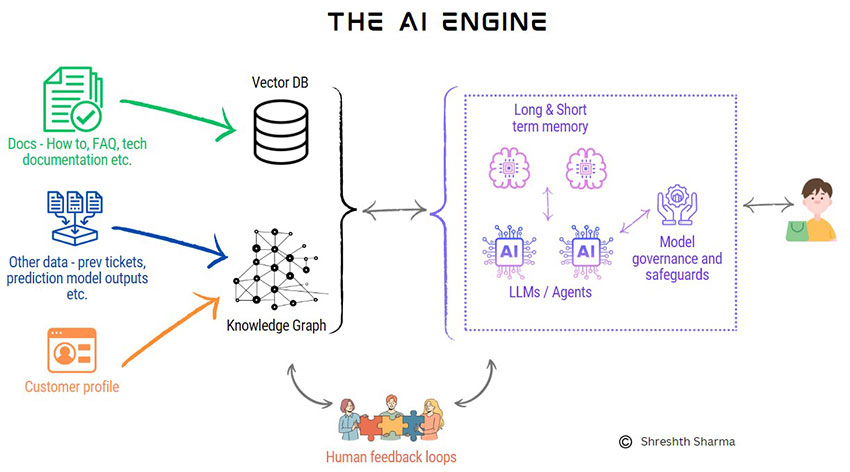
The critical components of this engine are:
- Query enhancement: Initial customer queries would be intercepted and evaluated for safety, then enhanced for better AI response through prompt tuning.
- Context preparation: Based on the customer and the query, two types of knowledge sets are provided to the LLM/AI. First is the information relevant to the query, which is through a vector database (DB). Second is the relevant user context from the graph – e.g., previous issues, products used, usage level, segment, etc.
- Query processing: The LLMs, either standalone or agentic, would get the query and context to answer intelligently.
- Memory management: As the conversation progresses, the state of the conversation and memory would need to be maintained so that the customer never has to repeat themselves.
- Reinforcement learning from human feedback (RLHF): Customer feedback and chat history themselves become a knowledge base to help improve the data sources and algorithms.
- Systems integrations: Seemingly a base requirement, getting all these systems to smoothly work together is a big unlock.
Step 3: Organizational Engine – Empowering Innovation
Building a culture of innovation and collaboration is easier said than done! There are three unlocks most of the time: (1) provide the resources, (2) break down silos and (3) give permission.
Siemiatkowski actively solved for 1 and 3. First, by sensing the opportunity and setting up a partnership with OpenAI, he gave his organization the technology and know-how. However, every organization now has access to the same technology and know-how. For the third point, Siemiatkowski actively encouraged experimentation, saying, “[It] was important to me to encourage people internally to really lean in and try it … we made sure to very quickly solve these things so we were GDPR compliant and that we could set the right structures around it … some people leaned in and it happened to be so that one of the teams that leaned in started looking at a fairly actually complex challenge in a way which was what we call dispute resolution.”
From this experimentation came the first big success on dispute resolution use case, an especially complicated process. The team was able to clear a backlog of issues that had never been cleared, which became proof that AI customer service could work and be scaled.
The other focus needs to be on breaking down silos and promoting information sharing. Leaders must ensure sharing of data and knowledge across silos. Teams must work to make their data accessible. A team’s value should be in their innovation, not the data they hold. Finally, this must become a living, breathing culture. Without constant improvement, effectiveness will decline.
So, what should you do to get similar benefits?
Here are the five most important things to keep in mind as you implement the three steps above:
- Focus on data foundations. Klarna’s success shows that with a strong foundation, results can grow exponentially. Their unified knowledge graph improved collaboration and enhanced their AI assistant’s ability to access and use relevant information quickly.
- Don’t be allured by an off-the-shelf chatbot. Start with the basics. Then, tune the vector database (DB), knowledge graph, memory, agents and RLHF to your needs. The weight each of these gets creates a unique recipe. For example, if most of your questions will be on order statuses, tune for knowledge graph. But if a lot of questions are around complicated product setup, then tune for vector DB.
- Evolving core systems and adopt new ways of working. Klarna is moving away from traditional customer relationship management (CRM) systems. It is adopting a more flexible, AI-friendly data setup. This will allow for quickly deploying and improving AI solutions and finding and scaling effective use cases. This will create a flywheel effect, in which each success fuels the next.
- Focus on people. It is not all about technology. In fact, it is mostly about people. Klarna aimed to foster a culture of innovation at all levels. AI adoption was a company-wide effort, not just a top-down initiative. Motivated, empowered employees naturally collaborate to solve tough problems.
- Finally, don’t lose the customer focus. Klarna’s goal was to enhance its customer experience, not reduce cost. By being transparent with customers about AI use and its benefits, they built trust. This is vital for long-term success in adopting AI.
As you seek to replicate Klarna’s success, remember this. The above analysis of Klarna’s recipe can help as a starting point. But the path to AI transformation will be unique to each organization. It’s time for enterprises to take a hard look at their data, culture and technology infrastructure. Are you ready to unlock the potential of AI in your organization? Start now!
Shreshth Sharma is a technology strategy and operations executive specializing in human-machine teaming and data-driven decision-making. He has 15 years of experience across management consulting, technology and media industries in leading firms such as BCG, Sony Pictures and Twilio. Currently, he is senior director of strategy and operations at Twilio and leads Twilio’s Enterprise Data team.