

February 14, 2025 in Healthcare Analytics
Health and Human Services with AI: Harness the Power For Scaling New Horizons
SHARE: PRINT ARTICLE: https://doi.org/10.1287/LYTX.2025.01.09
Prologue
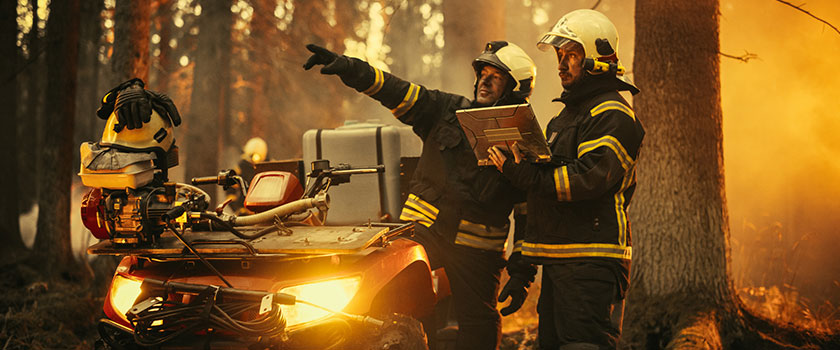
This year began with devastation caused by natural fiascos in the form of wildfires in my home state of California. The tragedy unfolded as the dry conditions and extreme, hurricane-strength wind burned and gutted tens of millions of dollars of mansions and vegetation in Los Angeles and the surrounding area. Lives were lost, communities were devastated and memories were stolen. Celebrities or commoners, no one was spared. As the climate change scenarios manifest in several ways, such devastations during a supposedly rainy season of the state made me wonder whether, as humans, we could harness our newfound strengths of artificial intelligence (AI) to deploy in both preventing and tackling such disasters more effectively. This column will discuss some of those thoughts and considerations – it is an increasingly important topic for all. Although we want to safeguard human society from the potential harm that AI can cause, like many in this field, I would like to leverage the sheer power of this technology for human benefit. Healthcare and Human Services is my area of work, my mission and my passion. AI is my new direction. I am increasingly passionate about converging these two streams of inspiration into one cohesive and impactful innovation. I welcome an open conversation in response to this column.
AI as a Transformative Tool for Government
AI has emerged as a transformative tool for governments worldwide to improve their management of natural disasters, such as the wildfires. In recent years, we have witnessed devastation in California, Oregon, Washington and areas of Canada. AI is rapidly advancing, perhaps more than some would like or hope; however, this progress allows AI to enable quicker and more efficient mitigation, response and recovery, reducing loss of life and property damage. With ongoing investment and innovation, AI can assume an even greater role in safeguarding communities and ecosystems from the escalating threats of climate change and natural disasters.
Before discussing specific examples of how this is accomplished, let’s briefly review what is possible today.
1. Early Detection and Prediction
AI-powered systems can analyze vast datasets from satellites, weather stations and other sensors to detect early signs of wildfires and predict their spread. Data acquisition via satellite imagery has been ongoing for decades, and IoT sensors are now deployed to collect data. The following are examples of government agencies’ early detection and prediction models.
- Wildfire prediction models: Machine learning (ML) models currently analyze historical weather patterns, vegetation density, wind conditions and other variables to forecast areas at high risk of wildfires. Many models are available, and research communities are constantly trying to fine-tune them to make predictions accurate. The European Space Agency (ESA) uses AI with satellite imagery to monitor fire-prone regions in Europe and Africa, identifying hotspots in near real time. The Wildfire Management Branch of British Columbia uses AI to analyze weather and forest conditions to predict fire behavior and allocate firefighting resources.
- Sensor networks: Governments deploy IoT sensors to monitor temperature, humidity and smoke levels in vulnerable areas. AI processes this data to detect anomalies that may signal a potential fire.
2. Real-Time Monitoring and Risk Assessment
AI currently processes real-time data to monitor ongoing wildfires, predict their behavior and assess risks to surrounding areas. This area is rapidly evolving and progressing, with technology companies like Google providing ample support with their large-scale computational models.
- Satellite and drone data analysis: AI can process high-resolution images from satellites and drones to monitor wildfire size, location and intensity. NASA’s Fire Information for Resource Management System (FIRMS) uses satellite imagery and AI to detect and monitor fires globally, providing critical updates to first responders.
- Risk mapping: AI tools such as Google’s Wildfire AI generate real-time wildfire maps using a constellation of small satellites (called FireSat), which predict the spread and identify high-risk zones, enabling governments to prioritize evacuations and resource allocation.
3. Disaster Response Optimization
AI enhances disaster response by improving communication, resource allocation and decision-making during a wildfire.
- Evacuation planning: AI models simulate wildfire spread and identify optimal evacuation routes, helping first responders and communities evacuate safely. One Concern, a California-based company, uses AI to predict the impact of disasters and optimize evacuation and resource deployment plans.
- Resource allocation: AI-powered algorithms help governments allocate resources such as firefighters, equipment and aerial water tankers to the areas where they are most needed.
4. Community Awareness and Communication
AI supports governments in keeping communities informed and prepared. Some developed, disaster-prone countries (e.g., Japan) have utilized such methods for many years to rapidly spread community awareness during tsunamis and other natural disasters. In the U.S., this technological trend is now catching up.
- AI-driven alerts: Governments can use AI systems to send location-specific alerts about impending wildfires and evacuation instructions. In Japan, AI powers disaster alert systems that send targeted warnings to residents’ phones, reducing response times during natural disasters. In Florida, a new AI-enabled system named Beacon can stay active even during hurricane events when the lights go out.
- Public awareness campaigns: AI tools analyze social media data to identify misinformation and ensure accurate information reaches the public during crises.
5. Recovery and Mitigation
Recovery, including assessing damage, is a key activity after a forest fire runs through a rural or urban landscape like Los Angeles. If a fire can’t be prevented, the speed of operationalizing recovery will undoubtedly bring governments closer to the next steps. After the wildfire has been contained, AI can assist in recovery efforts and future mitigation strategies, including:
- Damage assessment: AI analyzes drone and satellite imagery to estimate damage to infrastructure, vegetation and ecosystems, expediting insurance claims and disaster relief. Planet Labs, a satellite imaging company, uses AI to provide post-disaster imagery to assess wildfire impacts.
- Reforestation and land management: AI tools help identify areas for reforestation and monitor regrowth efforts. AI also supports controlled burns and vegetation management to prevent future wildfires. After devastating wildfires, the Australian government used AI-powered drones to efficiently monitor fire-prone areas and deploy resources. AI systems also assist in regrowth monitoring and wildlife tracking.
The Advent of AI Agents: Impact on Healthcare
The AI world is abuzz with the concept of AI agents. Think of this as an army of trained AI robots that can seamlessly conduct complex actions without any human interventions with predictable outcomes when trained and orchestrated correctly. That is the current hope. In the healthcare setting, such orchestration can revolutionize care coordination by enabling more efficient, personalized and proactive care. These agents, powered by AI/ML, streamline communication, automate administrative tasks and provide actionable insights for care teams, ultimately improving patient outcomes and operational efficiency. Large health systems, such as Geisinger, Mass General Brigham and Mayo Clinic, are using AI agent solutions for various task automation, from bed management to appointment scheduling to flagging early signs of sepsis during a hospital stay. In the following, I’ll outline a few examples of how AI agents can positively contribute to operational efficiency in care delivery.
1. Streamlining Communication and Collaboration
- Efficient team coordination: AI agents facilitate real-time communication between providers, care managers and patients (or clients). They analyze patient data to prioritize urgent tasks and suggest the next steps in care plans. CareSignal, a U.S.-based company, uses AI-driven alerts to monitor patients’ health conditions and alert care teams if there’s a risk of deterioration, enabling timely interventions.
- Patient engagement: AI-powered chatbots and virtual assistants inform patients about their care plans, appointment schedules and medication regimens. This reduces manual follow-ups and improves adherence to care recommendations. Kaiser Permanente uses an AI-based clinical documentation tool to summarize clinical notes from conversations between clinicians and patients, allowing more engaged conversations rather than note-taking.
2. Automating Administrative Tasks
- Appointment scheduling and follow-ups: AI agents automate routine tasks such as scheduling follow-ups, sending reminders and rescheduling missed appointments. This reduces administrative burden and ensures care coordination.
- Revenue cycle management: AI agents can reduce manual data entry by automatically generating documentation, verifying insurance claims against actual contracts from provider insurance companies and identifying coding errors, saving time for care coordinators. This capability could also be extended throughout the health and human services spectrum using social determinants of health (SDOH) data. My company, Health Roads, is focused on this innovative approach to generate the best values for small to mid-sized organizations.
3. Personalized Care Plans
- Dynamic care pathways: AI agents assess individual patient needs and create personalized care plans. They continuously update recommendations based on real-time data from patient monitoring devices or new test results. Livongo Health, now part of Teladoc Health, uses AI to personalize diabetes management by analyzing blood sugar trends and suggesting lifestyle adjustments.
- Medication management: AI-powered tools identify potential drug interactions, monitor adherence and alert care teams about risks, ensuring safe and effective treatment plans. PillPack by Amazon Pharmacy uses AI to manage patient prescriptions and send reminders for medication adherence.
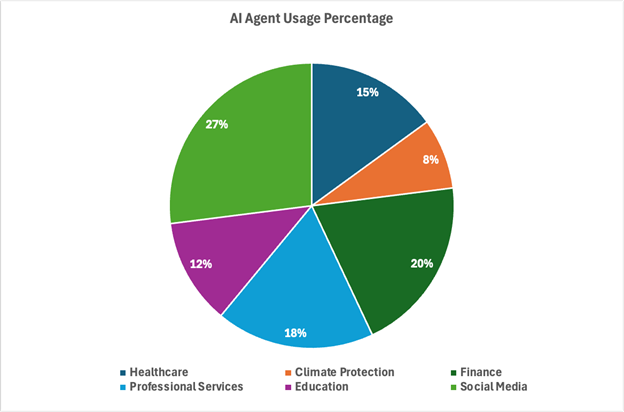
Although the use of AI agents in healthcare is still limited compared with industries such as professional services or social media, it is gradually increasing. The industry lacks supply, but the demand is growing as the population is aging and living longer. Figure 1 shows an empirical distribution of usage of AI agents in different industries, including healthcare.
Conclusion
2025 will be a big year for AI and AI agents. We have already seen the shakeup in the market with the release of DeepSeek, an AI chatbot that beat OpenAI’s ChatGPT in terms of execution cost for similar performance metrics. This is prompting all the major players, including OpenAI, Microsoft, Meta and Google, to double down on their innovation prowess to get better and faster. They aim to produce accurate, ethical AI platforms that are cheaper and faster. The race is on. Most of us will be absorbing these new developments to improve our lives through productivity gains and speed of response to tackle significant issues such as natural disasters caused by worsening climate change or healthcare resource scarcity. There are many other use cases, but those are the ones I am invested in at Health Roads. We have an exciting time ahead of us, and we are just getting started.
Rajib Ghosh is the founder and CEO of Health Roads, LLC, a consulting company for enabling digital transformation in healthcare organizations. He has 25 years of technology experience in various industry verticals where he had management roles in software engineering, data analytics, program management, product management, business operations and strategy development. Ghosh spent a decade and half in the U.S. healthcare industry as part of a global ecosystem of medical device manufacturers, medical software vendors, telemedicine and telehealth solution providers. He’s held senior positions at Hill-Rom, Solta Medical and Bosch Healthcare. His recent work includes leading data-driven digital transformation in the public health space, including county-level healthcare agencies and organizations focused on underserved populations.
([email protected])