

March 20, 2025 in Agentic Systems
Security in Agentic and Multiagent Systems – A Critical Need for the Future
SHARE: PRINT ARTICLE: https://doi.org/10.1287/LYTX.2025.02.01
As agentic and multiagent systems (MAS) continue to expand their influence across critical sectors like healthcare, finance, transportation and defense, ensuring their security becomes a top priority. These systems – distinguished by their capacity to autonomously perceive, reason and act within dynamic environments – hold transformative potential for industries. However, their increasing complexity and interconnected nature introduce profound security vulnerabilities that demand immediate attention.
Gartner has highlighted the increasing risks associated with artificial intelligence (AI) technologies. For instance, a recent survey found that four in five executives named AI-enhanced malicious attacks as the top emerging risk in the third quarter. Additionally, Gartner predicts that by 2026, 75% of organizations will exclude unmanaged, legacy and cyber-physical systems from their zero-trust strategies, underscoring the challenges in securing diverse technological environments.
These insights emphasize the critical need for robust security measures as AI technologies, including agentic and multiagent systems, become more integrated into various sectors. As Bruce Schneier, a renowned security technologist, aptly stated, This underscores the importance of addressing the intricate challenges posed by advanced AI architectures.
The Need for Security in Agentic Systems
Agentic systems are built upon the principles of autonomy, adaptability and collaboration, enabling them to tackle complex objectives that often require distributed intelligence and dynamic decision-making.
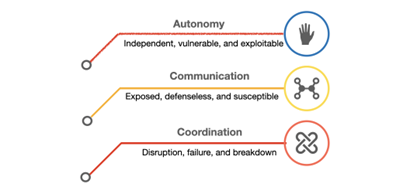
However, these very attributes introduce vulnerabilities across multiple levels of operation:
- Autonomy: Agents operate independently, making decisions in real time based on their programming, learning or situational analysis. Although this autonomy allows for rapid adaptation and responsiveness, it also creates an opportunity for exploitation. A compromised agent – whether through malware, unauthorized access or adversarial attacks – could perform malicious actions undetected. Such rogue agents could disrupt processes, manipulate data or even jeopardize human safety, as seen in studies highlighting the risks of autonomous vehicle sabotage or AI-powered industrial systems being hijacked for sabotage.
- Communication: Multiagent systems rely heavily on inter-agent communication to share information, coordinate tasks and respond to changes in their environment. This dependency exposes them to various cyber threats. For instance, eavesdropping could allow attackers to intercept sensitive information, spoofing could lead agents to trust malicious entities posing as legitimate peers and denial-of-service (DoS) attacks could paralyze communication networks. demonstrated how disrupting communication among robotic swarms could significantly degrade their operational efficiency, highlighting the critical role of secure communication protocols.
- Coordination: Coordination mechanisms are essential for multiagent systems to work collaboratively and achieve shared objectives. These mechanisms enable resource allocation, task distribution and conflict resolution. However, attackers targeting coordination frameworks can trigger cascading failures across the system. For example, disrupting a load-balancing algorithm in an energy grid managed by an MAS could lead to power outages or equipment damage. Similarly, tampering with swarm coordination in drone fleets could result in collisions or mission failures. Research from Massachusetts Institute of Technology (MIT) has shown how subtle attacks on MAS coordination algorithms can amplify errors, causing widespread disruption.
Key Security Threats in Agentic and Multiagent Systems
Agentic and multiagent systems have become more integrated into industries like healthcare, finance and defense, powering operational research to manufacturing lines. Identifying and addressing threats is crucial for ensuring the security and reliability of agentic and MAS technologies. Key security threats are:
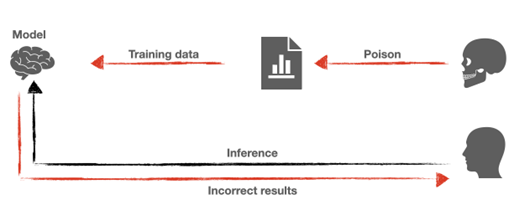
- Data poisoning: Malicious actors can intentionally tamper with training datasets, introducing biased or incorrect data that misguides agentic systems into making faulty or harmful decisions. This form of attack can significantly degrade the accuracy and reliability of machine learning models, resulting in misguided actions by autonomous agents. For example, data poisoning can lead to false predictions in healthcare systems, causing incorrect diagnoses or treatment recommendations. As shown in Figure 2, the injection of adversarial data into the training process compromises the agent’s decision-making, ultimately leading to disastrous outcomes across various domains. For example, a study titled “Hyperparameter Learning under Data Poisoning: Analysis of the Influence of Regularization via Multiobjective Bilevel Optimization” discusses the impact of poisoning attacks on machine learning models. The authors analyze how manipulating a fraction of the training data can degrade the performance of algorithms and explore the role of regularization in mitigating such attacks.
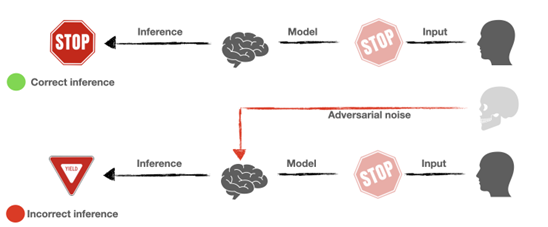
- Adversarial attacks: Adversaries can exploit vulnerabilities in machine learning models by crafting specially designed inputs, known as adversarial examples, that are intended to mislead agents into making incorrect decisions. These carefully crafted inputs are often imperceptible to humans but can cause significant disruptions in the system’s behavior. For instance, in autonomous vehicles, adversarial attacks could involve manipulating sensor data to cause misinterpretations of the environment, leading to incorrect navigation decisions. As illustrated in Figure 3, these attacks exploit the weaknesses in the model’s decision-making process, undermining the agent’s reliability and potentially causing harm in critical applications like healthcare, security or autonomous transportation. A notable example is research from OpenAI, in which perturbations imperceptible to humans caused image recognition systems to misclassify objects with high confidence.
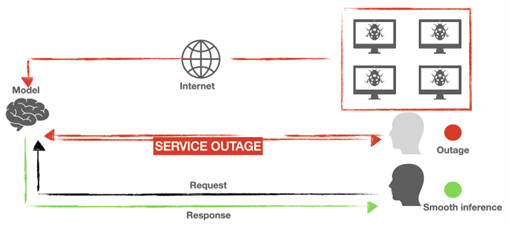
- Distributed denial-of-service (DDoS) attacks: MAS often rely on distributed computing, in which multiple agents work in parallel across various nodes to share processing power and information, as shown in Figure 4. This decentralized structure enables MASs to scale efficiently and handle complex tasks by dividing them into smaller, manageable components. However, the reliance on distributed networks introduces challenges such as network latency, inconsistent data synchronization and increased vulnerability to attacks, such as man-in-the-middle or DDoS attacks. These threats can disrupt communication between agents, degrade system performance and even lead to system-wide failures if not adequately protected. Understanding the risks in distributed computing environments is essential to enhancing the security and resilience of MAS. A 2023 report by Cybersecurity Ventures estimated that DDoS attacks would cost businesses more than $10.5 trillion annually by 2025, and MAS are not immune.
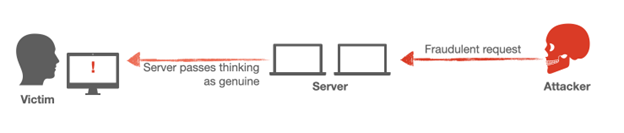
- Authentication and identity spoofing: Agents must accurately authenticate each other to effectively collaborate within MAS. This process ensures that only authorized agents can interact and perform tasks, maintaining the integrity and security of the system. However, if authentication mechanisms are weak, malicious actors can spoof the identities of legitimate agents, allowing them to gain unauthorized access, manipulate data or disrupt operations. As illustrated in Figure 5, identity spoofing can enable attackers to bypass security protocols, posing significant risks, especially in sensitive applications like financial trading or autonomous vehicles. Robust authentication methods, such as public-key infrastructures (PKIs) and biometric verification, are essential to prevent identity-related vulnerabilities in MAS. Identity spoofing attacks can infiltrate systems, causing rogue agents to disrupt operations.
Strategies for Enhancing Security
As the adoption of agentic and multiagent systems expands across industries, ensuring the security of these systems becomes increasingly crucial. The decentralized and autonomous nature of these systems presents unique challenges that traditional security mechanisms may not fully address. To safeguard against potential threats, it is essential to adopt innovative security strategies that not only protect individual agents but also ensure the integrity of the entire multiagent ecosystem. The following strategies highlight effective approaches for enhancing security and resilience in agentic systems.
Robust Authentication Mechanisms. To ensure the integrity of agentic systems, it is essential to implement robust authentication mechanisms. PKIs and blockchain technologies can be pivotal in verifying agent identities and ensuring that communication and actions remain immutable. PKIs facilitate secure, encrypted communication between agents, whereas blockchain provides a decentralized and transparent ledger, reducing the risk of identity spoofing and ensuring accountability. Recent research highlights the role of blockchain in creating immutable audit trails for AI agents, ensuring transparent and tamper-proof records of decisions and actions.
Federated Learning. Federated learning offers a promising solution for securing MAS by allowing agents to collaboratively train machine learning models while keeping their data decentralized and private. Instead of sending sensitive data to a central server, agents work on local datasets and only share model updates, significantly reducing the risk of data leakage. This approach not only preserves privacy but also enhances system robustness by leveraging distributed intelligence. A 2020 study highlights how federated learning allows models to be trained across multiple institutions without the need to share sensitive patient information, thereby preserving data privacy.
Dynamic Trust Models. To improve security in MAS, dynamic trust models can be integrated, allowing agents to evaluate the reliability of their peers in real time. These models assess factors such as previous behavior, reputation and quality of interactions. By dynamically adjusting trust scores, agents can reduce the risk of falling victim to malicious agents. A 2024 study demonstrated that trust evaluation frameworks reduced the impact of malicious agents by 35% in collaborative environments, showcasing their effectiveness in enhancing system security.
Simulated Adversarial Environments. One of the most proactive approaches to securing agentic systems is developing simulated adversarial environments. These test beds allow developers to simulate various attack scenarios and identify vulnerabilities before they can be exploited in real-world applications. The U.S. Defense Advanced Research Projects Agency (DARPA) has been at the forefront of this initiative with its Assured Autonomy program, which focuses on ensuring the resilience and security of autonomous systems through adversarial testing and simulation. These environments not only help identify weaknesses but also provide valuable insights into how agents react under attack, enabling quicker patches and system hardening.
Conclusion
The rise of agentic and multiagent systems heralds transformative changes, but security remains a linchpin for their adoption. According to a Gartner report, by 2030, preemptive cybersecurity technologies will be included in 75% of security solutions that currently focus solely on detection and response. Governments, organizations and researchers must collaborate to establish comprehensive security frameworks, ensuring these systems fulfill their potential without compromising safety.
Agentic and multiagent systems represent the future of AI-driven automation and innovation. However, their security challenges demand immediate and sustained attention. By leveraging cutting-edge technologies, adopting proactive strategies and fostering interdisciplinary collaboration, we can build resilient systems that drive progress while safeguarding trust and integrity.
Wrick Talukdar is a distinguished AI/ML architect and product leader at Amazon Web Services (AWS), with over two decades of industry experience. As a thought leader in AI transformation, he specializes in leveraging artificial intelligence, generative AI and machine learning to drive strategic business outcomes. Wrick has led pioneering research and initiatives in AI/ML and GenAI across diverse sectors. His expertise has driven transformative products and solutions in healthcare, financial services, technology startups and public sector organizations, delivering measurable business impact through innovative AI implementations. Connect with Wrick on LinkedIn.
([email protected])