April 25, 2025 in Generative AI
Model Distillation in Generative AI: Making Large Models More Accessible
SHARE: PRINT ARTICLE: https://doi.org/10.1287/LYTX.2025.02.02

As generative artificial intelligence (AI) continues to transform industries and revolutionize how we approach complex problems, organizations face a growing challenge: balancing the remarkable capabilities of large AI models with their substantial computational demands. Although powerful models such as GPT-4o and Llama demonstrate impressive abilities in tasks ranging from text generation to code creation, their size and resource requirements often make them impractical for real-world applications. Enter model distillation, a sophisticated technique that promises to bridge this gap by creating smaller, more efficient models without significantly compromising performance.
There are significant environmental and economic implications of training and deploying large language models. Training a model with hundreds of billions of parameters can consume energy equivalent to the annual usage of multiple households, with some models requiring over 1,200 megawatt-hours during their training phase alone [1]. Although recent advances have improved efficiency, with models like Meta’s Llama 3 achieving carbon neutrality through renewable energy usage, organizations are increasingly recognizing the value of purpose-built, smaller models. These distilled models not only reduce operational costs and environmental impact but also offer practical advantages in deployment flexibility, reduced latency and easier maintenance. For enterprises implementing AI systems, these smaller models present a compelling alternative that balances capability with sustainability.
The Science Behind Model Distillation
Model distillation operates on a teacher-student paradigm, where knowledge from a large, complex model (the teacher) is transferred to a smaller, more efficient model (the student). Unlike traditional compression techniques that simply reduce model size through pruning or quantization, distillation aims to capture the nuanced patterns and representations that make large models so effective.

The knowledge transfer process in model distillation occurs through several sophisticated mechanisms:
- Logit-based distillation: Instead of learning from hard labels, the student model learns from the teacher’s softened probability distributions, capturing subtle relationships between different outputs. Imagine training a model to classify images of animals. A traditional model might output “hard” decisions like “100% sure it’s a dog” or “100% sure it’s a cat.” In reality, an image of a wolf might be 70% similar to a dog and 30% similar to a fox. This nuanced probability distribution represents the model’s “soft” decisions or logits. In logit-based distillation, instead of just teaching the smaller student model to make those hard yes/no decisions, we teach it to mimic these softer probability distributions from the teacher model. By learning these subtle relationships (“this is mostly a dog, but has some foxlike features”), the student model gains a richer understanding that’s more analogous to how the larger teacher model thinks, although it’s much smaller in size [2].
- Feature-based distillation: The student model learns to mimic the intermediate representations produced by the teacher model, helping it develop similar internal understanding [3]. Think of how an expert chef identifies a complex dish. They don’t just look at the final plate – they recognize specific ingredients, cooking techniques and flavor combinations along the way. Similarly, in feature-based distillation, we teach the smaller student model to recognize these “intermediate ingredients” that the larger teacher model has learned to identify. When processing information, the teacher model creates internal representations or “features” at various stages, such as identifying edges in an image before recognizing it is a face, or understanding individual words before comprehending a full sentence. The student model is trained to recognize these same important features, although it has fewer parameters overall. This helps the smaller model develop a similar thought process to its teacher, rather than just copying the final answers.
- Attention-based distillation: Particularly crucial in transformer-based architectures, this approach ensures the student model learns effective attention patterns from the teacher. In transformer models, attention patterns are how the model decides which parts of the input are most important for generating each output. Attention-based distillation focuses on teaching the smaller student model to focus on the same important elements that the larger teacher model has learned to prioritize [4]. For instance, when processing a sentence, the teacher model knows exactly which words to pay attention to for understanding context and meaning. Through attention-based distillation, we transfer these learned patterns of focus and relevance to the student model, helping it develop the same ability to identify and prioritize crucial information, despite having fewer parameters to work with.
- Relational knowledge distillation: This method focuses on learning the relationships between different data points rather than direct feature mapping. You can think of relational knowledge distillation as teaching the smaller model to understand patterns and connections between different pieces of information, rather than just memorizing individual facts. Instead of copying exactly what the teacher model knows about each data point, the student learns how different pieces of information relate to and influence one another [5]. For example, when the larger teacher model processes data, it doesn’t just understand individual items in isolation – it grasps how they connect and influence each other within the broader context. The student model learns these same relationship patterns, helping it maintain the teacher’s ability to make nuanced decisions based on how different pieces of information interact with each other, although it has a simpler architecture.
Practical Applications Across Generative AI Domains
The implementation of model distillation significantly varies across different domains of generative AI, each presenting unique challenges and opportunities. In text generation, where large language models dominate, distillation strategies focus on maintaining coherence and contextual understanding while reducing model size. This is achieved through sequence-level distillation, in which the teacher model generates multiple outputs and the student learns from the highest-quality samples.
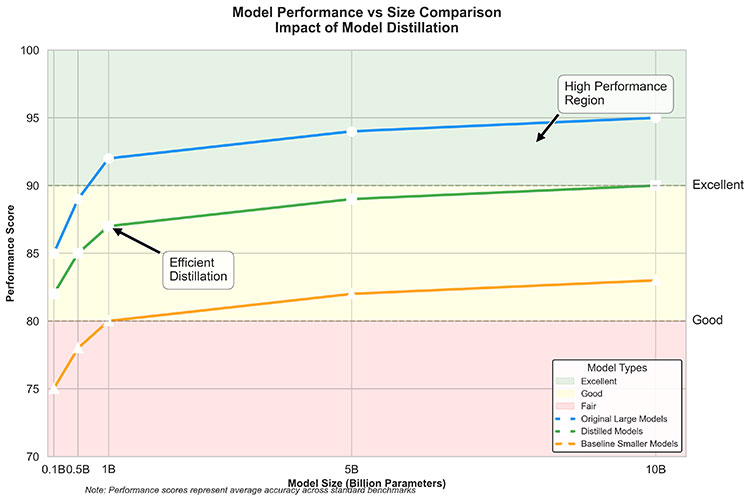
In image generation, the focus shifts to preserving visual fidelity and creative capabilities. Generative adversarial networks (GANs) and diffusion models benefit from specialized distillation techniques that ensure the student model can generate high-quality images while requiring fewer computational resources. This involves careful attention to:
- Generator distillation: In this approach, the student model learns to replicate the output distribution of a pretrained teacher generator. The teacher model, typically a large GAN or diffusion model, generates high-quality samples that serve as training data for the student. The student model is trained to generate identical or near-identical outputs when given the same input conditions, effectively learning to mimic the teacher's generation capabilities while using fewer parameters. This method is particularly effective because it focuses on the final output quality rather than intermediate representations.
- Feature space alignment: This technique ensures that the student model's internal feature representations closely match those of the teacher model at multiple levels of abstraction. By aligning these intermediate representations, the student learns to process visual information in a similar manner to the teacher, despite having a simpler architecture. The alignment is typically achieved through carefully designed loss functions that compare feature activations at multiple layers, ensuring that the student captures both low-level details like textures and high-level semantic information like object shapes and relationships.
- Perceptual loss optimization: This methodology incorporates sophisticated visual similarity metrics that align with human perception of image quality. Rather than relying solely on pixel-wise differences, perceptual loss functions use pretrained vision models (often VGG or similar networks) to compare images at a more semantic level. These loss functions measure differences in features that correspond to human-perceived qualities such as texture consistency, structural integrity, and stylistic elements. By optimizing for these perceptual metrics, the student model learns to generate images that maintain high visual quality even with reduced computational capacity.
Code generation presents another unique challenge, where syntactic correctness and semantic understanding are paramount. Here, distillation methods must preserve the model's ability to generate valid, efficient code while reducing resource requirements. This is accomplished through syntax-aware distillation techniques and specialized attention mechanisms that focus on code structure.
Challenges and Future Directions
While model distillation offers promising solutions for making generative AI more accessible, several challenges remain. The most significant is the delicate balance between model compression and performance maintenance. Higher compression ratios often lead to some degradation in output quality, requiring careful optimization of the distillation process.

Looking ahead, several exciting developments are shaping the future of model distillation:
- Multi-teacher distillation: This advanced methodology enables knowledge transfer from multiple specialized teacher models to a single student model. By aggregating expertise from diverse teacher models, each optimized for specific domains or tasks, the student model can achieve performance that potentially surpasses single-teacher approaches [6]. The architecture facilitates the synthesis of complementary knowledge streams, enabling the student to learn optimal feature representations across multiple domains. Implementation has demonstrated particular efficacy in complex tasks such as multilingual processing and cross-domain inference, where different teacher models contribute specialized domain expertise.
- Neural architecture search (NAS): NAS represents an automated approach to architectural optimization for student models. This methodology uses systematic exploration of the architectural search space to identify optimal configurations specifically suited for knowledge distillation [7]. By leveraging reinforcement learning or evolutionary algorithms, NAS can discover novel architectures that maximize the efficiency of knowledge transfer while maintaining model compactness. Recent implementations have demonstrated that automatically discovered architectures frequently outperform conventional manually designed configurations in terms of both performance metrics and computational efficiency.
- Edge AI applications: This development focuses on the deployment of distilled models in resource-constrained environments. Through sophisticated compression and optimization techniques, complex models are transformed into efficient versions capable of execution on edge devices while maintaining acceptable performance characteristics. This advancement enables local processing of AI workloads, reducing latency and bandwidth requirements while enhancing privacy preservation. The methodology has particular significance in scenarios requiring real-time processing or operating under connectivity constraints.
Conclusion
Model distillation represents a crucial bridge between the impressive capabilities of large AI models and the practical constraints of real-world applications. As organizations continue to seek ways to effectively leverage generative AI, distillation techniques offer a path to more efficient, accessible implementations without sacrificing essential capabilities. The ongoing research and development in this field suggest that we will see even more sophisticated distillation methods emerge, further democratizing access to powerful AI technologies while maintaining high performance standards.
The future of model distillation lies in finding innovative ways to compress knowledge while preserving the nuanced understanding that makes large models so effective. As these techniques continue to evolve, they will play an increasingly important role in making advanced AI capabilities available to a broader range of applications and users, ultimately helping to realize the full potential of generative AI in practical, real-world settings.
References
- “Small Models, Big Impact: The Sustainable Future of AI Language Models,” https://www.computer.org/publications/tech-news/community-voices/sustainable-future-of-ai-language-models.
- Sun, Shangquan, Wenqi Ren, Jingzhi Li, Rui Wang and Xiaochun Cao, 2024, “Logit standardization in knowledge distillation,” Proceedings of the IEEE/CVF Conference on Computer Vision and Pattern Recognition, pp. 15731-15740.
- Liu, Dongyang, Meina Kan, Shiguang Shan and Xilin Chen, 2023, “Function-consistent feature distillation,” arXiv preprint arXiv:2304.11832.
- Ji, M., B. Heo and S. Park, 2021, “Show, attend and distill: Knowledge distillation via attention-based feature matching,” Proceedings of the AAAI Conference on Artificial Intelligence, Vol. 35, No. 9, pp. 7945-7952.
- Dong, Yijun, Kevin Miller, Qi Lei and Rachel Ward, 2023, “Cluster-aware semi-supervised learning: Relational knowledge distillation provably learns clustering,” Advances in Neural Information Processing Systems, Vol. 36, pp. 40799-40831.
- Zuchniak, Konrad, 2023, “Multi-teacher knowledge distillation as an effective method for compressing ensembles of neural networks,” arXiv preprint arXiv:2302.07215.
- Zoph, Barret, and Quoc V. Le, 2016, “Neural architecture search with reinforcement learning,” arXiv preprint arXiv:1611.01578.
Srinivas Reddy Bandarapu is a principal cloud architect at DigiTech Labs with more than 22 years of IT experience. He specializes in enterprise architecture, cloud systems and digital transformation, with a decade focused on AI, ML and generative AI research. His expertise spans healthcare, financial services and public sector projects, with particular emphasis on distributed computing and AI implementation. Srinivas holds a master’s in computer science and maintains active memberships with IEEE (Senior Member), Singapore Computer Society, IETE India, ITServ USA and IAENG. He is dedicated to making AI technology more accessible and developing innovative solutions using Azure services and advanced computing resources. Connect with Srinivas Reddy Bandarapu on LinkedIn.