

April 10, 2025 in 2025 INFORMS Analytics Conference
USA Cycling Strikes Gold with PROJECT 4:05: A Data-Driven Triumph at the 2025 Franz Edelman Award Competition
SHARE: PRINT ARTICLE: https://doi.org/10.1287/LYTX.2025.02.04n
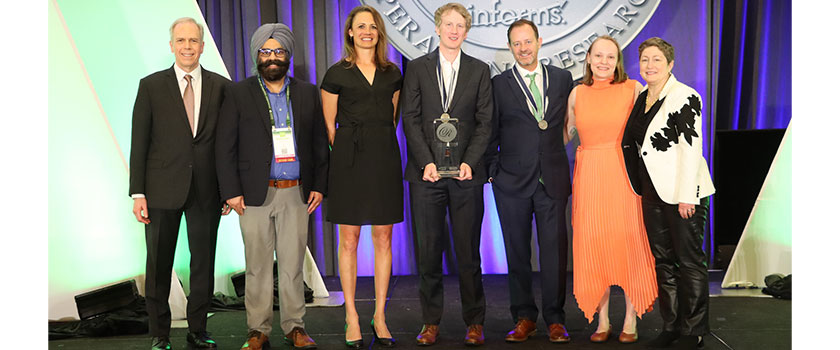
In a sport where milliseconds separate dreams from defeat, USA Cycling’s Women’s Team Pursuit squad proved that gold medals can be won with the power of data. This week, the team behind “PROJECT 4:05: Optimizing USA Cycling’s Women’s Team Pursuit Gold” was honored with the prestigious 2025 INFORMS Franz Edelman Award, celebrating their groundbreaking use of analytics, operations research (O.R.) and machine learning to overcome the odds and achieve Olympic gold in Paris.
At the heart of this achievement lies an extraordinary story of resilience, science and transformation. In 2023, the outlook for Team USA was bleak. At the UCI World Championships in Glasgow, the women’s team placed sixth with a time of 4:12.684 – just 0.159 seconds shy of qualifying for the bronze medal final. Ranked 8th in the world and facing a 10% probability of medaling in Paris – far behind dominant cycling powers New Zealand and Great Britain – USA Cycling had a massive gap to close.
“We were staring at a 7-second deficit in a discipline where elite improvements are measured in tenths,” said Ryan Cooper, the analytical mastermind behind the project, during the team’s reprise presentation at the 2025 INFORMS Analytics+ Conference in Indianapolis. “Most considered that kind of leap nearly impossible in elite sport.”
But with limited financial resources and no government funding for Olympic sport development, USA Cycling turned necessity into innovation. Leveraging a suite of analytics tools – race simulations, machine learning models and a sophisticated mixed-integer programming (MIP) framework – they created a blueprint not just to compete, but to win.
Why 4:05?
The goal was clear: get the team’s time down to 4:05 or better, a threshold identified through deep analysis of historical medal-winning performances. Achieving it would require not only technical refinement, but strategic allocation of every available resource: physical, financial and human.
At speeds nearing 60 km/h (40 mph), aerodynamic drag accounts for over 90% of resistance in cycling. A mere 3% increase in velocity demands 9% more power. The team’s MIP model integrated the physics of drag, individual athlete energy profiles and real-time speed targets to build optimized race strategies down to each pedal stroke.
“Aerodynamic optimization is more impactful than just adding power,” Cooper noted. “It’s the table stakes of elite cycling.”
The Optimization Engine
The analytics backbone of PROJECT 4:05 consisted of four key components:
- Race Strategy MIP Model: Optimized rotation timing, power output and energy expenditure.
- Athlete Metric Simulation: Simulated countless race scenarios to fine-tune team composition and tactics.
- Data-driven Athlete Selection: Riders chosen based on quantifiable metrics such as Functional Reserve Capacity (FRC), critical power and aerodynamic profiles.
- Training Translation: Converted analytical insights into individualized training targets and race-day plans.
The model was rigorously validated, showing within 1% accuracy against historical performances and progressively aligning closer with real-world results as data collection matured.
From Analytics to Gold
Armed with actionable data, USA Cycling reimagined every aspect of its preparation. Each athlete was assessed and trained based on her own physiological limits and aerodynamic footprint. In collaboration with aerodynamics partner Vorteq, the team produced 19 custom skinsuit iterations and even mannequin-based testing to shave off crucial drag –achieving up to a 9.2% aerodynamic reduction for one rider.
The eventual lineup – Jennifer Valente, Chloé Dygert, Lily Williams and Kristen Faulkner –represented not just strength, but optimal synergy. For example, during Paris 2024, Jennifer’s extended initial pull helped establish early momentum, while tailored rotation timing allowed lower-energy riders to maximize recovery.
Even adversity didn’t derail the plan. In the days before the Olympic final, Dygert suffered a crash in a road race. Still, the model’s simulations showed a path to gold, if every second was executed to perfection.
And execute they did.
Team USA clocked a stunning 4:04.306 in the Paris final – an American record and more than 8 seconds faster than their 2023 World Championship performance. They dethroned cycling powerhouses New Zealand and Great Britain to claim Olympic gold in what can only be described as one of the sport’s greatest comebacks.
Measuring the Impact
The time gains weren’t the result of any single change. Aerodynamic positioning contributed 0.7 seconds; athlete selection added 2.1 seconds; profile-driven training shaved 2.2 seconds; and the MIP-based race strategy delivered an additional 1.2 seconds. Together, they made the impossible possible.
Behind the scenes, the challenges were immense: limited funding, athlete injuries, tight training windows, and early skepticism from veteran riders. But data prevailed. Training sessions were informed by daily analytics. Each decision, from gear to strategy, was modeled and validated.
“This wasn’t just about winning a race,” said Brendan Quirk, President and CEO of USA Cycling. “This was about redefining what’s possible with analytics. We’re setting benchmarks for the future of Olympic sport.”
A Golden Future
The ripple effects of PROJECT 4:05 extend far beyond one event. USA Cycling’s overall medal haul in Paris jumped to six, including three golds – double their total from Tokyo 2021. The program’s success has unlocked $1.6 million in new annual funding from the U.S. Olympic and Paralympic Committee and drawn sponsorships from tech giants like OpenAI and Strava.
With applications across cycling disciplines – BMX, Time Trial, Road – and potentially into other Olympic sports, the MIP model has laid the foundation for a new era in athletic performance.
At the Edelman Gala in which the team was announced first place in the competition, the applause wasn’t just for gold, but for what gold represented: the fusion of data analytics and sport, and the triumph of smart decision-making over sheer power.
In the words of Cooper, “O.R. and analytics aren’t just tools anymore – they’re our golden advantage.”
