May 2, 2025 in AI/ML
Federated Data Marketplaces: Enabling Secure AI/ML Workloads in a Multicloud World
SHARE: PRINT ARTICLE: https://doi.org/10.1287/LYTX.2025.02.05
The rapid advancement of artificial intelligence and machine learning (AI/ML) has created an unprecedented demand for high-quality training data. According to recent industry surveys, 65% of organizations currently leverage AI in their operations, with data accessibility and security remaining primary concerns for implementation [1]. A Statista survey reveals that AI adoption has surged to 72% of organizations, up from about 50% in previous years [2]. This dramatic increase has intensified the need for secure, efficient data-sharing mechanisms across organizational boundaries.
Recent industry surveys indicate that organizations are increasing their spending on data acquisition and management by roughly 6%-10% year over year, underscoring the growing need for efficient data-sharing mechanisms in today’s data-driven landscape [3]. In parallel, a MarketsandMarkets report estimates that the global AI training data market was valued at approximately $1.87 billion in 2023 and is projected to grow at a compound annual growth rate (CAGR) of 23.5% through 2030 [4]. This surge in data requirements, coupled with increasing privacy regulations and security concerns, has accelerated the adoption of federated approaches to data exchange.
The Evolution of Secure Data Exchange
Federated data marketplaces represent a paradigm shift in how organizations approach data sharing and monetization. These platforms enable controlled data exchange while ensuring data sovereignty, security and regulatory compliance. According to industry analysts, organizations implementing federated data-sharing solutions report a reduction in data acquisition costs and improvements in time to insight for AI/ML projects.
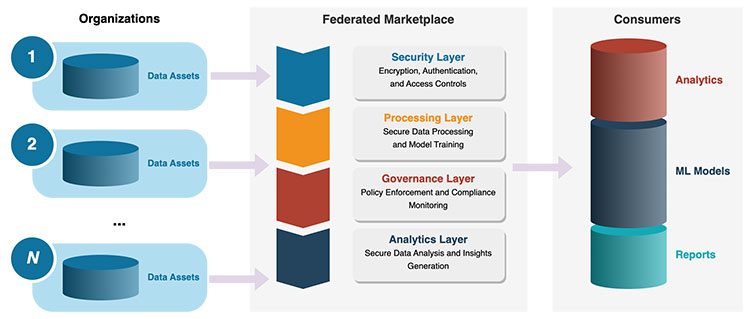
The architecture of modern federated data marketplaces incorporates several sophisticated components working in concert.
Core Components
At the heart of federated data marketplaces lies a sophisticated infrastructure designed to protect data while enabling collaborative analysis. These essential building blocks form the foundation of secure data exchange:
- Secure enclaves for protected data processing: These isolated computing environments provide hardware-level security guarantees, ensuring that data remains encrypted even during processing. Recent implementations have shown that secure enclaves can reduce the risk of data breaches by up to 85% while maintaining processing efficiency.
- Granular access controls and continuous verification: Advanced access management systems constantly monitor and verify user permissions, implementing the principle of least privilege. The system performs real-time authentication checks and maintains detailed logs of all access attempts, ensuring only authorized users can interact with specific datasets.
- Privacy-preserving computation techniques: These methods enable analysis of sensitive data without exposing the underlying information. Techniques such as homomorphic encryption and secure multiparty computation allow organizations to derive insights while maintaining data confidentiality. Studies show these approaches can preserve up to 95% of analytical accuracy while ensuring privacy.
- Cross-cloud interoperability standards: Standardized protocols ensure seamless data exchange across different cloud platforms. These standards define common interfaces for data access, security controls and monitoring, enabling consistent operations across diverse environments.
- Automated compliance monitoring: Real-time compliance-checking systems automatically verify that all data exchanges adhere to regulatory requirements and organizational policies. These systems can reduce compliance-related incidents by up to 60% through continuous monitoring and automated enforcement.
- Real-time data quality assessment: Automated systems continuously evaluate data quality metrics, ensuring that shared data meets predetermined quality thresholds. This includes checks for completeness, accuracy and consistency, with real-time alerts for any quality issues.
Implementation Considerations
Successfully deploying a federated data marketplace requires careful attention to various operational aspects that impact system effectiveness and reliability:
- Data standardization and schema alignment: Organizations must establish common data formats and schemas to ensure interoperability. This involves creating standardized data models that can accommodate variations while maintaining semantic consistency. Industry studies show that proper standardization can reduce integration times by up to 40%.
- Network performance optimization: Given the distributed nature of federated systems, optimizing network performance is crucial. This includes implementing intelligent routing protocols, caching mechanisms and load-balancing systems to minimize latency and maximize throughput. Organizations typically aim for response times under 100 milliseconds for real-time data access.
- Identity and access management (IAM): A comprehensive IAM strategy must integrate with existing enterprise systems while supporting federated identity management. This includes single sign-on capabilities, role-based access control and just-in-time access provisioning to ensure secure and efficient user authentication.
- Audit trail mechanisms: Immutable audit logs track all system interactions, providing a complete history of data access and modifications. These logs support compliance requirements and enable forensic analysis when needed, with some systems maintaining audit trails for up to seven years.
- Disaster recovery planning: Robust disaster recovery and business continuity plans ensure system availability even during unforeseen events. This includes implementing redundant systems, regular backups and automated failover mechanisms to maintain service availability targets of 99.99% or higher.
- Data life cycle management: Comprehensive policies govern data from ingestion through retirement, including retention periods, archival procedures and secure deletion protocols. Organizations typically implement automated life cycle management tools that enforce these policies while maintaining compliance with regulatory requirements.
Security and Privacy Technologies
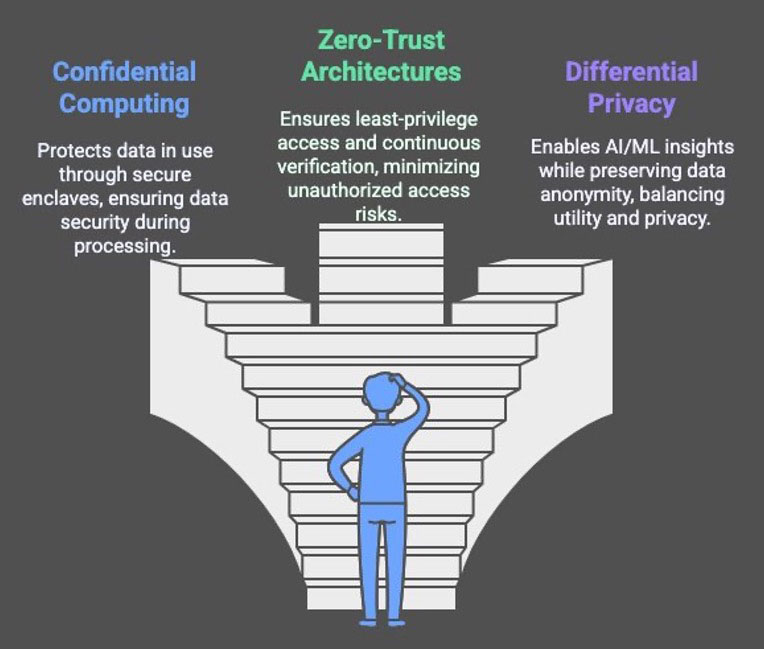
The foundation of federated data marketplaces rests on three critical technologies that enable secure AI/ML workloads: confidential computing, zero-trust architectures and differential privacy.
Confidential Computing
This technology protects data during processing by using hardware-based trusted execution environments [5]. It ensures that even cloud providers cannot access sensitive data while it’s being processed, creating a secure foundation for cross-organizational collaboration. Industry reports suggest that confidential computing adoption has grown by 300% since 2022, with 67% of organizations planning to implement it in their data-sharing initiatives.
Key aspects of confidential computing include:
- Hardware-based memory encryption
- Secure key management
- Run-time verification
- Attestation mechanisms
- Secure data sealing
Zero-Trust Architectures
By implementing the principle of least privilege and continuous verification, zero-trust frameworks ensure that only authorized entities can access specific datasets [6]. This approach has shown to reduce data breach risks by up to 50% in early-adopting organizations. Recent implementations have demonstrated a 75% reduction in unauthorized access attempts and a 40% improvement in data governance efficiency. Zero-trust implementation requires:
- Continuous authentication and authorization
- Microsegmentation of data assets
- Real-time threat monitoring
- Behavioral analytics
- Automated response mechanisms
Differential Privacy
This mathematical framework enables organizations to extract valuable insights from datasets while maintaining individual privacy [7]. Recent implementations have demonstrated the ability to preserve up to 95% of analytical accuracy while ensuring regulatory compliance. Organizations using differential privacy in their federated data sharing report a 70% reduction in privacy-related incidents while maintaining high-quality AI/ML model training capabilities. Implementation considerations include:
- Privacy budget management
- Noise injection mechanisms
- Query analysis and optimization
- Privacy loss accounting
- Utility-privacy trade-off analysis
The Role of Generative AI
Generative AI has introduced new possibilities and challenges in federated data marketplaces. Organizations can now leverage these platforms to train and fine-tune large language models without directly exposing sensitive data. This capability has particular relevance in regulated industries such as healthcare and finance, where data privacy is paramount.
The technical implementation of generative AI in federated marketplaces must address several critical aspects of model training and deployment. Organizations need to establish robust protocols that ensure model integrity while preventing unauthorized access to sensitive training data. Key technical requirements include:
- Model training integrity and validation protocols
- Prevention of data leakage and unauthorized access
- Distributed training coordination
- Model parameter synchronization
- Inference optimization
- Performance monitoring and scaling
Beyond technical implementation, organizations must establish comprehensive governance frameworks that ensure responsible AI development and deployment. These frameworks should address ethical considerations, regulatory compliance and transparency in AI systems. Essential governance elements include:
- Mitigation of bias and ethical considerations
- Balancing model performance with privacy requirements
- Real-time monitoring of model behavior and outputs
- Compliance with evolving AI regulations
- Ethical AI guidelines enforcement
- Transparency and explainability mechanisms
Multicloud Integration and Management
The multicloud nature of modern enterprise environments adds another layer of complexity to federated data marketplaces. With most organizations operating across multiple cloud providers, seamless cross-cloud integration becomes essential for effective data sharing and AI/ML workload execution.
Several established marketplaces demonstrate different approaches to multicloud data sharing. Amazon Web Services (AWS) Data Exchange allows organizations to securely buy and sell third-party data across industries, facilitating AI/ML model training without direct data access. Ocean Protocol, a decentralized marketplace, leverages blockchain technology to enable secure data sharing while maintaining ownership control. Google Cloud Analytics Hub provides a federated data-sharing platform that allows enterprises to exchange insights across multiple cloud environments while enforcing governance policies. Dawex, a global data marketplace, facilitates secure, regulatory-compliant data monetization across industries such as finance, healthcare and logistics.
Managing AI/ML workloads across multiple cloud providers requires sophisticated orchestration mechanisms. Organizations must address several key challenges when implementing federated marketplaces in multicloud environments, including:
- Cross-cloud data movement: Organizations need efficient mechanisms to move data between different cloud providers while maintaining security and compliance. This includes implementing intelligent data routing that considers costs, latency and regulatory requirements for data residency. Optimized cross-cloud data movement strategies need to balance performance requirements with associated transfer costs.
- Cloud-agnostic interface layer: A unified interface layer enables consistent access to data and compute resources across different cloud providers. This abstraction layer must handle variations in cloud provider APIs, security models and service offerings while providing a seamless experience for marketplace participants.
- Resource optimization: Organizations operating across multiple clouds need sophisticated resource allocation strategies. This includes balancing workloads across providers based on cost, performance and availability considerations. The ability to dynamically shift workloads between clouds provides flexibility and resilience in resource management.
- Uniform security controls: Implementing consistent security controls across different cloud environments is crucial. Organizations must ensure that security policies, access controls and encryption standards are uniformly applied regardless of the underlying cloud infrastructure. This includes maintaining a unified identity and access management system that works seamlessly across all cloud providers.
The federated marketplace exhibits distinct patterns in both workload distribution and data exchange across environments. As shown in Figure 3, there’s a clear specialization among regions, with Region A handling 40% of model training workloads while edge environments excel in analytics tasks (35%). The heat map reveals intensive bidirectional data flow between Regions A and B (45%), highlighting the need for robust data exchange protocols and security measures. This distributed pattern emphasizes why organizations need effective orchestration mechanisms to manage workloads and data flows while maintaining operational efficiency across environments. The balanced distribution also suggests a mature approach to resource utilization, leveraging the strengths of each environment while ensuring optimal performance across the federated ecosystem.
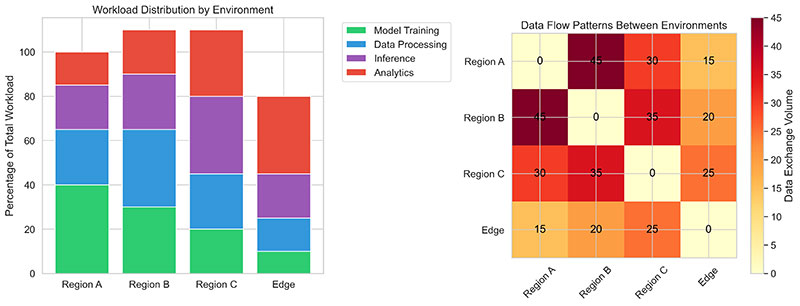
Federated marketplaces in multicloud environments enable organizations to leverage the unique strengths of different cloud providers while maintaining data sovereignty and regulatory compliance. The ability to execute AI/ML workloads across multiple clouds provides greater flexibility, resilience and cost optimization opportunities, making it a crucial consideration in modern data-sharing architectures.
Conclusion
Federated data marketplaces represent a vital development in the evolution of AI/ML capabilities, enabling organizations to leverage diverse datasets while maintaining security and compliance. As these platforms mature, their role in facilitating secure, cross-organizational data sharing will become increasingly important.
The success of these marketplaces will depend on continued innovation in security technologies, standardization of interoperability protocols and development of clear governance frameworks. Organizations that embrace these platforms while maintaining strong security and ethical standards will be well positioned to leverage the full potential of AI/ML in an increasingly connected world. As we move forward, the focus must remain on creating sustainable, secure and ethical data-sharing ecosystems that drive innovation while protecting privacy and maintaining trust.
References
- “The state of AI in early 2024: Gen AI adoption spikes and starts to generate value,” Quantum Black, McKinsey, https://www.mckinsey.com/capabilities/quantumblack/our-insights/the-state-of-ai
- “Adoption of artificial intelligence among organizations worldwide from 2017 to 2024, by type,” Statista, https://www.statista.com/statistics/1545783/ai-adoption-among-organizations-worldwide/.
- Deloitte, “The state of generative AI in the enterprise: 2024 year-end generative AI report,” https://www2.deloitte.com/us/en/pages/consulting/articles/state-of-generative-ai-in-enterprise.html.
- MarketsandMarkets, 2024, “AI Training Dataset Market,” October, https://www.marketsandmarkets.com/Market-Reports/ai-training-dataset-market-153819655.html.
- Eichner, Hubert, Daniel Ramage, Kallista Bonawitz, Dzmitry Huba, Tiziano Santoro, Brett McLarnon, Timon Van Overveldt, et al., 2024, “Confidential Federated Computations,” arXiv preprint, arXiv:2404.1076.
- Ghasemshirazi, Saeid, Ghazaleh Shirvani and Mohammad Ali Alipour, 2023, “Zero Trust: Applications, Challenges, and Opportunities,” arXiv preprint, arXiv:2309.03582.
- Danger, Roxana, 2022, “Differential privacy: What is all the noise about?,” arXiv preprint, arXiv:2205.09453.
Nishchai Jayanna Manjula is a seasoned Senior Specialist Solutions Architect with nearly 15 years of experience in consultancy and advisory roles, specializing in data analytics, AI/ML and cloud computing. He holds a bachelor’s degree in computer science and is a Fellow at IETE. Known for his expertise in modernizing data warehouses, data governance and data security for generative AI, Nishchai collaborates with organizations to unlock the full potential of their data. He actively contributes thought leadership through blogs, journals and public speaking on platforms like AWS re:Invent. Passionate about innovation, Nishchai advises a startup company on product development and provides strategic guidance to businesses, including those in the financial sector, automotive and manufacturing, to solve complex data challenges. Connect with Nishchai on LinkedIn.