August 1, 2025 in Edge AI
Edge AI and Regulatory Readiness: Architecting Compliant Intelligence at the Edge
SHARE: PRINT ARTICLE: https://doi.org/10.1287/LYTX.2025.03.14

Edge artificial intelligence (AI) – running AI algorithms directly on devices at the edge of the network – is emerging as a way to deliver lightning-fast insights while keeping sensitive data closer to its source. By processing data locally rather than in the cloud, edge AI can reduce latency and improve privacy. However, ensuring these distributed intelligent systems meet data protection, transparency and security regulations has become a pressing concern across jurisdictions. As global regulatory frameworks evolve – most notably, the EU’s draft AI Act, which mandates “trustworthy AI” practices – organizations adopting edge AI must be just as vigilant about compliance as they are about performance. This article explores the promise of edge AI, the compliance challenges it raises (data privacy, explainability, secure updates, data governance) and technical solutions for architecting compliant intelligence at the edge. This article also highlights some practical frameworks and tools for building these principles into real-world edge AI deployments.
The Nature and Promise of Edge AI
Edge AI refers to AI computation performed on local devices or on-premises gateways instead of centralized cloud servers [1]. This approach offers distinct benefits. First, it enables real-time intelligence: By eliminating long network round trips, edge AI systems can respond near instantly – crucial in settings like autonomous vehicles or industrial controls, in which split-second decisions matter. Processing data on-site also reduces dependency on constant connectivity.
Perhaps most importantly, processing data at the edge can enhance privacy and compliance by design. Sensitive information (for example, video from a hospital or personal financial data at a branch office) need not be continuously transmitted to the cloud. Local processing reduces the chance of data mishandling and helps ensure data stays within required jurisdictions. For instance, an edge AI system in a healthcare clinic could analyze medical images on-site and deliver immediate diagnostic results while the data remains on premises. This inherent data locality aligns with regulations that mandate keeping personal information under strict control. In essence, edge AI promises to bring advanced analytics into sensitive domains without continuously exporting raw data, allowing organizations to gain insights while staying compliant.
Key Compliance Challenges in Edge AI
Despite its advantages in latency and data locality, edge AI introduces a unique compliance landscape in which traditional cloud-era safeguards fall short. From device-level data privacy to fragmented jurisdictional mandates, organizations face a multidimensional risk surface [3]. Figure 1 compares edge AI and centralized cloud AI across key compliance dimensions – such as data locality, explainability and update security – in which lower scores indicate lower compliance risk and higher regulatory robustness [4].
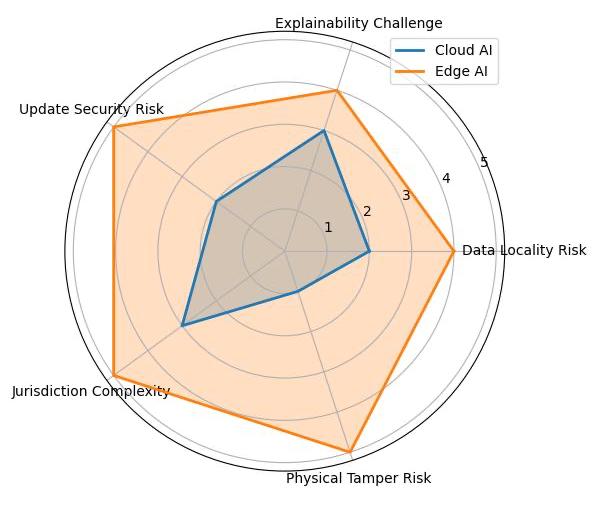
- Data Security and Privacy: Edge devices in the field are more vulnerable to tampering or attack than cloud systems, making it challenging to safeguard sensitive data across many distributed nodes.
- Explainability and Accountability: Edge AI models often act as “black boxes,” yet regulations demand explanations for automated decisions. Providing such transparency on small devices is difficult.
- Software Updates and Data Governance: Keeping edge AI software up to date and secure is challenging. Updates must be delivered in a trusted, tamper-proof way (e.g., with signed code). Moreover, devices in different jurisdictions must handle data according to local laws, which requires controlling what information is collected and shared.
Technical Solutions for Compliance at the Edge
To meet these challenges, practitioners are using a range of technical solutions that embed compliance into edge AI systems:
- Secure Enclaves: Hardware-based secure enclaves (trusted execution environments) create an isolated, encrypted space on the device for sensitive code and data, protecting them even if the device is compromised.
- Differential Privacy: These techniques introduce carefully calibrated noise to data or model outputs so that individual personal information cannot be inferred. It enables devices to share useful insights or train models without exposing individual personal data, aiding compliance with privacy laws.
- Federated Learning: Enables collaborative model training across many devices without centralizing the raw data. The raw data stays on each device, greatly reducing the risk of data privacy violations. Organizations can train a collective model from distributed data without ever aggregating sensitive data centrally.
- Explainable AI: Developers are integrating explainable AI (XAI) methods into edge systems to provide interpretable justifications for model outputs. These techniques help fulfill regulatory demands for clarity. Even basic XAI measures can improve user trust and compliance, although implementing them is challenging.
- Model Watermarking: Embedding a hidden identifier in a model to verify its origin and detect unauthorized use. Watermarking helps prove that an edge-deployed model is genuine and can deter tampering or intellectual property theft.
- Zero-Trust Security: Zero-trust means no implicit trust for any device or interaction – every access request is continuously verified. It limits breach impacts and aligns with stringent regulatory security expectations.

As Figure 2 illustrates, achieving regulatory compliance in edge AI requires an orchestrated integration of privacy-preserving computation, secure hardware, explainability modules and federated learning infrastructure. Each component reinforces the others, creating a layered defense-in-depth model that aligns with emerging global AI governance frameworks while preserving operational efficiency at the edge.
Frameworks and Tools for Compliant Edge AI
Translating compliance principles into deployable solutions requires robust frameworks that directly integrate privacy, security and governance into the edge AI pipeline. The following platforms exemplify how leading-edge tools support federated learning, secure model updates and policy-aligned AI deployments across diverse operational environments.
- NVIDIA FLARE: An open-source federated learning software development kit (SDK) that enables model training across multiple parties without centralizing data. It has been used in sensitive fields (e.g., multihospital medical AI) to train models while keeping all data on premises, supporting privacy requirements [5].
- Microsoft Azure Percept: A platform combining secure edge hardware with Azure cloud services to simplify building AI at the edge. It includes hardware-based security (for device identity and encryption) and follows Microsoft’s Responsible AI principles, so edge solutions can be deployed with privacy and transparency by design [6].
- AWS IoT Greengrass: Software that extends AWS cloud capabilities to local edge devices. It allows data to be processed and filtered on-site so that only high-value, nonsensitive information is sent to the cloud. Greengrass also provides built-in encryption and authentication for device communication, helping implement data minimization and strong security on IoT edge deployments [2, 7].
Together, these frameworks provide the foundational infrastructure needed to operationalize compliant edge intelligence. By embedding privacy-preserving training, secure device management and real-time inference monitoring, they enable organizations to scale AI deployments while aligning with regulatory mandates and industry best practices.
Conclusion
Edge AI has immense potential to transform industries by bringing intelligent automation closer to where data is generated. But this potential can only be sustainably realized if organizations make regulatory readiness a design priority. As we have discussed, a combination of technical approaches – from privacy-preserving data techniques and secure hardware enclaves to explainable AI and zero-trust architectures – can enable edge AI systems to meet stringent data protection and governance requirements without sacrificing functionality. Proactively adopting these measures is critical, especially as regulators catch up to the unique challenges of AI outside the data center. Companies today are already aligning with general AI governance guidelines (NIST, OECD, etc.) and adapting them for edge contexts, anticipating more explicit rules on the horizon.
In summary, architecting compliant intelligence at the edge means building systems that are private, secure and transparent by design. Organizations that succeed in this will not only avoid legal pitfalls but also earn the trust of users, partners and regulators. Edge AI can drive innovation in sensitive domains while respecting the rights and safety of individuals – provided it is built on a foundation of strong compliance and ethics.
References
- IBM, “What Is Edge AI?,” IBM Think Blog, https://www.ibm.com/think/topics/edge-ai.
- Amazon Web Services, 2024, “Unlocking the Power of Edge Intelligence with AWS,” AWS IoT Official Blog, November 29, https://aws.amazon.com/blogs/iot/unlocking-real-time-intelligence-at-the-edge-with-awss-connected-edge-intelligence/.
- International Association of Privacy Professionals, 2025, “Toward a tailored approach for privacy, trustworthiness in Edge AI,” IAPP News, April 16, https://iapp.org/news/a/towards-a-tailored-approach-for-privacy-trustworthiness-in-edge-ai.
- Meuser, Tobias, Lauri Loven, Monowar Bhuyan, Shishir G. Patil, Schahram Dustdar, Atakan Aral, et al., 2024, “Revisiting Edge AI: Opportunities and Challenges,” IEEE Internet Computing, Vol. 28, No. 4, pp. 49-59.
- NVIDIA, “NVIDIA FLARE Overview,” https://nvflare.readthedocs.io/en/2.6/flare_overview.html.
- Roanne Sones, 2021, “Azure Percept: Edge intelligence from silicon to service,” Microsoft Azure Blog, March 2, https://azure.microsoft.com/en-us/blog/azure-percept-edge-intelligence-from-silicon-to-service/.
- AWS, “Intelligence at the IoT Edge – AWS IoT Greengrass,” https://aws.amazon.com/greengrass/.
Kunal Khanvilkar is an accomplished technology leader with over 14 years of experience spearheading innovation across the payroll, contact center and finance industries. Serving as both a Cloud Architect and an AI practitioner-researcher, he possesses extensive expertise in cloud-native architectures, serverless computing, data and analytics, deep learning, and generative AI. His work is distinguished by a strong focus on enterprise-scale migration and modernization, resiliency and compliance, consistently leveraging advanced technologies to deliver scalable and future-ready solutions. Kunal holds a Master of Technology in Data Science and Engineering and a Bachelor of Engineering in Computer Science, complemented by multiple industry certifications, including AWS credentials. He has authored five patent submissions and is widely recognized for his innovative contributions and commitment to advancing the field of software engineering. Connect with Kunal Khanvilkar on LinkedIn.