

August 26, 2025 in Agentic AI for BI
Agentic AI: The New Paradigm of BI Reporting
SHARE: PRINT ARTICLE: https://doi.org/10.1287/LYTX.2025.04.02
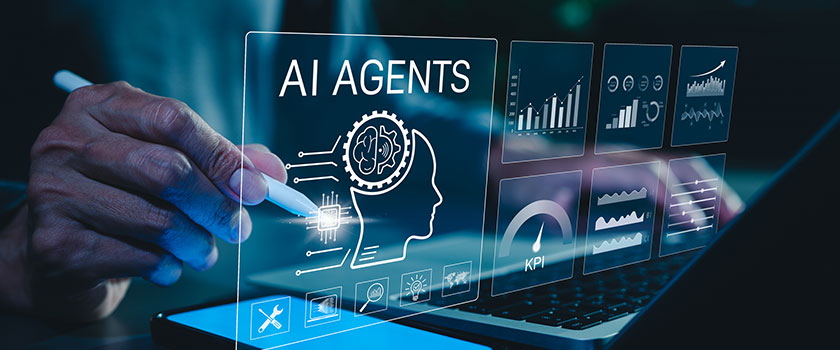
In today’s data-rich but insight-poor business environment, traditional business intelligence (BI) is reaching its limits. Static dashboards, rigid reporting cycles and manual analysis cannot keep pace with the velocity of decision-making required in a digital-first economy. Enter agentic artificial intelligence (AI), a new approach that reshapes how BI functions and how insights are delivered. Rather than asking data teams to chase answers, agentic AI anticipates business needs, explores data autonomously and delivers insights without being explicitly requested, acting and adapting like analysts. Agentic AI allows companies to transform large volumes of data into relevant, real-time insights amid growing business complexity. The result is a significant organizational advantage – accelerated decision-making, reduced blind spots and improved strategic foresight across operations.
Traditional Dashboards vs. Agentic AI
Agentic AI dashboards change how companies analyze data, predict trends and plan for the future. A 2025 study surveyed 500 companies and determined that agentic AI systems reduced task completion times by 34%, increased accuracy by 8% and improved resource utilization by 14%. Traditional dashboards rely on tools like Excel, Tableau and Power BI and require data scientists to manually process data to generate static reports. These legacy systems are not well suited to handle large datasets, increasing data scientists’ workload and preventing companies from accessing valuable real-time insights.
Agentic AI dashboards combine the power of machine learning (ML) algorithms, natural language processing (NLP) and real-time analytics into automated data tools. Agentic AI manages the movement and processing of data at scale within data pipelines. When a sensor, such as a smart thermostat, produces data, agentic AI collects this information and passes it through data pipelines, applying its algorithms and generating results. The dashboards update in real time, giving business leaders an edge in a wide range of applications, from fraud detection to inventory management. The key differentiator of agentic AI dashboards is the application of ML models to surface actionable insights without manual intervention. It enhances system efficiency by dynamically adjusting analytical workflows based on data context, user behavior and evolving business objectives. Much of the manual labor of working with big data is fully automated with these tools, improving efficiency and reducing the need for repetitive tasks.
How Agentic AI Systems Work
Agentic AI systems draw data from internal and external sources, organize it, and look for patterns and trends. As data is sent to the agentic AI, engineers use the extract, transform and load (ETL) data framework to ensure information is correctly formatted. The agentic AI system learns which insights are valuable in a specific business context by applying NLP and computer vision to user queries. The retrieval-augmented generation (RAG) process is used to further train and optimize the agentic AI on company-specific data. Although agentic AI is powerful, human expertise around business processes remains essential. In many cases, agentic AI requires people to set its overall goals and monitor the process. Once those goals are established, AI applies strategies like decision trees, reinforcement learning and other planning algorithms to determine how best to achieve the objectives.
Implementing agentic AI in BI requires a combination of advanced tools and technologies to enable autonomous data analysis, continuous learning and real-time decision-making. At the outset, data integration platforms assist in aggregating and cleaning data from diverse sources. ML frameworks, such as TensorFlow, PyTorch or custom agentic AI platforms, then use that data to support autonomous model training and adaptive learning. The NLP component of the tech stack processes unstructured data and facilitates conversational interfaces.
Automation and orchestration tools bring powerful, strategic decision-making value to agentic AI dashboards, managing workflows, triggering actions and enabling agents to execute decisions autonomously. All those decisions require vast computational power provided by the tech stack’s cloud infrastructure layer. The point at which employees interface with the agentic AI, BI visualization and reporting tools integrate with AI outputs to deliver actionable insights in user-friendly formats. Together, these tools form a robust architecture, enabling organizations to scale agentic AI-driven BI and generate real-time, strategic business insights.
Examples From Various Business Sectors
Agentic AI dashboards are applied in a variety of contexts across business sectors. In the healthcare industry, these dashboards impact patient care and clinical decision-making. The Mayo Clinic uses an agentic AI platform to analyze large volumes of patient records and flag patients who may be at high risk for specific conditions. Telemedicine and remote health monitoring companies use these tools with real-time data from wearable devices to automatically identify health risks and alert providers.
In retail, the aggregation of numerous data sources, such as sales transactions and market trends, allows for a deeper understanding of customer behavior. For managing inventory, AI dashboards help track trends and plan and identify problems. Walmart applies an agentic AI dashboard to forecast demand for 500 million items weekly – as the system learns with more data, the improved forecasting results in significant cost savings.
The customer service sector was an early adopter of AI tools, applying NLP to aggregate data from sources such as email and social media. Many large companies apply sentiment analysis through agentic AI dashboards to proactively monitor customer feedback and address concerns. Delta Air Lines, for example, reports that this strategy has led to a 30% increase in customer satisfaction ratings.
Agentic AI dashboards have had a significant impact on system monitoring and cybersecurity. Engineers can now receive predictions about when systems are likely to fail, allowing them to repair them before they break. In cybersecurity threat detection, agentic AI allows companies to process trillions of threats weekly, generate actionable insights and visualize trends. Some companies are using unsupervised learning to detect and respond to threats autonomously.
Challenges to Adopting Agentic AI
Introducing new technology is always a challenge; agentic AI is no exception. A significant obstacle is managing the changes AI tools bring to a company, in which employees may be required to learn new skills and modify their day-to-day tasks. One way to anticipate and manage this challenge is with extensive employee training and a thorough change-management strategy. Organizations can take steps to shift their culture by embedding automated alert systems into core business functions and prioritizing predictive analytics. When setting up automated monitoring and alerts, it’s still crucial to incorporate human feedback at regular intervals throughout the process. This feedback loop between AI systems and human operators helps mitigate biased decision-making by ensuring that the models are continuously validated.
Maintaining and improving system performance is an ongoing problem for organizations using these tools. AI agents must continually update their models to improve, so it is critical for organizations to ensure that the system is provided with uninterrupted streams of data. Additionally, leveraging metadata management, context-aware embeddings and data versioning ensures that agents maintain situational awareness and adapt their behavior as business logic and data environments evolve.
Agentic AI in BI reporting can introduce risks like model drift, biased decision-making and data privacy vulnerabilities. A 2025 study found that 78% of organizations had concerns about data privacy and agentic AI systems. To mitigate these risks, experts recommend implementing human-in-the-loop oversight, continuous model validation, audit trails and robust governance frameworks that monitor agent behavior, data quality and alignment with business rules.
Strategic Business Insights
Agentic AI for BI reporting offers the promise of a dynamic, fine-grained understanding of business processes combined with real-time insights. These tools surface relationships between data points and translate them into readable text, which lets data scientists generate strategic business insights and access up-to-the-minute metrics. The successful implementation of agentic AI for BI depends on a solid understanding of how data moves through an organization’s tech infrastructure. This foundation is used to build layered architectures of tools that enable organizations to scale agentic AI-driven BI and deeply embed intelligence into business processes.
Swechcha Gurram ([email protected]) is a data expert with more than 17 years of professional experience in the government, financial services, technology, healthcare and energy sectors. She has a strong background in data visualization, predictive analysis, statistical analysis and machine learning and is skilled in ETL processes, reporting and data modeling. Swechcha completed the artificial intelligence and machine learning postgraduate program at the University of Texas at Austin. 
([email protected])