November 13, 2025 in AI Tools
From Choice Overload to Clarity: Making Better AI Tool Decisions
SHARE: PRINT ARTICLE: https://doi.org/10.1287/LYTX.2025.04.12

The rapid adoption of artificial intelligence (AI) tools has created opportunities and challenges for organizations seeking to establish a competitive edge in a rapidly changing marketplace. Companies can now choose from a wide variety of AI tools, ranging from general-purpose platforms that automate multiple tasks to focused solutions that target specific problems. Choice, however, does not always equal clarity. Many organizations struggle to select the best tool for their specific needs.
To succeed, it’s essential for companies to first evaluate their current situation and determine where they want to go before investing in solutions that don’t meet objectives. Some enterprises build new systems that automatically route work to the AI tool that is most effective at a given moment, considering cost, performance and historical outcomes. Businesses that master this balanced approach, strategically choose tools and adjust in real time can gain a measurable competitive edge.
The Paradox of Choice in AI Tool Selection
When navigating today’s AI landscape, there is no shortage of AI tools. That said, when faced with too many choices, companies can become paralyzed by indecision. Alternatively, they may select a vendor based on reputation, industry buzz or competitor adoption. Although this decision might kickstart implementation, it’s an unstable foundation. The result is often a tangle of underutilized tools, what analysts now call “AI sprawl.” Projects hit frustrating walls, promised return on investments (ROIs) vanish and teams become cynical as they witness yet another “transformative” technology that fails to deliver.
The solution isn’t more technology, but greater discipline. A winning strategy, which may seem counterintuitive, is to initially ignore the tools. Instead, it’s beneficial for companies to start by zeroing in on specific business problems, identifying inefficiencies and decision points that lack data or processes that can benefit from automation. Once the issue is crystal clear, companies can evaluate which AI capability addresses each need. This method of working backward, paired with a simple value-versus-feasibility grid, can filter out the noise. This approach shifts the conversation from what’s trendy to what’s tangible, thereby transforming AI from a budgetary burden into a powerful engine for results.
Build, Buy or Partner
Every organization must make a critical decision when implementing new AI capabilities: build an in-house solution, purchase it off the shelf or develop it with a partner. Each option carries a distinct set of trade-offs in implementation speed, control, cost and long-term value (Figure 1):
- Building internally. This option offers superior customization capabilities and the opportunity to create valuable intellectual property closely aligned with business goals. However, building a solution demands significant investment in specialized talent and ongoing maintenance.
- Buying prebuilt tools. This option promises faster deployment but can sacrifice flexibility and introduce scaling or integration risks that may not be immediately apparent.
- Collaborating with a tech partner. Although partnering balances control with outside expertise, long-term reliance on a third party can add complexity and increase costs.
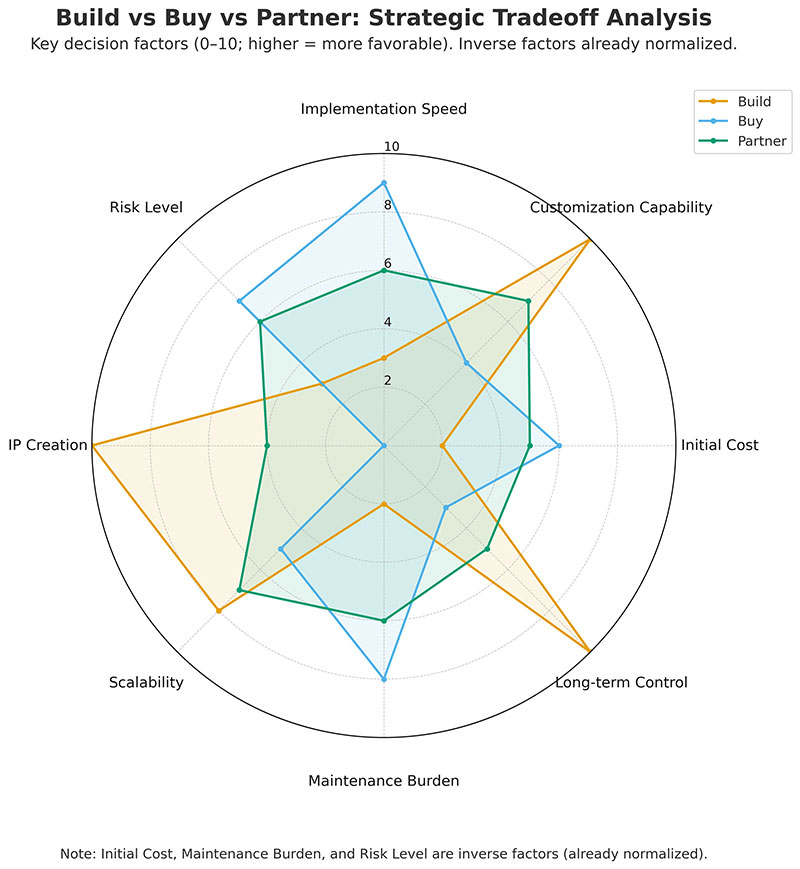
Many organizations turn to proof-of-concept pilot programs to guide this complex decision. These tests reveal hidden data not shared in a sales demonstration, such as integration challenges, training costs or the quality of vendor support. By testing before scaling enterprise-wide, organizations can gain real-world experience to ensure their final choice aligns with the company’s long-term needs. The process of deciding whether to build, buy or partner provides leaders with a way to balance the need for speed with the desire for control.
Aligning Tools with AI Maturity
The effectiveness of AI tools depends on more than their technical features. It is deeply tied to an organization’s maturity level and technical capability. Teams just starting out often find the most value in low-code platforms or pretrained models. These options make initial experimentation feasible without a major upfront technical investment because they lower the barrier to entry, help teams build confidence and generate quick wins that demonstrate their effectiveness to stakeholders. Meanwhile, mid-stage organizations may lean toward tools that offer greater customization, direct application programming interface (API) access and integration capabilities across various business units. For advanced enterprises, the focus moves to sophisticated orchestration platforms, mature machine learning operations practices and robust governance frameworks. These systems must manage at scale across the organization while maintaining strict compliance and accountability.
Industry research confirms that aligning tool selection with maturity level is critical. A recent study highlights that organizations succeed by matching their deployment strategy to their actual capability level. Overlooking this alignment can lead to costly mistakes. For example, a company might invest in advanced orchestration tools before establishing the necessary data infrastructure or in-house expertise to support them. The most successful companies conduct an honest assessment of their readiness before implementing any solution. This self-evaluation allows them to select tools that deliver immediate value while also creating a realistic foundation for future growth as their experience deepens.
Intelligent Orchestration as an Operational Layer
The strategy of adopting a single AI tool for permanent use is becoming obsolete. Operational performance fluctuates, costs vary unpredictably and models can adapt unevenly to new information. For these reasons, a more fluid and responsive strategy is now essential. Intelligent orchestration addresses this need by introducing a flexible management layer that dynamically routes each task to the most suitable tool available at that moment. This approach shifts away from viewing tools as fixed, long-term solutions and treats them as modular elements within a broader, integrated system. Dynamic routing decisions prioritize critical factors like result accuracy, processing speed and budget constraints to ensure optimal resource allocation, enhance overall efficiency and minimize dependence on a single vendor.
New research supports orchestration as a valuable solution for fragmented AI environments. Because the framework enables seamless switching between tools, it directly embeds the capacity for adaptive decision-making into daily operations. Two technical components make this possible: Abstraction layers act as a vital buffer, decoupling applications from the constant churn of individual models. Meanwhile, automated feedback loops monitor outcomes in real time, refining routing logic based on performance data. This represents a fundamental shift in philosophy. Forward-thinking leaders are moving away from siloed projects and building a unified, strategic system of interoperable tools that strengthen organizational agility.
Continuous Evaluation and Long-Term Fit
Many companies make the mistake of treating AI as a one-time investment. Technology that seemed advanced just a year ago can quickly become a liability, silently falling out of step with the company’s progress. Successful teams avoid this by conducting ongoing evaluations that ask difficult questions, including whether the tool is still valuable, whether it should be retired and what new options deserve a pilot program. It’s critical for this process to balance quantitative metrics like ROI and system latency with qualitative ones like user adoption and satisfaction. Strong performance data means little if the tool sits unused.
Long-term success depends on flexibility. A modular technology architecture allows teams to replace one component without causing other issues down the line. This approach also prevents vendor lock-in, thereby lowering the costs of switching and experimenting with new technologies. The companies that thrive are not those with the latest technologies but those most open to continual adaptation. By adopting this approach, organizations can ensure their technology investments support their strategic goals, protect their investment and maintain resilient operations resistant to rapid change.
Building Resilient AI Strategies for the Future
The expanding availability of AI tools is a double-edged sword for businesses. On one hand, companies have unprecedented access to tools that promise faster insights, more efficiency and smarter automation. At the same time, this abundance of tools often leads to being overwhelmed, with stalled projects and lackluster results. The difference between success and failure depends on strategic selection, alignment with maturity and ongoing adaptability.
Companies that build flexible systems and view AI tool selection as an ongoing process rather than a one-time investment enhance their ability to respond to changing business environments and emerging technologies. By delegating tasks to the most appropriate tools based on current objectives, performance and constraints, intelligent orchestration makes this possible. This strategic approach encourages continuous learning and avoids the risks of overcommitment or stagnation. As AI becomes embedded in strategic operations, the organizations that thrive will be those that choose with clarity and adjust with confidence.
Muath Juady is the CEO and founder of SearchQ.AI, a platform that unifies more than 100 AI models and tools. With more than 10 years of experience in full-stack development, AI and Web3, he has led projects across industries, including e-commerce, blockchain and data-driven automation. Muath holds master’s degrees in information systems engineering and management, and entrepreneurship and innovation from the EU, U.K. and U.S. Muath specializes in AI orchestration, intelligent platforms and scalable product design. Connect with him on LinkedIn.