November 21, 2025 in Edge Computing
On the Edge and in the Cloud: The Future of Real-time Data Flows
SHARE: PRINT ARTICLE: https://doi.org/10.1287/LYTX.2025.04.19
Internet of Things (IoT) devices are everywhere – in cars, medical devices and industrial settings like manufacturing lines. Managing and using the large volumes of real-time IoT data, also known as telemetry data, is a key challenge for companies across various industries. For time-sensitive and critical business functions, cloud architectures lack the reliability and responsiveness required to effectively process telemetry data. To address this challenge, new hybrid approaches combine the benefits of cloud architectures with edge computing, pushing compute closer to the data source at the edge and enabling faster decision-making for use cases like device health monitoring and predictive maintenance. Integrating edge systems with centralized cloud telemetry data platforms allows for historical data analysis, data aggregation and pattern recognition at scale, harnessing the power of cloud computing to reduce costs and enhance system performance.
The “Design Triangle” of Edge-Cloud Telemetry Systems
Latency, bandwidth and compute form the “design triangle” that helps engineers determine where processing occurs, what data gets prioritized and how resilient the entire system is under real-world conditions. Latency, or the amount of time delay in a system, influences whether data is processed immediately on the edge or more slowly via the cloud. Time-sensitive data, such as health alerts or anomaly detection, requires low latency and is well suited to edge computing. In contrast, deep analytics, artificial intelligence (AI) models and long-term trend analysis require significant computational resources and are better suited for the cloud.
Bandwidth is the speed at which data can be transmitted through a network, influencing which data is sent to the cloud and when. Because bandwidth fluctuates over time, techniques like intelligent filtering, local caching and compression enable its optimization without compromising on critical data fidelity.
Compute refers to features like processing capability, storage, networking and other resources that make up the computational power of a system. Compute resources are less available in edge computing than in the cloud, making it crucial to optimize for lightweight telemetry agents that prioritize the most valuable insights. Techniques such as containerization, modular design and purpose-built hardware accelerators enable system designers to maximize the value from the limited resources of edge devices.
Edge Computing, Cloud Telemetry and Hybrid Designs
Although edge computing is characterized by low latency, efficient bandwidth use and operational resiliency, its computational resources are limited. However, the vast compute power of the cloud comes with higher latency. Hybrid designs combine the power of cloud computing and the speed of edge telemetry by ingesting and curating data from all the connected edge devices. These layered architectural designs are tailored to specific business cases, orchestrating which data to process on the edge and which to send to the cloud.
The benefits of hybrid telemetry infrastructures include reduced latency and ultrafast response times for mission-critical applications, efficient bandwidth use through local data filtering and preaggregation, and enhanced security and privacy by processing sensitive information locally. Additional advantages include operational resilience through local autonomy, which keeps systems running amid network disruptions; scalability and flexibility through distributed compute resources; and cost savings by minimizing unnecessary cloud transmission and storage.
Architectural Challenges and Engineering Mitigations
Distributed telemetry systems can comprise millions of connected devices, increasing complexity and posing unique issues. Because of the large number of nodes, deployment and management at scale require engineers to build custom features into the platform. These features enable over-the-air updates, remote diagnostics and secure provisioning for coordinating tasks like software updates.
Another challenge in integrating edge computing with cloud telemetry is architectural fragmentation. Often, edge and cloud environments have vastly different capabilities, operating conditions and deployment life cycles. Making them work together in a cohesive, reliable way requires deliberate design and custom tools.
To ensure telemetry streams remain synchronized, timestamping data at the source is crucial. This is most important when correlating telemetry data from different components or geographies.
When telemetry is generated and processed in multiple layers, sometimes asynchronously, ensuring unified schemas, timestamps and metadata becomes complex. Companies address this by enforcing standardized telemetry contracts and version-controlled schemas across all nodes, with transformation logic built into their ingestion pipelines. To maintain data consistency, system designers implement checksums, message signing and end-to-end validation mechanisms across the pipeline.
Security has become a frontline concern in edge-cloud telemetry. As the number of entry points increases – including edge devices, cloud end points and communication protocol – so does the attack surface. Security experts recommend adopting a zero-trust security model in which every telemetry packet is authenticated and encrypted, both at rest and in transit. Techniques such as mutual transport layer security, device identity verification and role-based access control ensure the secure operation of edge agents and cloud services.
Cost control is a central challenge because transmitting massive telemetry streams to the cloud can quickly become expensive. Companies address this by implementing smart filtering, adaptive sampling and edge-side analytics to reduce unnecessary data flow.
Working with Real-time Data Protocols
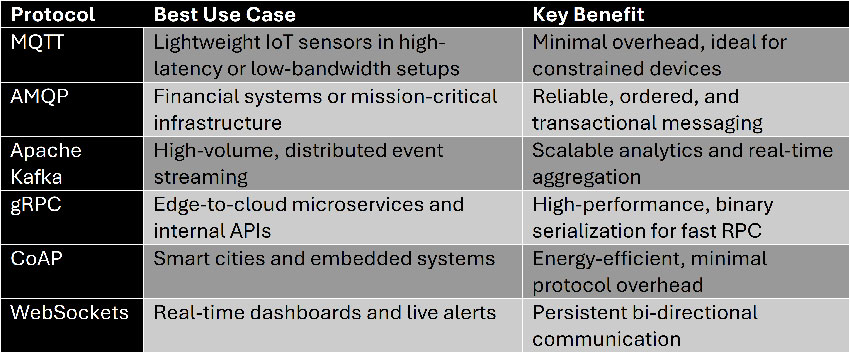
Effective telemetry requires lightweight, secure and interoperable protocols, including:
- MQTT: is best for lightweight, low-bandwidth, high-latency use cases like IoT sensors.
- AMQP: offers high-reliability, transactional and ordered messaging ideal for critical infrastructure and finance.
- Apache Kafka: provides high-throughput, distributed event streaming for large volumes and analytical aggregation.
- gRPC: is a type of Remote Procedure Call (RCP) that enables binary serialization between servers and clients for streaming and edge-to-cloud microservices.
- CoAP: is an energy-efficient protocol designed for use in embedded systems and smart cities.
- WebSockets: provides persistent bidirectional communication for real-time dashboards and alerts.
Modern systems often layer these protocols in the following ways: MQTT for device-edge, Kafka for mid-tier or core aggregation, and gRPC/AMQP where transactional guarantees matter. The most effective protocol depends on the use case, where latency sensitivity, network conditions and payload size are key determining factors (see Table 1).
Edge-Cloud Telemetry in Practice
Various industries use edge-cloud telemetry, including:
- Industrial IoT. Siemens uses edge analytics in factories, reducing unplanned downtime via predictive maintenance and cutting network loads by up to 70%.
- Autonomous vehicles. Tesla and Waymo use real-time local decision-making aggregate data to the cloud for system-wide updates, improving both safety and machine learning velocity.
- Smart cities. Barcelona uses distributed edge nodes for real-time traffic and environmental management, boosting response speed and reducing congestion by 20%.
- Healthcare. Medtronic wearables process telemetry on-device for instant patient alerts, uploading analytics to the cloud for longitudinal population health studies.
How to Prepare for the Future
It is essential to anticipate future trends, such as AI-driven edge analytics, edge-native platforms, quantum computing and self-optimizing systems, when building an edge-cloud telemetry system. Companies that invest in flexible, future-forward telemetry architectures and prioritize team training are well placed to benefit from these upcoming innovations. Embracing observability as a core capability rather than a support function enables more flexible and adaptable telemetry architectures.
Next-Gen Real-time Data Flows
Edge and cloud integration are central in next-generation real-time data workflows, facilitating agility and scale. For companies to optimize their data, it is vital for business leaders to treat telemetry as a technical pipeline and as a strategic differentiator that fuels better products, services and customer experience. Success hinges on robust orchestration, data governance and multidisciplinary talent transformation. When companies balance the benefits, trade-offs and unique business requirements of telemetry integration, the outcome is a resilient, real-time system that responds faster and delivers better insights over time. The future belongs to those who architect for speed, security and flexibility from the edge to the cloud and beyond.
Disclaimer: The views and opinions expressed in this article are those of the author and do not necessarily reflect the official policy or position of the author’s employer.
Ivan Martis is a senior manager of software engineering with over 20 years of experience leading and delivering large-scale software projects with globally distributed teams. He holds a Bachelor of Engineering in computer science and a Master of Technology in computer science, and is a certified project management professional with expertise across telemetry, healthcare and EMS/NMS domains. Connect with Ivan on LinkedIn.