December 9, 2025 in Predictive Analytics
Churn Prediction and Prevention: Using Data Analytics to Retain Customers
SHARE: PRINT ARTICLE: https://doi.org/10.1287/LYTX.2025.04.21

The importance of return clientele can’t be overstated. Many companies place more attention and resources on generating new business, but retaining repeat customers is the lifeblood that keeps the vast majority of businesses going. According to a 2014 study from Harvard Business Review, a 5% increase in customer retention generally leads to a 25%-95% increase in profits.
So, what is churn? Churn is simply the rate at which your customers or subscribers decide to pack up and leave. It’s the inverse of retention, and if left unchecked, it can be a silent killer of growth. Think of your customer base like a bucket. Ideally, a business is constantly pouring new customers in, which we call customer acquisition. But if you have holes in the bottom of that bucket (churn), you’ll never fill it up, no matter how much you pour in.
Measuring Success: KPIs for Churn Reduction and Retention
Analytics always starts with the ability to measure what we want to analyze. There are several common metrics and key performance indicators (KPIs) that can be used to measure and segment customer churn.
Churn Rate
Churn rate can be calculated as (Number of Customers Lost in a Period/Total Customers at the Beginning of that Period) x 100. This equation quantifies the percentage of individual customers who discontinue their relationship with your business within a specific timeframe. It tells you the raw number of people walking away.
Customer Lifetime Value
Customer lifetime value (CLV) can be calculated as (Average Purchase Value x Average Purchase Frequency) x Average Customer Lifespan. In simpler terms, CLV is all about how much an average customer spends in their lifetime as a customer. When you gain a new customer, you are gaining that new customer not just for one time but ideally for ongoing future transactions.
Customer Satisfaction Survey Metrics
One of the most popular ways to measure customer satisfaction is through surveys. Businesses use surveys to get a pulse of how their customers (and potential customers) feel about their brand, products, etc. In the world of surveys, there are two near-universal metrics:
- Customer satisfaction (CSAT) scores typically range 1-5, directly gauging a customer’s immediate satisfaction with a specific interaction or recent experience. These scores are used for identifying precise points of delight or friction, enabling quick, targeted improvements to a particular touchpoint.
- Net promoter scores (NPS) typically range 1-10, assessing a customer’s overall loyalty and their likelihood of recommending your brand to others. This metric serves as a powerful indicator of long-term relationship health and the potential for organic growth through word-of-mouth referrals.
Data Analytics for Churn Reduction
This is the fun part. There are several types of analysis you can perform when it comes to churn reduction. Always keep the end goal in mind and don’t lose sight of the purpose. We are doing this to understand historical churn and ultimately increase client retention.
Usage Curves and Average Customer Lifetime Value
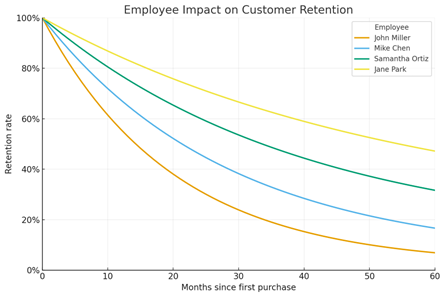
Usage curves are a method to measure return customer behavior over time through line charts. The x-axis on usage curves is always the same. The far-left value is month 0, the month at which each customer on the chart had their first transaction. It doesn’t matter when their first transaction was, per se; we just want to see how customers behave from month 0 onward. The rest of the x-axis to the right will go up incrementally, one month (or any other duration you choose) at a time, to measure the customer return behavior after the first transaction.
The y-axis on a usage curve is always the return rate. It shows the percentage of customers in the chart who returned as customers on any given month after month 0. Month 0 will, by definition, always be 100%, but after that, behaviors can vary based on the patterns of the business. Once you have a basic usage curve across your whole business, you can segment it by various critical dimensions to generate insights about both causes and indicators of your retention.
In the usage curve in Figure 1, this data is split by employee, which is a way to track whether certain employees or managers have standout performances either positively or negatively in terms of their impact on customer retention. This can be leveraged for improved training, scheduling and incentive monitoring. In this example, John Miller is the lowest performer in terms of customer return rate, which is usually an indicator of employee performance.
Usage curves can generate insights for just about anything you can segment. This includes (but is not limited to):
- Individual employee or manager impact on retention.
- Scheduling behavior’s impact on employee performance and, in turn, retention.
- Retention trends and fluctuations over time.
- Top cross-selling products, services or bundles.
- Understanding of clients’ standard time-based drop-offs to reduce attrition at these times.
- Top customer segments by demographic, behavioral or geographic data.
Once you have created usage curves and segmented them according to your needs, you can go a step further and layer average CLV into the mix. Specifically, we can create a new set of charts that swap the y-axis value away from customer return rate toward customer average spend per month for each segment. This quantifies the impact of your retention efforts.
Customer Feedback Analysis
Customer feedback can be collected in many ways, but some of the more common channels include phone surveys, written/email surveys and social media. Of course, the return rate is a quiet indicator of customer feedback. If customers don’t come back or refer your business, that is feedback.
When analyzing surveys, CSAT scores and NPS can be segmented based on various variables. In a Render Analytics case study with BlueCross BlueShield, for example, there is a thorough breakdown of how analyzing call center phone survey data led to improvements in predicting customer renewal and membership behavior. Customers who reported poor CSAT scores and NPS on surveys were statistically significantly more likely to churn to a competitor at the end of their coverage period. This led to insights on a few cost-effective, controllable variables that drove retention, such as call center employee tenure, that ultimately spun up initiatives that effectively reduced churn.
Predictive Modeling Techniques
Logistic regression is uniquely suited to analyze churn because of the binary nature of retention. A customer either stays or leaves; there is no middle ground. This statistical method predicts the probability of a customer churning, outputting a score between 0 and 1. By analyzing historical customer data (i.e., demographics, usage patterns), logistic regression identifies the factors most strongly associated with a customer leaving. The model provides interpretable coefficients, meaning you can see exactly how much each variable (like monthly charges or customer service interactions) influences the likelihood of churn. This not only allows you to predict which customers are at risk but also crucially reveals why they might be churning, empowering your business to develop targeted and effective retention strategies.
Decision trees offer another intuitive and powerful approach to predictive modeling. A decision tree can visually map out the paths customers take before churning, revealing specific combinations of factors that lead to attrition. For example, a tree might show that customers who joined in a specific year, used a particular feature infrequently and contacted support twice within a month have a high probability of churning.
AI and Machine Learning for Churn Prediction
Machine learning is a branch of artificial intelligence (AI) that empowers systems to learn and make decisions without explicit programming. Unlike traditional rule-based approaches, machine learning algorithms rely on patterns and data to improve their performance over time. Churn analysis is just one practical use case, and there are plenty of practical applications of machine learning in the business world.
Implementing a Churn Prediction Workflow
Although even a one-off analysis can provide insights, the real impact comes from embedding churn analytics into daily operations. A typical workflow moves from a baseline analysis to centralizing data, to building dashboards with alerts and finally to periodic deep dives for new trends.
Actionable Strategies for Customer Retention Based on Analysis Insights
Where do we go from here? We pragmatically apply our lessons learned. This means hitting leads at key touchpoints.
Personalized Retention Offers and Loyalty Programs
By analyzing churn data, businesses can pinpoint individual vulnerabilities and preemptively deploy hyper-tailored incentives. Targeted discounts and exclusive feature access make customers feel uniquely valued and reduce the likelihood of churn. Customer loyalty programs, when strategically designed with insights from churn analysis, move beyond simple discounts to cultivate genuine affinity by rewarding ongoing engagement. Offering exclusive perks significantly increases the perceived “switching cost” for customers who might otherwise stray.
Improving Customer Experience
This isn’t a vague aspiration; it’s a data-driven mandate. By systematically identifying and smoothing out friction points across the entire customer journey from website navigation to support interactions, businesses can directly enhance satisfaction and reduce the likelihood of disengagement. Which trigger points have an outsized impact on perceived value and, therefore, retention?
Onboarding Optimization
Often the first and most critical touchpoint, customer onboarding involves leveraging churn data to identify precisely where new users struggle or fail to realize value. For example, Atlassian Technologies found that if an enrolled user in one of their training programs does not reopen their course within 5 days of the first time they started the course, that user’s likelihood of ever returning drops off a cliff. They were able to use this information to send emails to these users at the three- or four-day mark to try to decrease total churn at this touchpoint. By swiftly refining these initial experiences, businesses can ensure rapid product adoption and solidify early-stage commitment, drastically reducing immediate postacquisition churn.
Challenges and Future Trends in Churn Analytics
When performing any sort of data analysis, it is important to be aware of common challenges and pitfalls as well as best practices to avoid them. One of the most common issues with any type of analysis, with churn prediction being no exception, is data quality and availability. The foundation of any accurate prediction is robust and clean data. Inconsistencies or missing values can fundamentally undermine a model’s reliability and lead to flawed insights.
One way churn analytics is changing is through real-time, proactive interventions. The ability to identify churn signals as they happen in real-time enables immediate, automated trigger points that can reengage customers at their precise moment of vulnerability. The future also opens the door to hyperpersonalization. Churn analytics will enable dynamic, individualized retention journeys. The messaging of communication, offers and in-app experiences will become more unique to each customer’s specific behaviors, preferences and predicted likelihood of churn.
Charlie Render, founder of Render Analytics, is a data analytics expert with more than a decade of experience in data engineering and digital optimization. Render Analytics offers personalized AI and data-driven solutions to clients of all industries and sizes, varying from large organizations, such as Marriott Hotels and BlueCross BlueShield, to small mom-and-pop businesses.