January 16, 2026 in Viewpoint
The Double-Edged Sword of AI Innovation
SHARE: PRINT ARTICLE: https://doi.org/10.1287/LYTX.2026.01.02

We are at an inflection point in the artificial intelligence (AI)-infused world of business today. AI offers not only efficiency, but reinvention – rewiring the very nature of decision-making, product creation, service delivery and more. However, with this power comes a hidden tax: shadow AI and technical debt.
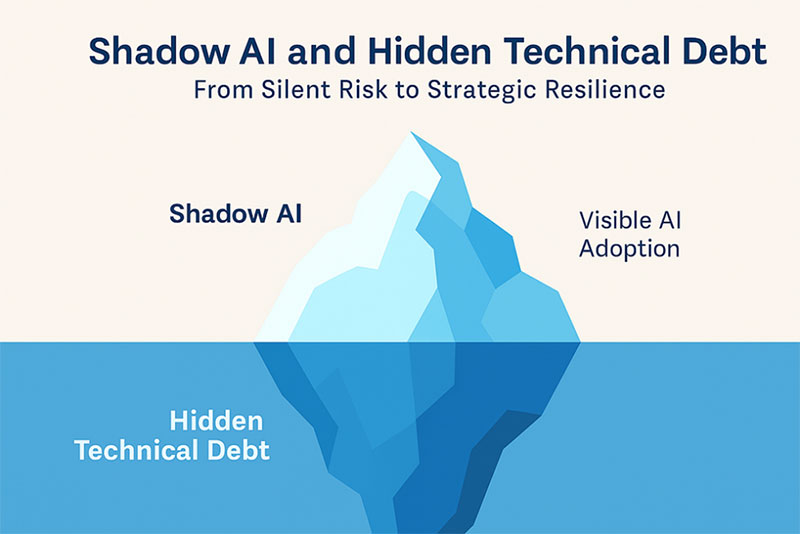
Think of it like renovating a house without an architect. You might get a shiny new kitchen fast (thanks to a few clever tools), but you may also unknowingly compromise the foundation. This is the silent risk many companies are taking in the race to “do more with AI.”
AI Product Insight: These issues are not fringe cases. In reality, they emerge as product delivery bottlenecks, security weaknesses and long-term scalability issues – problems that compound over time, like interest on a loan you didn’t know you had.
The Rise of Shadow AI: The Digital Garage Revolution
Just as early software developers hacked together applications in their garages, employees today are creating their AI-enhanced workflows ; only this time, it’s happening within regulated enterprises.
They’re not trying to cause trouble. They’re trying to accomplish things. AI tools are increasingly like the duct tape of modern knowledge work – sticky, easy to grab and surprisingly effective … until they make something worse instead of better.
For example, if a marketing team uses an AI content generator to replicate customer data, allowing them to localize campaigns more efficiently, is that helpful? Absolutely. Is it compliant and secure? Not quite.
Shadow AI as a Product Demand Signal
Rather than demonizing shadow AI, organizations should view its emergence as a signal for product discovery , or an indicator of unmet needs and gaps in their existing tooling.
Think of shadow AI as “unsolicited user research.” If dozens of employees are using Notion AI or Midjourney without approval, it’s not disobedience – it’s feedback.
Hidden Technical Debt: AI’s Silent Saboteur
Technical debt is like cholesterol, invisible and easy to ignore until it causes a heart attack. In the AI world, technical debt hides behind beautiful demos and slick dashboards, silently corroding trust and maintainability.
What makes AI-specific debt even more complex is that it involves living systems that constantly learn, decay and adapt. The costs often arrive long after launch, such as model retraining failures, broken data pipelines and biased outcomes.
AI systems blur the line between product and infrastructure. Unlike traditional apps that “do what they were coded to do,” AI models learn behavior, meaning that even seemingly stable products can rot from within if monitoring and retraining aren’t baked in from Day 1.
Strategic Mitigation: AI-First Engineering and Governance
More than having the best models, maturity in AI also requires having a proper scaffolding to support them over time. This necessitates a change in approach and action.
Governance is not bureaucracy – it’s enablement. Instead of slow-moving compliance gates, think of AI governance as a “digital scaffolding” that enables teams to safely experiment without risking collapse.
Human-in-the-loop as product strategy. Not every AI output should be automated. Strategic checkpoints – especially in high-stakes or customer-facing workflows – can act as “trust circuit breakers.”
POV: From Risk to Resilience
AI innovation and risk aren’t opposing forces – they are two sides of the same system. The challenge is to design for both.
Mindset Shift #1: Shadow AI is not a violation – it’s a voice. Listen to it.
Mindset Shift #2: Technical debt isn’t a cost center – it’s a signal. Invest in understanding where and why it accrues, and you’ll unlock agility others can’t reach.
By embracing governance as a lever for speed and clarity, and by managing AI systems as evolving products, organizations can turn shadow AI and hidden technical debt into long-term competitive advantages.
Ram Kumar Nimmakayala is a Principal Product Manager – AI & Data Strategy at Western Governors University, one of the largest online universities in the U.S. He leads AI products that support over 190,000 learners and is a frequent invited speaker and panelist on pragmatic, responsible AI for large enterprises.