March 4, 2026 in Cyber Resilience in the Age of Intelligent Systems
The New Digital Fragility: How AI-Enhanced Cyber Threats Are Reshaping Operational Resilience
SHARE: PRINT ARTICLE: https://doi.org/10.1287/LYTX.2026.01.06

As organizations accelerate the adoption of analytics, automation and artificial intelligence (AI), a new form of digital fragility is emerging – one increasingly exploited by cyber adversaries. Traditional, control-centric defenses are ill suited to attacks that disrupt operations, decision systems and trust rather than simply compromising data. Using the commitment-preparedness-discipline (CPD) framework, this article examines how leaders can build durable cyber-operational resilience through aligned leadership, proactive readiness and disciplined execution.
The New Digital Fragility
Digital transformation has delivered unprecedented connectivity, analytic capability and operational efficiency. Modern enterprises now depend on expansive digital ecosystems built on cloud platforms, application programming interfaces (APIs), identity services, data pipelines and AI-enabled decision systems. However, recent incidents across industries reveal a sobering reality. As digital capability has expanded, systemic fragility has increased alongside it.
In early 2024, a large global enterprise experienced a cascading operational failure – not because its data systems were compromised but because a coordinated distributed denial-of-service (DDoS) attack overwhelmed its identity and authentication services. Employees could not log in, automated workflows stalled and customer-facing applications failed across multiple regions. Although data integrity was preserved, operations were effectively paralyzed. That failure illustrates a critical shift in attacker strategy. Modern cyber campaigns increasingly target operational dependencies rather than traditional data repositories.
In another widely reported incident, attackers used AI-generated voice cloning to impersonate a senior executive and authorize an urgent financial transfer. Technical controls were functioning as designed, yet trust was exploited at the human-machine interface. The attack succeeded through AI’s ability to erode long-standing verification cues, resulting in immediate financial loss and reputational harm.
Together, these examples underscore a broader trend. Today’s adversaries increasingly resemble AI-augmented enterprises themselves – adaptive, automated and globally coordinated. Their objective extends beyond data theft to the disruption of business continuity, decision-making and stakeholder confidence.
Why Current Defenses Fall Short
If digital fragility defines today’s operating environment, the next question is why so many well-funded cybersecurity programs falter under real-world stress.
Despite record levels of cybersecurity investment, high-profile breaches and outages continue to proliferate. Conversations with chief information security officers, incident responders and threat researchers consistently point to several recurring failure modes.
First, perimeter-centric assumptions persist. Many organizations continue to rely on legacy security models even as cloud adoption, remote work and SaaS platforms dissolve traditional boundaries. Publicly disclosed incidents involving cloud misconfigurations and API abuse show how attackers routinely bypass perimeter controls by exploiting identity systems and poorly governed interfaces.
Second, visibility gaps delay detection. In numerous ransomware and supply-chain incidents, postincident analyses revealed attackers maintaining persistence for extended periods because of fragmented telemetry, inconsistent logging and limited observability across hybrid environments. The issue was not a lack of tools but the absence of integrated situational awareness.
Third, response velocity lags attacker speed. During major ransomware outbreaks affecting health care and logistics providers, response efforts were slowed by unclear escalation paths and fragmented ownership. Attackers, by contrast, leveraged automation to escalate privileges and move laterally within minutes.
Finally, AI adoption is outpacing governance. As organizations deploy AI for forecasting, optimization, and automation, new attack surfaces emerge. Public advisories and incident analyses have documented cases of data poisoning, prompt manipulation and exposed model end points – demonstrating how weak AI governance can undermine operational decision systems.
A Practical Framework for Resilience
Understanding why defenses fail leads naturally to a more constructive question. What does effective cyber-operational resilience look like in practice?
The CPD framework offers a holistic and practice-oriented model for building cybersecurity readiness and operational resilience. Unlike many security frameworks that emphasize controls, compliance checklists or technical architectures in isolation, CPD integrates leadership behavior, organizational capability and continuous execution into a single reinforcing system.
At its core, CPD rests on three mutually reinforcing pillars:
- Commitment reflects leadership resolve and cultural integration. It establishes cybersecurity as a shared responsibility embedded in organizational decision-making, governance and incentives. Commitment distinguishes CPD from control-centric frameworks by emphasizing tone at the top, crossfunctional ownership and sustained investment rather than episodic compliance.
- Preparedness translates intent into operational capability. It focuses on anticipating disruption through risk assessment, asset prioritization, access control, incident response and business continuity planning. Although many frameworks catalog required safeguards, CPD emphasizes readiness in practice, ensuring that critical systems, people and processes can withstand and recover from real-world stress.
- Discipline institutionalizes continuous oversight and improvement. Through monitoring, testing, audits and learning loops, discipline ensures that cybersecurity does not degrade over time. This pillar differentiates CPD from one-time maturity assessments by treating resilience as a living capability that must adapt as threats, technologies and business models evolve.
Importantly, CPD is not a substitute for established standards, such as NIST, ISO or sector-specific regulations. Rather, it provides a strategic operating model that helps organizations integrate those standards coherently, align them with business objectives and sustain them over time. When advanced together, commitment, preparedness and discipline shift cybersecurity from reactive defense to proactive, analytics-driven resilience.
Threat Patterns Leaders Must Understand
With a resilience framework in place, leaders must ground their strategies in a clear understanding of the threat patterns most likely to test that resilience.
AI-enabled social engineering has emerged as a dominant risk. Deepfake audio and video attacks have been used to impersonate executives, manipulate employees and authorize fraudulent transactions. Law enforcement and financial-sector advisories confirm that these attacks are increasing in both frequency and effectiveness.
Multivector DDoS campaigns target websites as well as identity services, APIs and cloud control planes. In several large-scale outages, attackers used DDoS as a diversion while executing secondary intrusions.
Identity compromise has become the primary attack vector. Techniques, such as multifactor authentication (MFA) fatigue, OAuth token theft and session hijacking, now account for the majority of successful breaches. Once credentials are compromised, traditional perimeter defenses offer limited protection.
AI and software supply-chain risk continues to grow as organizations depend on open-source libraries, external models and shared datasets. Incidents involving poisoned data and compromised dependencies demonstrate how upstream weaknesses can cascade into downstream operational failures.
Turning Insight Into Action
Recognizing these threat patterns is necessary but insufficient; operational resilience depends on translating insight into repeatable practice. This is where the CPD framework becomes operational rather than conceptual.
From a commitment perspective, leaders must ensure that accountability for resilience is shared across business, technology and analytics teams. Investment decisions, incentives and governance structures should reinforce the idea that cyber-operational resilience is an enterprise responsibility, not a siloed security function.
From a preparedness standpoint, organizations should adopt continuous attack-surface intelligence, dynamically mapping cloud assets, APIs and identity exposures. Preparedness also requires modernizing identity systems through phishing-resistant MFA, behavioral analytics, microsegmentation and Zero Trust principles – measures that materially reduce the blast radius of credential compromise.
From a discipline lens, resilience depends on sustained execution. DDoS preparedness must extend beyond network teams into business-continuity planning, with coordinated response playbooks across IT, security and operations. AI systems must be governed as risk-bearing assets supported by ongoing monitoring, testing and decision traceability. Finally, high-velocity incident response demands automation, real-time dashboards and clear decision rights. Regular tabletop exercises and simulations reinforce learning loops and prevent complacency.
Together, these CPD-aligned practices transform resilience from an aspirational goal into an executable, measurable capability.
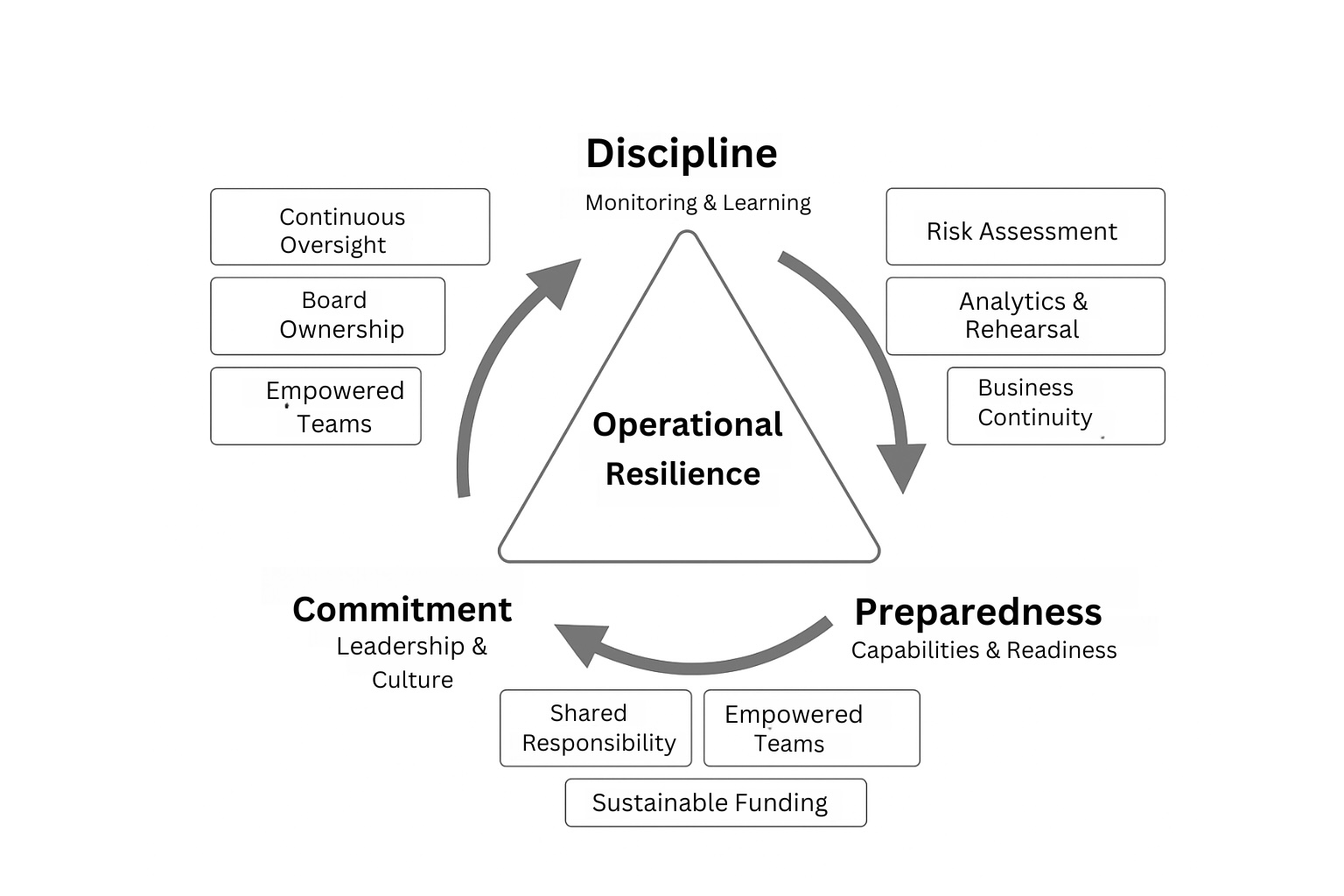
Figure 1. The CPD framework in action.
Conclusion
Cybersecurity and operational resilience are now inseparable. AI-enhanced adversaries target the interconnected systems that underpin modern enterprises. Defending these systems requires integrated thinking, analytics-driven strategies and alignment across security, IT, analytics and business leadership.
By combining strategic commitment, proactive preparedness and disciplined execution, organizations can navigate digital fragility and transform cybersecurity from a defensive necessity into a source of operational resilience.
Dave Chatterjee, PhD, is an adjunct associate professor at Duke University and the creator of the commitment-preparedness-discipline framework. His research and advisory work focus on cybersecurity leadership, AI-driven risk and operational resilience under real-world stress. He is the author of Cybersecurity Readiness: A Holistic and High-Performance Approach and The DeepFake Conspiracy.